 Add to Chrome
 Add to Firefox
 Add to Edge
FAME: Force-Adaptive RL for Expanding the Manipulation Envelope of a Full-Scale Humanoid
Mar 09, 2026
Maintaining balance under external hand forces is critical for humanoid bimanual manipulation, where interaction forces propagate through the kinematic chain and constrain the feasible manipulation envelope. We propose \textbf{FAME}, a force-adaptive reinforcement learning framework that conditions a standing policy on a learned latent context encoding upper-body joint configuration and bimanual interaction forces. During training, we apply diverse, spherically sampled 3D forces on each hand to inject disturbances in simulation together with an upper-body pose curriculum, exposing the policy to manipulation-induced perturbations across continuously varying arm configurations. At deployment, interaction forces are estimated from the robot dynamics and fed to the same encoder, enabling online adaptation without wrist force/torque sensors. In simulation across five fixed arm configurations with randomized hand forces and commanded base heights, FAME improves mean standing success to 73.84%, compared to 51.40% for the curriculum-only baseline and 29.44% for the base policy. We further deploy the learned policy on a full-scale Unitree H12 humanoid and evaluate robustness in representative load-interaction scenarios, including asymmetric single-arm load and symmetric bimanual load. Code and videos are available on https://fame10.github.io/Fame/

DeliGrasp: Inferring Object Mass, Friction, and Compliance with LLMs for Adaptive and Minimally Deforming Grasp Policies
Mar 12, 2024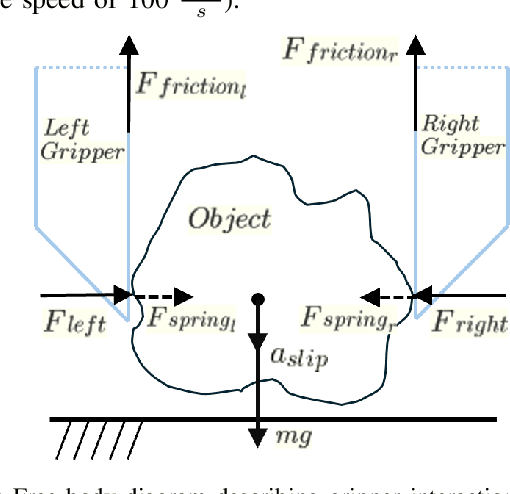
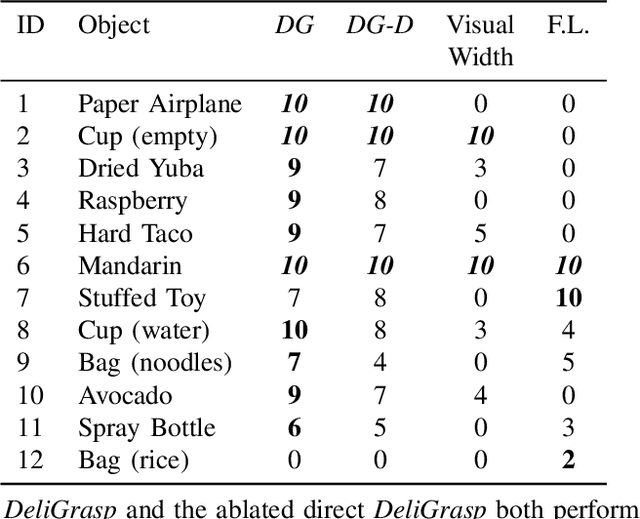
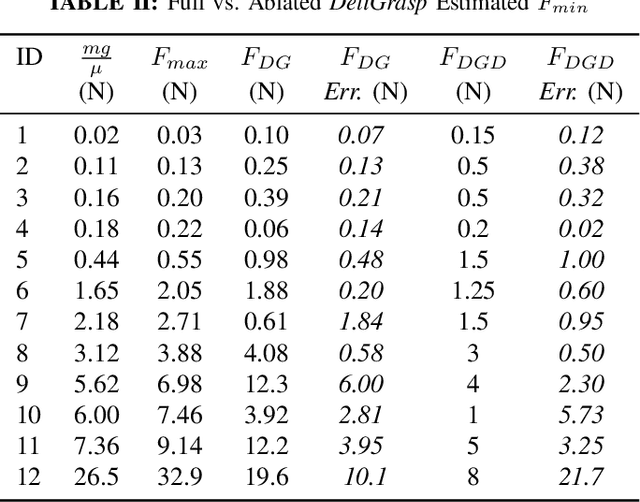
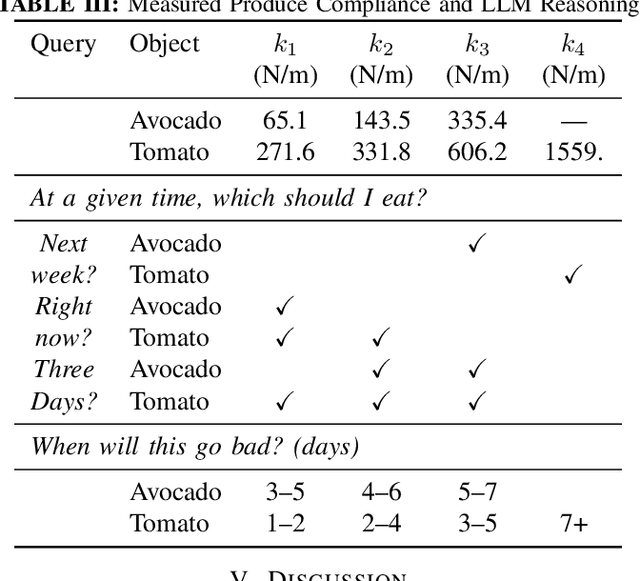
Large language models (LLMs) can provide rich physical descriptions of most worldly objects, allowing robots to achieve more informed and capable grasping. We leverage LLMs' common sense physical reasoning and code-writing abilities to infer an object's physical characteristics--mass $m$, friction coefficient $\mu$, and spring constant $k$--from a semantic description, and then translate those characteristics into an executable adaptive grasp policy. Using a current-controllable, two-finger gripper with a built-in depth camera, we demonstrate that LLM-generated, physically-grounded grasp policies outperform traditional grasp policies on a custom benchmark of 12 delicate and deformable items including food, produce, toys, and other everyday items, spanning two orders of magnitude in mass and required pick-up force. We also demonstrate how compliance feedback from DeliGrasp policies can aid in downstream tasks such as measuring produce ripeness. Our code and videos are available at: https://deligrasp.github.io