 Add to Chrome
 Add to Firefox
 Add to Edge
Object Tokens as a Bridge Between Segmentation and Visual Question Answering in Robotic Surgery
Jun 14, 2026
Visual Question Answering (VQA) in robotic surgery, referred to as surgical VQA, requires high-level understanding of complex surgical scenes and the integration of visual perception with language reasoning, with the potential to support surgical training and intraoperative decision-making. Recent Vision-Language Models (VLMs) have shown promising performance through parameter-efficient fine-tuning; however, most existing approaches rely on coarse visual grounding, typically limited to bounding boxes, which fails to capture the fine-grained spatial structure of surgical objects. In this work, we propose a unified framework that jointly performs pixel-level segmentation and visual question answering within a single framework. Our approach integrates a VLM with a Segment Anything Model (SAM)-based decoder and represents scene elements as object tokens generated by the VLM. These object tokens guide answer prediction and are further projected to the SAM-based decoder to produce segmentation masks. By optimizing the object token embeddings through both segmentation and question answering objectives, the model learns spatially grounded representations that enhance visual reasoning while providing explicit pixel-level grounding. We evaluate the proposed method on the private RAMIE (Robot-Assisted Minimally Invasive Esophagectomy) dataset and the public EndoVis18 dataset, where it consistently outperforms baseline methods for surgical VQA. These results demonstrate that incorporating context-aware object tokens into vision-language models improves fine-grained surgical scene understanding.

Benchmarking and Enhancing Surgical Phase Recognition Models for Robotic-Assisted Esophagectomy
Dec 05, 2024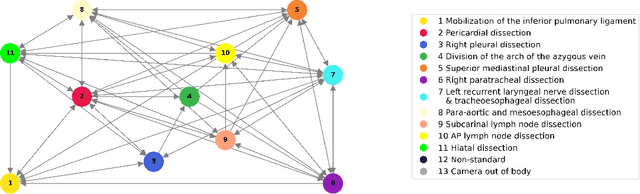
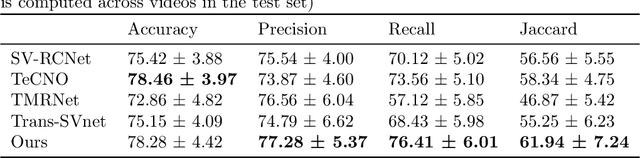
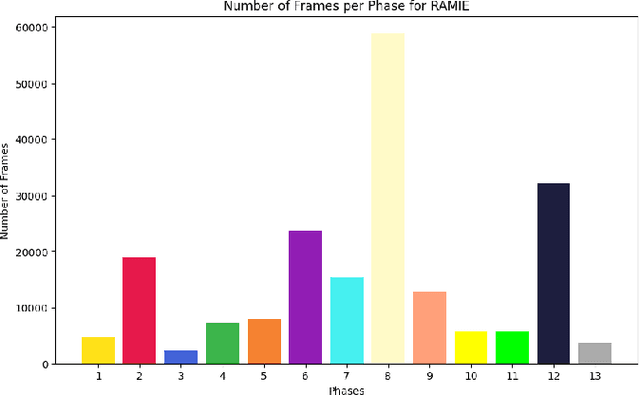
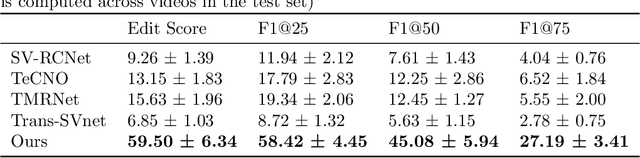
Robotic-assisted minimally invasive esophagectomy (RAMIE) is a recognized treatment for esophageal cancer, offering better patient outcomes compared to open surgery and traditional minimally invasive surgery. RAMIE is highly complex, spanning multiple anatomical areas and involving repetitive phases and non-sequential phase transitions. Our goal is to leverage deep learning for surgical phase recognition in RAMIE to provide intraoperative support to surgeons. To achieve this, we have developed a new surgical phase recognition dataset comprising 27 videos. Using this dataset, we conducted a comparative analysis of state-of-the-art surgical phase recognition models. To more effectively capture the temporal dynamics of this complex procedure, we developed a novel deep learning model featuring an encoder-decoder structure with causal hierarchical attention, which demonstrates superior performance compared to existing models.