 Add to Chrome
 Add to Firefox
 Add to Edge
Non-asymptotic Tail Bounds for the Kostlan--Shub--Smale Field: Tensor PCA and Spherical $k$-Spin Complexity
Jun 16, 2026
This paper builds a hierarchy of explicit, non-asymptotic tail bounds for the supremum of the Kostlan--Shub--Smale (KSS) random field on the sphere, and applies it to two problems: Spiked Tensor PCA and the landscape of the spherical $k$-spin model. For Tensor PCA, we study the non-asymptotic statistical limits of estimating a rank-$R$ symmetric signal tensor of order~$k\ge 3$ and dimension~$d\ge 3$ from a single Gaussian observation at signal-to-noise ratio~$λ$, through the \emph{profile maximum likelihood estimator}, the MLE restricted to normalized rank-$R$ tensors of coherence at least~$κ$. Our analysis uses a single reduction: a deterministic geometric inequality (the Tube Method) and a rank-reduction step bound the estimation error by the supremum of the canonical KSS field, which the Kac--Rice formula turns into a Gaussian integral against the expected absolute characteristic polynomial of a shifted Gaussian Orthogonal Ensemble, controlled in turn by the four explicit tail bounds of our hierarchy (three from a Mehta--Fyodorov representation, one from a Ben Arous--Dembo--Guionnet large deviation). The same reduction yields two results, each with explicit constants. For estimation, a finite-$(k,d)$ error bound recovers the asymptotically optimal rate~$\sqrt{d\log k}$ of Perry, Wein and Bandeira, with explicit dependence on the rank~$R$ and the coherence~$κ$. For the landscape, a two-sided non-asymptotic bracketing of the annealed complexity of the spherical $k$-spin Hamiltonian recovers the Auffinger--Ben Arous--Černý complexity function in the high-dimensional limit.

Nonnegative matrix factorization with side information for time series recovery and prediction
Sep 19, 2017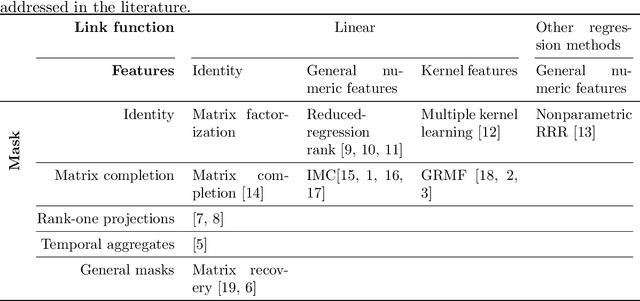
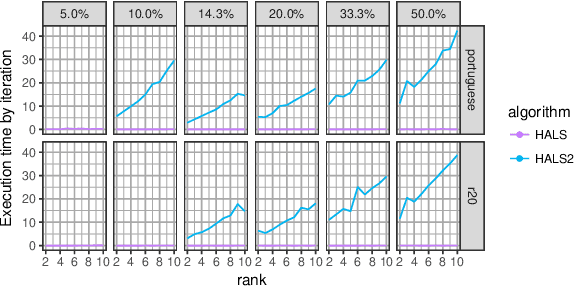
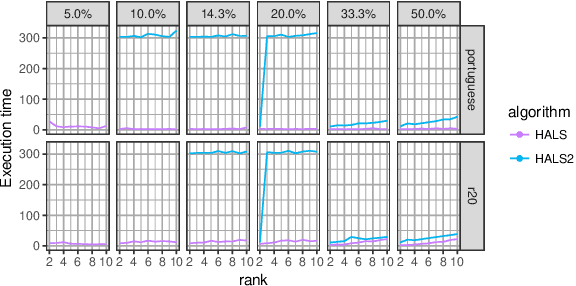
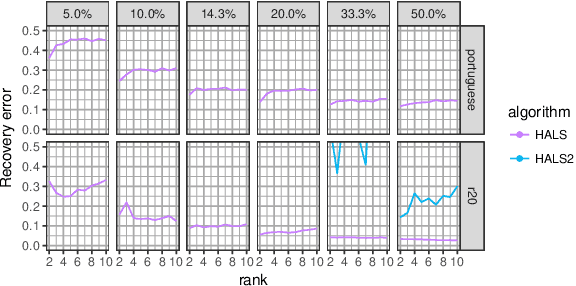
Motivated by the reconstruction and the prediction of electricity consumption, we extend Nonnegative Matrix Factorization~(NMF) to take into account side information (column or row features). We consider general linear measurement settings, and propose a framework which models non-linear relationships between features and the response variables. We extend previous theoretical results to obtain a sufficient condition on the identifiability of the NMF in this setting. Based the classical Hierarchical Alternating Least Squares~(HALS) algorithm, we propose a new algorithm (HALSX, or Hierarchical Alternating Least Squares with eXogeneous variables) which estimates the factorization model. The algorithm is validated on both simulated and real electricity consumption datasets as well as a recommendation dataset, to show its performance in matrix recovery and prediction for new rows and columns.