 Add to Chrome
 Add to Firefox
 Add to Edge
Audio-visual Contrastive Alignment for Diffusion-based Visual-conditioned Speech Enhancement
Jun 16, 2026
Audio-visual speech enhancement (AVSE) exploits visual cues such as lip movements to recover speech in noisy environments. Recent work introduced diffusion-based unsupervised AVSE, where a speech diffusion model conditioned on visual features via cross-attention is trained and used as a data-driven prior for posterior sampling-based speech enhancement. Despite promising performance over its audio-only counterpart, the impact of explicitly enforcing cross-modal alignment in the fusion remains unclear. In this work, we propose to augment the diffusion training objective with a contrastive audio-visual loss to encourage stronger use of visual information while keeping the posterior sampling framework unchanged. Experiments across matched and mismatched test data show consistent improvements in interference suppression, signal reconstruction, and perceptual quality, with the largest gains at low SNRs. Code is available at https://github.com/ cexauce/AV-CA-DiffUSE

Posterior Transition Modeling for Unsupervised Diffusion-Based Speech Enhancement
Jul 03, 2025

We explore unsupervised speech enhancement using diffusion models as expressive generative priors for clean speech. Existing approaches guide the reverse diffusion process using noisy speech through an approximate, noise-perturbed likelihood score, combined with the unconditional score via a trade-off hyperparameter. In this work, we propose two alternative algorithms that directly model the conditional reverse transition distribution of diffusion states. The first method integrates the diffusion prior with the observation model in a principled way, removing the need for hyperparameter tuning. The second defines a diffusion process over the noisy speech itself, yielding a fully tractable and exact likelihood score. Experiments on the WSJ0-QUT and VoiceBank-DEMAND datasets demonstrate improved enhancement metrics and greater robustness to domain shifts compared to both supervised and unsupervised baselines.
Diffusion-based Unsupervised Audio-visual Speech Enhancement
Oct 04, 2024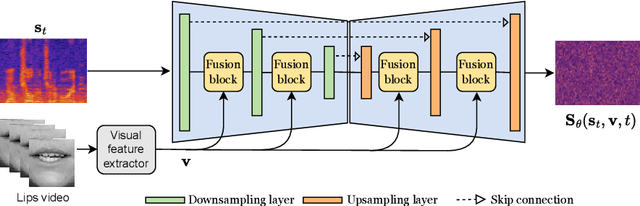
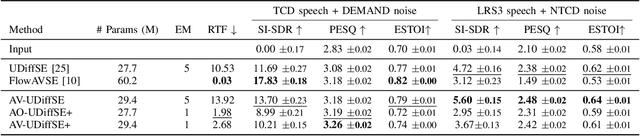
This paper proposes a new unsupervised audiovisual speech enhancement (AVSE) approach that combines a diffusion-based audio-visual speech generative model with a non-negative matrix factorization (NMF) noise model. First, the diffusion model is pre-trained on clean speech conditioned on corresponding video data to simulate the speech generative distribution. This pre-trained model is then paired with the NMF-based noise model to iteratively estimate clean speech. Specifically, a diffusion-based posterior sampling approach is implemented within the reverse diffusion process, where after each iteration, a speech estimate is obtained and used to update the noise parameters. Experimental results confirm that the proposed AVSE approach not only outperforms its audio-only counterpart but also generalizes better than a recent supervisedgenerative AVSE method. Additionally, the new inference algorithm offers a better balance between inference speed and performance compared to the previous diffusion-based method.
Diffusion-based speech enhancement with a weighted generative-supervised learning loss
Sep 19, 2023Diffusion-based generative models have recently gained attention in speech enhancement (SE), providing an alternative to conventional supervised methods. These models transform clean speech training samples into Gaussian noise centered at noisy speech, and subsequently learn a parameterized model to reverse this process, conditionally on noisy speech. Unlike supervised methods, generative-based SE approaches usually rely solely on an unsupervised loss, which may result in less efficient incorporation of conditioned noisy speech. To address this issue, we propose augmenting the original diffusion training objective with a mean squared error (MSE) loss, measuring the discrepancy between estimated enhanced speech and ground-truth clean speech at each reverse process iteration. Experimental results demonstrate the effectiveness of our proposed methodology.