 Add to Chrome
 Add to Firefox
 Add to Edge
Towards A Deeper Geometric, Analytic and Algorithmic Understanding of Margins
Jan 29, 2016

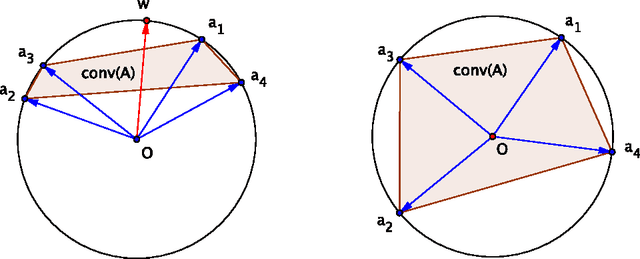


Given a matrix $A$, a linear feasibility problem (of which linear classification is a special case) aims to find a solution to a primal problem $w: A^Tw > \textbf{0}$ or a certificate for the dual problem which is a probability distribution $p: Ap = \textbf{0}$. Inspired by the continued importance of "large-margin classifiers" in machine learning, this paper studies a condition measure of $A$ called its \textit{margin} that determines the difficulty of both the above problems. To aid geometrical intuition, we first establish new characterizations of the margin in terms of relevant balls, cones and hulls. Our second contribution is analytical, where we present generalizations of Gordan's theorem, and variants of Hoffman's theorems, both using margins. We end by proving some new results on a classical iterative scheme, the Perceptron, whose convergence rates famously depends on the margin. Our results are relevant for a deeper understanding of margin-based learning and proving convergence rates of iterative schemes, apart from providing a unifying perspective on this vast topic.
* 18 pages, 3 figures

Margins, Kernels and Non-linear Smoothed Perceptrons
May 15, 2015We focus on the problem of finding a non-linear classification function that lies in a Reproducing Kernel Hilbert Space (RKHS) both from the primal point of view (finding a perfect separator when one exists) and the dual point of view (giving a certificate of non-existence), with special focus on generalizations of two classical schemes - the Perceptron (primal) and Von-Neumann (dual) algorithms. We cast our problem as one of maximizing the regularized normalized hard-margin ($\rho$) in an RKHS and %use the Representer Theorem to rephrase it in terms of a Mahalanobis dot-product/semi-norm associated with the kernel's (normalized and signed) Gram matrix. We derive an accelerated smoothed algorithm with a convergence rate of $\tfrac{\sqrt {\log n}}{\rho}$ given $n$ separable points, which is strikingly similar to the classical kernelized Perceptron algorithm whose rate is $\tfrac1{\rho^2}$. When no such classifier exists, we prove a version of Gordan's separation theorem for RKHSs, and give a reinterpretation of negative margins. This allows us to give guarantees for a primal-dual algorithm that halts in $\min\{\tfrac{\sqrt n}{|\rho|}, \tfrac{\sqrt n}{\epsilon}\}$ iterations with a perfect separator in the RKHS if the primal is feasible or a dual $\epsilon$-certificate of near-infeasibility.
* 17 pages, published in the proceedings of the International Conference on Machine Learning, 2014