 Add to Chrome
 Add to Firefox
 Add to Edge
How the Fusion of Onboard Sensors and V2X Data can Improve (or not) the Cooperative Perception of Connected Automated Vehicles
Jul 08, 2026
Automated vehicles rely on onboard sensors to perceive their surroundings and navigate autonomously. However, sensor performance may degrade under adverse weather conditions or when line-of-sight is obstructed. Cooperative perception (or collective perception) is expected to mitigate these limitations by enabling Connected and Automated Vehicles (CAVs) to share sensor data and collaboratively enhance situational awareness. Several studies have analyzed the potential of cooperative perception, yet the fusion of V2X data with information from onboard sensors has received limited focus. V2X data may contain errors that affect the quality of the fused data, and hence the effectiveness of cooperative perception. This study analyzes the impact of sensing measurement errors, V2X packet losses, and GNSS inaccuracies on the effectiveness of cooperative perception. The results highlight the potential of cooperative perception to enhance perception levels and range compared to using onboard sensors alone. However, they also identify key challenges related to the generation of ghost vehicles during the fusion process, which must be addressed to prevent V2X data from introducing additional errors when fused with onboard sensor data.

Importance of Intent-Sharing for V2X-based Maneuver Coordination
Jun 23, 2026This paper examines the critical role of intent-sharing in enabling effective maneuver coordination for connected and automated vehicles (CAVs). Successful maneuver coordinations require vehicles to accurately know other vehicles' driving intentions. Intent-sharing can be achieved by the remote vehicles directly communicating their plans with the ego vehicle, as opposed to the ego vehicle predicting the trajectory on the remote vehicles' behalf. In this paper, we investigate the potential of intent-sharing on maneuver coordination effectiveness by quantifying the percentage of successful coordinations. We analyze the potential of intent-sharing by comparing its effectiveness for coordinated lane changes in a highway scenario with the effectiveness of a trajectory prediction method based on current kinematic data. Our analysis demonstrates in two scenarios substantial improvements in maneuver coordination when CAVs have direct access to the nearby vehicles' driving intentions through intent sharing. These findings highlight the importance of including intent-sharing in the maneuver coordination protocol.
Multi-Target Maneuver Coordinations: Unlocking Coordination Opportunities in Connected Automated Driving
Jun 20, 2026Maneuver coordination is a key enabler of connected and automated driving, allowing vehicles to negotiate and execute maneuvers that would otherwise be difficult, inefficient or unsafe. Existing approaches and use cases typically assume coordination with a single predefined target vehicle, which limits the number of coordination opportunities. This paper introduces a maneuver coordination approach based on multi-target selection, which allows a vehicle to identify and select among multiple potential coordination vehicles for a given maneuver. Multi-target maneuver coordination does not require modifications to the maneuver execution logic or to the underlying coordination protocol. Instead, it extends the decision-making process preceding coordination, enabling vehicles to exploit a broader set of feasible cooperative interactions. Results show that multi-target maneuver coordination significantly increases triggered and successfully executed coordinations while maintaining a low computational cost, as the proposed approach achieves these gains without requiring the analysis of a large number of potential target vehicles. These improvements preserve coordination success rates while enabling earlier maneuver initiation.
Mind the Noise: Sensitivity of Transformer-based Interaction-Aware Trajectory Prediction Models to Noisy Data
Jun 19, 2026Trajectory prediction allows autonomous vehicles to anticipate the future behavior of surrounding objects (or agents) and, accordingly, maximize the safety and efficiency of their driving. State-of-the-art Transformed-based interaction-aware trajectory prediction models, which rely on attention mechanisms to capture multi-agent interactions and maximize prediction accuracy, are commonly trained and evaluated on long-range high-quality datasets. These datasets are typically obtained by aggregating data from multiple vehicles or drones and removing any object detection or tracking noise offline. Yet, information about a surrounding object's state (its position, speed, heading) is far from being noiseless in real-world deployments. Object state estimation is affected by perception uncertainties and localization errors that can be particularly large for objects received via Vehicle-to-Everything (V2X) communications. In this paper, we analyze the impact of noisy object state information on the trajectory prediction accuracy of a state-of-the-art Transformer-based interaction-aware trajectory prediction model. Our study demonstrates that trajectory prediction accuracy can rapidly deteriorate as the noise intensity increases. Numerical results show that the prediction accuracy can reduce by a 1.3x factor under small noise levels and by as much as a 3.9x factor under the highest (yet realistic) noise conditions. These findings reveal the strong sensitivity of trajectory prediction models to noisy data, underscoring the need for more realistic training and evaluation datasets as well as noise mitigation strategies.
Self-Supervised Relevance Modelling in Autonomous Driving via Counterfactual Analysis
Jun 09, 2026Autonomous driving relies on computationally intensive perception pipelines to continuously detect and track objects in the surrounding environment. While some objects are key to plan safe and effective maneuvers, others may not be relevant and have no impact on the autonomous vehicle's driving decisions. Focusing on relevant objects allows a more efficient usage of available computational resources, reduces processing latencies, and limits the downstream propagation of perception noise. In this work, we propose a novel self-supervised approach based on counterfactual analysis to develop a relevance model - an AI-based tool that quantifies the relevance of objects for an autonomous vehicle. To demonstrate the potential of the proposed approach, we train a relevance model on a synthetic causal dataset generated in a selected urban scenario. Results show that the relevance model is able to accurately estimate the objects' relevance with millisecond-level latency, enabling real-time relevance estimation also in high-density scenarios. We also show that the relevance model can be used to build relevance heatmaps that offer valuable insights into the autonomous vehicle's driving policy and can be used to proactively inform perception and planning tasks. We openly release both the relevance model and the causal dataset.
Adaptive Beamwidth Configuration for Millimeter Wave V2X Scheduling
Dec 14, 2021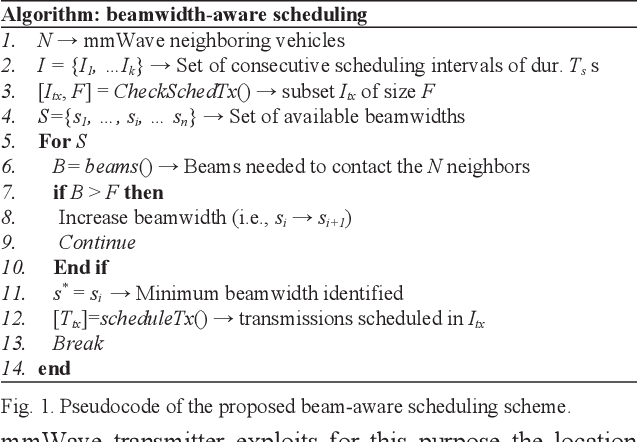
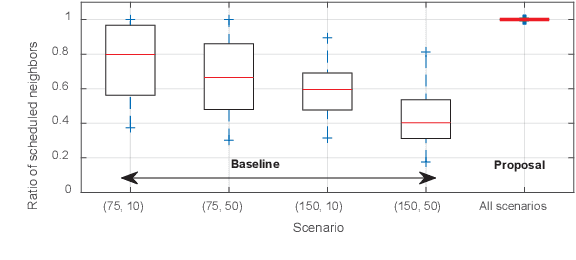
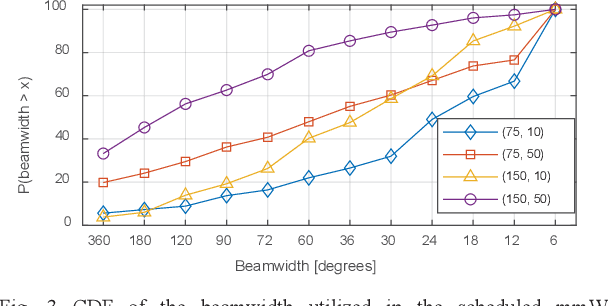
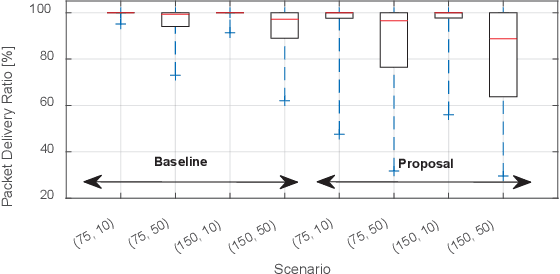
Millimeter wave (mmWave) technologies will support the high bandwidth and data rate requirements of V2X services demanded by connected and automated vehicles (CAVs). MmWave V2X technologies will leverage directional antennas that challenge the management of the communications in dynamic scenarios including the identification of available links, beams alignment, and scheduling. Previous studies have shown that these challenges can be reduced when mmWave communications are supported by side information like the one transmitted in sub-6GHz V2X technologies. In this context, this paper proposes a beamwidth-aware mmWave scheduling scheme for V2V communications supported by sub-6GHz V2X technologies. The proposal enables mmWave transmitters to schedule a mmWave transmission to several neighboring vehicles at the same time by adapting the beamwidth configuration. In addition, the proposal derives the minimum beamwidth that mmWave transmitters should use to contact their neighboring vehicles in a limited number of scheduling intervals. The obtained results demonstrate that the proposal helps increasing the amount of mmWave data that can be transmitted to neighboring vehicles.
* 4 pages, 4 figures, 1 table
A Tutorial on 5G NR V2X Communications
Feb 08, 2021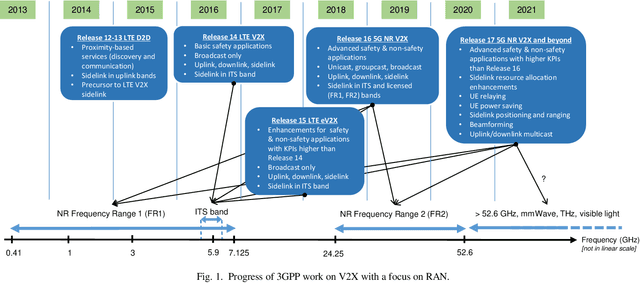
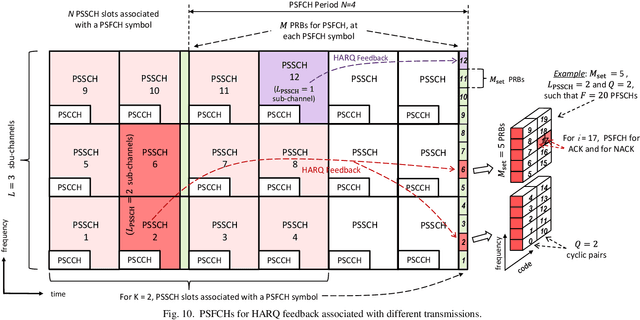
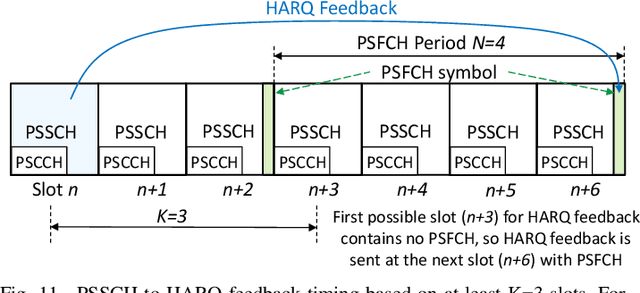
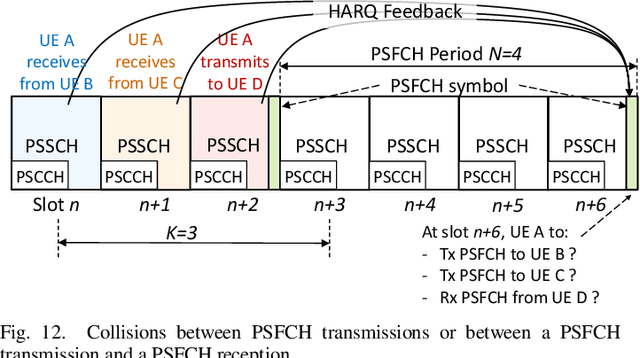
The Third Generation Partnership Project (3GPP) has recently published its Release 16 that includes the first Vehicle to-Everything (V2X) standard based on the 5G New Radio (NR) air interface. 5G NR V2X introduces advanced functionalities on top of the 5G NR air interface to support connected and automated driving use cases with stringent requirements. This paper presents an in-depth tutorial of the 3GPP Release 16 5G NR V2X standard for V2X communications, with a particular focus on the sidelink, since it is the most significant part of 5G NR V2X. The main part of the paper is an in-depth treatment of the key aspects of 5G NR V2X: the physical layer, the resource allocation, the quality of service management, the enhancements introduced to the Uu interface and the mobility management for V2N (Vehicle to Network) communications, as well as the co-existence mechanisms between 5G NR V2X and LTE V2X. We also review the use cases, the system architecture, and describe the evaluation methodology and simulation assumptions for 5G NR V2X. Finally, we provide an outlook on possible 5G NR V2X enhancements, including those identified within Release 17.