 Add to Chrome
 Add to Firefox
 Add to Edge
ADMITBench: A Safety-Governed Reference Framework for Evaluating the Admissibility of Industrial LLM Advisories
Aug 04, 2026
This white paper presents ADMITBench, a reference framework for evaluating industrial LLM advisories at the level of the proposed action. The framework implements a versioned, safety-governed evaluation contract that checks whether a recommendation is supported by the available evidence, permitted under the stated authority and procedure, and acceptable under the plant-specific consequence checks encoded in the selected evaluation profile. In this report, \emph{safety-governed} means that eligibility is determined through explicit, non-compensatory checks derived from a versioned plant profile; it does not mean that the evaluator, model, or plant has been safety-certified. Release 0.1.0 is a public reference implementation for technical and research evaluation, not an authorisation for physical execution.

Automating Cause-Effect Specification with Knowledge Graphs and Large Language Models
Jun 30, 2026Engineering specifications such as interlocks, alarm rationalization tables, and cause-and-effect (C&E) matrices remain central to process control and safety, yet their creation is still predominantly manual, document-driven, and prone to inconsistency. This paper presents a semantic-AI framework that automates the generation of C&E logic by combining a knowledge graph (KG) with a constrained large language model (LLM) layer. The KG builds on an established modular alignment ontology to represent process structure, operating modes, faults, symptoms, causes, and mitigation actions in a machine-interpretable form. The LLM then transforms this information into operator-ready safety narratives and Semantic Web Rule Language (SWRL) rules under strict ontology and vocabulary constraints, grounding the generated artifacts in the underlying semantic model. The workflow is demonstrated on a modular process plant, showing how engineering semantics, diagnostic relations, and machine-verifiable specifications can be generated from a unified knowledge representation with reduced manual effort.
A Tutorial on Autonomous Fault-Tolerant Control Using Knowledge-Grounded LLM Agents
Jun 30, 2026Fault recovery in process plants still relies heavily on plant operators, especially when faults fall outside predefined supervisory logic. Operators interpret alarms, procedures, P\&IDs, interlocks, and process trends, then decide how to move the plant to a safe operating mode without triggering a shutdown. This paper examines how Large Language Model (LLM) agents can support such recovery decisions. The proposed framework treats the LLM as a constrained supervisory planner. It uses plant-specific knowledge to propose recovery actions, and every proposal is checked by an external validator (symbolic or simulation-based) before actuation. The paper develops three design dimensions for applying the framework: the recovery patterns for which LLM agents are useful, the validation strategies that separate admissible from inadmissible proposals, and the deployment constraints imposed by latency, knowledge engineering, safety integration, and model lifecycle management. To make the framework directly usable, two openly available executable Python environments are provided. Both re-implement established case studies, a modular mixing module and a continuous stirred-tank reactor, extended with configurable faults and defined interfaces for custom recovery and validation methods.
From Detection to Action: Using LLM Agents for Fault-Tolerant Control
Jun 26, 2026We propose an agentic Large Language Model (LLM) framework for active Fault-Tolerant Control (FTC) that transforms fault detection outputs into constraint-aware recovery actions grounded in plant-specific knowledge. The approach couples (i) a multi-agent workflow that decomposes operator duties into monitoring, planning, action synthesis, simulation, validation, and reprompting; (ii) a Digital Process Plant Twin (DPPT) that exposes plant data, models, and a simulation service for pre-execution testing; and (iii) a Graph Retrieval-Augmented Generation (Graph RAG) layer built on the CPSMod ontology, which organizes plant knowledge (structure, function, hybrid dynamics, control context, and fault semantics) into a graph that supports relation-aware, multi-hop retrieval for the agents. Corrective actions are generated as minimal-risk state-machine recovery paths and corresponding discrete commands or continuous setpoint adaptations, then validated deterministically against interlocks, envelopes, and dynamic feasibility before any actuation. If no acceptable plan is found within a bounded time window, control is handed to a safety fallback. The framework is evaluated in simulation on two representative benchmarks: a discrete batch Mixing Module and a Continuous Stirred-Tank Reactor (CSTR) under closed-loop PID regulation. Results with lightweight LLMs (GPT-4o-mini and GPT-4.1-mini) show that semantically grounded agents can derive valid recovery decisions within latency budgets compatible with the respective process dynamics, demonstrating a practical pathway from detection to validated corrective action across both discrete and continuous FTC tasks.
Leveraging LLM Agents and Digital Twins for Fault Handling in Process Plants
May 04, 2025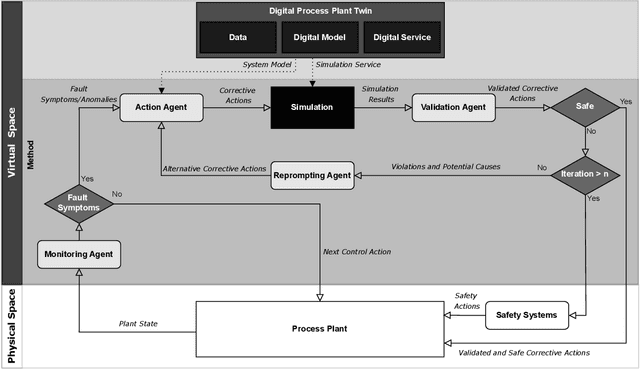
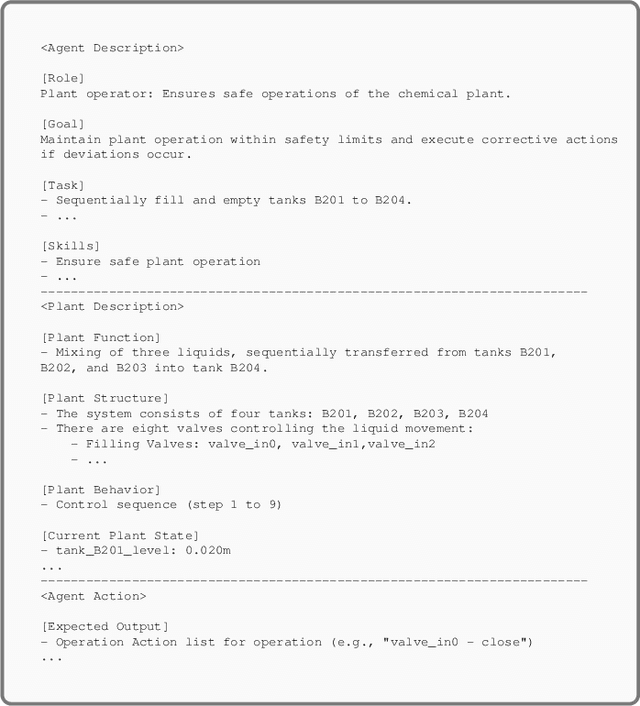
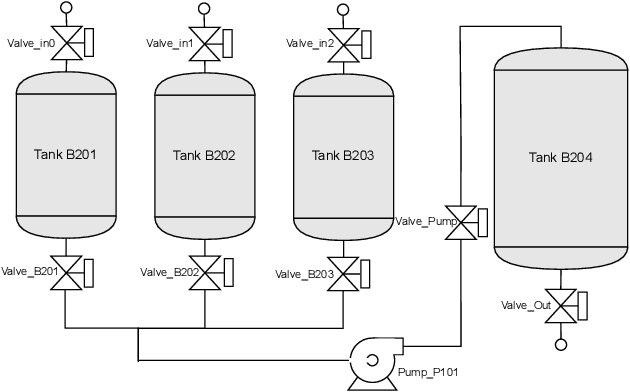
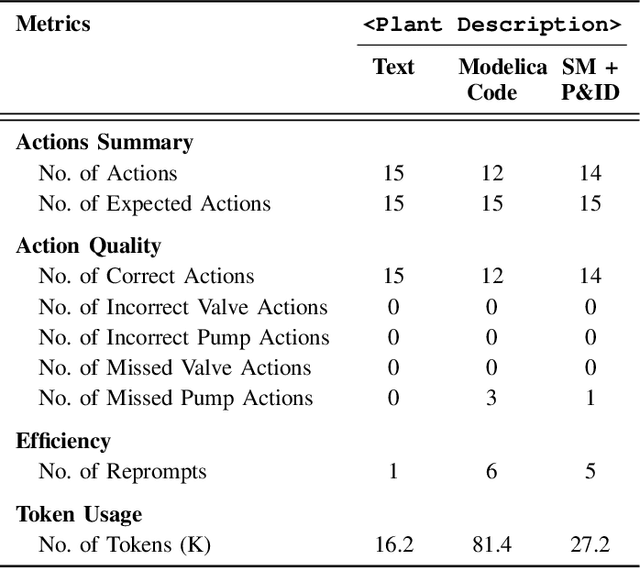
Advances in Automation and Artificial Intelligence continue to enhance the autonomy of process plants in handling various operational scenarios. However, certain tasks, such as fault handling, remain challenging, as they rely heavily on human expertise. This highlights the need for systematic, knowledge-based methods. To address this gap, we propose a methodological framework that integrates Large Language Model (LLM) agents with a Digital Twin environment. The LLM agents continuously interpret system states and initiate control actions, including responses to unexpected faults, with the goal of returning the system to normal operation. In this context, the Digital Twin acts both as a structured repository of plant-specific engineering knowledge for agent prompting and as a simulation platform for the systematic validation and verification of the generated corrective control actions. The evaluation using a mixing module of a process plant demonstrates that the proposed framework is capable not only of autonomously controlling the mixing module, but also of generating effective corrective actions to mitigate a pipe clogging with only a few reprompts.