 Add to Chrome
 Add to Firefox
 Add to Edge
Mind the Gaps: Measuring Visual Artifacts in Dimensionality Reduction
Nov 18, 2025
Dimensionality Reduction (DR) techniques are commonly used for the visual exploration and analysis of high-dimensional data due to their ability to project datasets of high-dimensional points onto the 2D plane. However, projecting datasets in lower dimensions often entails some distortion, which is not necessarily easy to recognize but can lead users to misleading conclusions. Several Projection Quality Metrics (PQMs) have been developed as tools to quantify the goodness-of-fit of a DR projection; however, they mostly focus on measuring how well the projection captures the global or local structure of the data, without taking into account the visual distortion of the resulting plots, thus often ignoring the presence of outliers or artifacts that can mislead a visual analysis of the projection. In this work, we introduce the Warping Index (WI), a new metric for measuring the quality of DR projections onto the 2D plane, based on the assumption that the correct preservation of empty regions between points is of crucial importance towards a faithful visual representation of the data.

Towards Robust Image-in-Audio Deep Steganography
Mar 14, 2023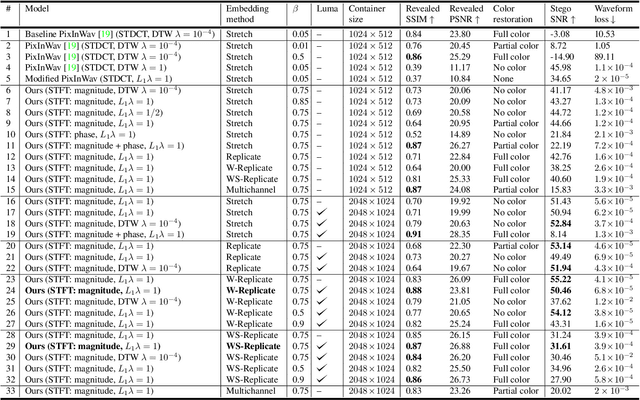
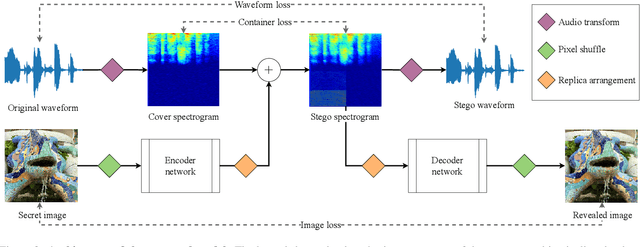
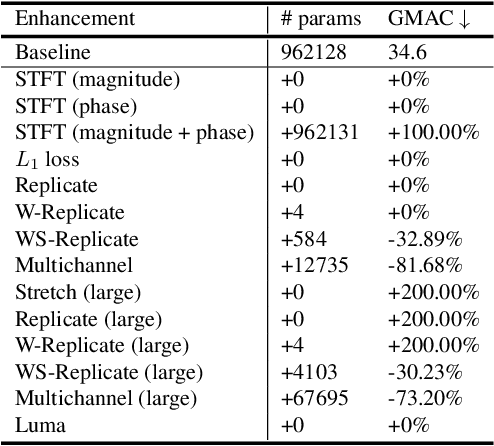
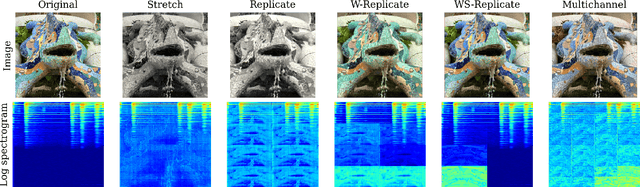
The field of steganography has experienced a surge of interest due to the recent advancements in AI-powered techniques, particularly in the context of multimodal setups that enable the concealment of signals within signals of a different nature. The primary objectives of all steganographic methods are to achieve perceptual transparency, robustness, and large embedding capacity - which often present conflicting goals that classical methods have struggled to reconcile. This paper extends and enhances an existing image-in-audio deep steganography method by focusing on improving its robustness. The proposed enhancements include modifications to the loss function, utilization of the Short-Time Fourier Transform (STFT), introduction of redundancy in the encoding process for error correction, and buffering of additional information in the pixel subconvolution operation. The results demonstrate that our approach outperforms the existing method in terms of robustness and perceptual transparency.