 Add to Chrome
 Add to Firefox
 Add to Edge
The Ethics of Autonomous AI Agents for Offensive Security
Jul 22, 2026
LLM-driven autonomous agents are reshaping offensive security. Unlike traditional penetration-testing tooling -- deterministic, narrowly scoped, and operated by trained practitioners -- agentic security tools exhibit \textit{indeterminacy} along three independent dimensions. First, their actions are drawn from a non-deterministic policy whose outputs resist both ex-ante and ex-post explanation, frustrating incident attribution and pre-deployment safety review. Second, their impact is open-ended due to the non-deterministic actions, agency of utilized models, and opaque LLM supply-chains. Third, their user population is indeterminate in both size and required skill: the operating skill floor for using or developing offensive capabilities has dropped sharply. These three properties are linked thematically, but are not derivable from one another. Combined with the structural cost asymmetry between offense and defense, they enable the industrialization of offensive capability. The net short-term effect favors attackers, even if the same technology may, in the long run, democratize access to defensive practice. Existing dual-use cybersecurity and AI-ethics frameworks were not designed for this combination. Our work analyzes how moral attribution becomes diffuse between users, tool-makers, and third parties when employing autonomous AI agents for offensive security. We also examine the stakeholder impact of this technology and provide stratified recommendations.

Are LLMs (Really) Ideological? An IRT-based Analysis and Alignment Tool for Perceived Socio-Economic Bias in LLMs
Mar 17, 2025We introduce an Item Response Theory (IRT)-based framework to detect and quantify socioeconomic bias in large language models (LLMs) without relying on subjective human judgments. Unlike traditional methods, IRT accounts for item difficulty, improving ideological bias estimation. We fine-tune two LLM families (Meta-LLaMa 3.2-1B-Instruct and Chat- GPT 3.5) to represent distinct ideological positions and introduce a two-stage approach: (1) modeling response avoidance and (2) estimating perceived bias in answered responses. Our results show that off-the-shelf LLMs often avoid ideological engagement rather than exhibit bias, challenging prior claims of partisanship. This empirically validated framework enhances AI alignment research and promotes fairer AI governance.
Supervised Machine Learning with Plausible Deniability
Jun 08, 2021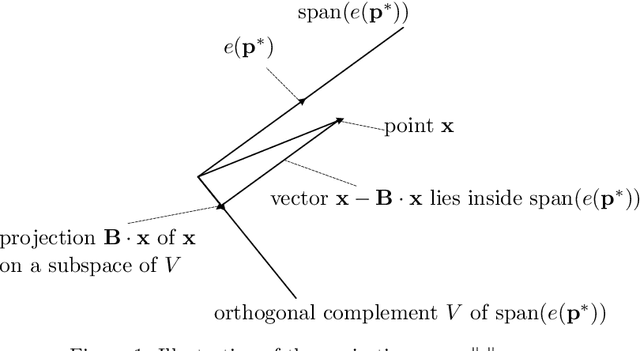
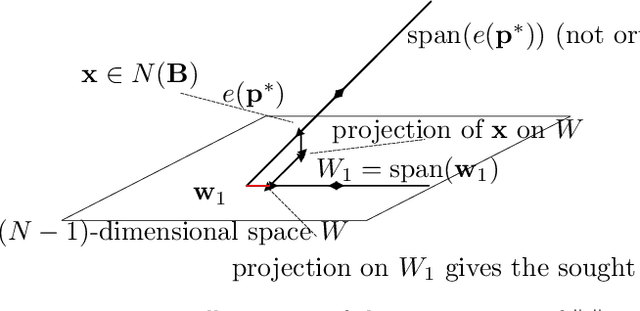
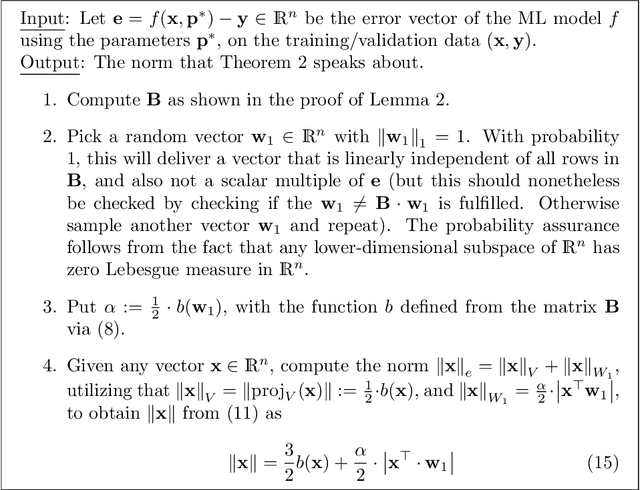
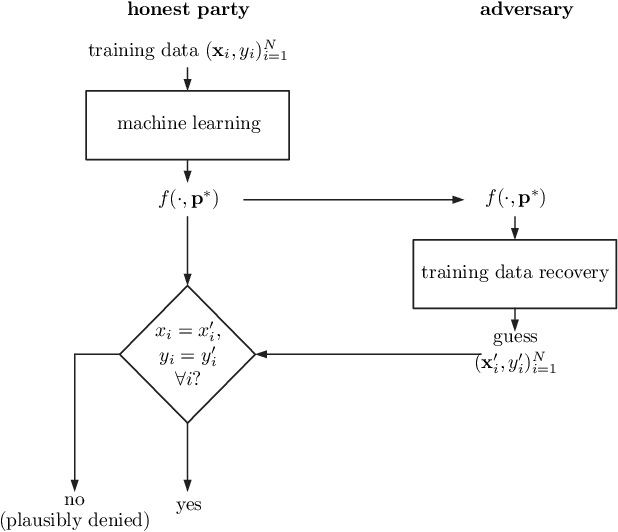
We study the question of how well machine learning (ML) models trained on a certain data set provide privacy for the training data, or equivalently, whether it is possible to reverse-engineer the training data from a given ML model. While this is easy to answer negatively in the most general case, it is interesting to note that the protection extends over non-recoverability towards plausible deniability: Given an ML model $f$, we show that one can take a set of purely random training data, and from this define a suitable ``learning rule'' that will produce a ML model that is exactly $f$. Thus, any speculation about which data has been used to train $f$ is deniable upon the claim that any other data could have led to the same results. We corroborate our theoretical finding with practical examples, and open source implementations of how to find the learning rules for a chosen set of raining data.