 Add to Chrome
 Add to Firefox
 Add to Edge
FlowCast: Advancing Precipitation Nowcasting with Conditional Flow Matching
Nov 12, 2025
Radar-based precipitation nowcasting, the task of forecasting short-term precipitation fields from previous radar images, is a critical problem for flood risk management and decision-making. While deep learning has substantially advanced this field, two challenges remain fundamental: the uncertainty of atmospheric dynamics and the efficient modeling of high-dimensional data. Diffusion models have shown strong promise by producing sharp, reliable forecasts, but their iterative sampling process is computationally prohibitive for time-critical applications. We introduce FlowCast, the first model to apply Conditional Flow Matching (CFM) to precipitation nowcasting. Unlike diffusion, CFM learns a direct noise-to-data mapping, enabling rapid, high-fidelity sample generation with drastically fewer function evaluations. Our experiments demonstrate that FlowCast establishes a new state-of-the-art in predictive accuracy. A direct comparison further reveals the CFM objective is both more accurate and significantly more efficient than a diffusion objective on the same architecture, maintaining high performance with significantly fewer sampling steps. This work positions CFM as a powerful and practical alternative for high-dimensional spatiotemporal forecasting.

Ensemble weather forecast post-processing with a flexible probabilistic neural network approach
Apr 07, 2023Ensemble forecast post-processing is a necessary step in producing accurate probabilistic forecasts. Conventional post-processing methods operate by estimating the parameters of a parametric distribution, frequently on a per-location or per-lead-time basis. We propose a novel, neural network-based method, which produces forecasts for all locations and lead times, jointly. To relax the distributional assumption of many post-processing methods, our approach incorporates normalizing flows as flexible parametric distribution estimators. This enables us to model varying forecast distributions in a mathematically exact way. We demonstrate the effectiveness of our method in the context of the EUPPBench benchmark, where we conduct temperature forecast post-processing for stations in a sub-region of western Europe. We show that our novel method exhibits state-of-the-art performance on the benchmark, outclassing our previous, well-performing entry. Additionally, by providing a detailed comparison of three variants of our novel post-processing method, we elucidate the reasons why our method outperforms per-lead-time-based approaches and approaches with distributional assumptions.
SMIXS: Novel efficient algorithm for non-parametric mixture regression-based clustering
Sep 19, 2022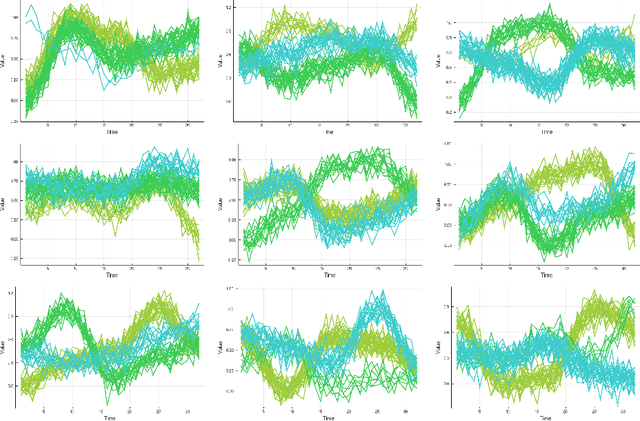
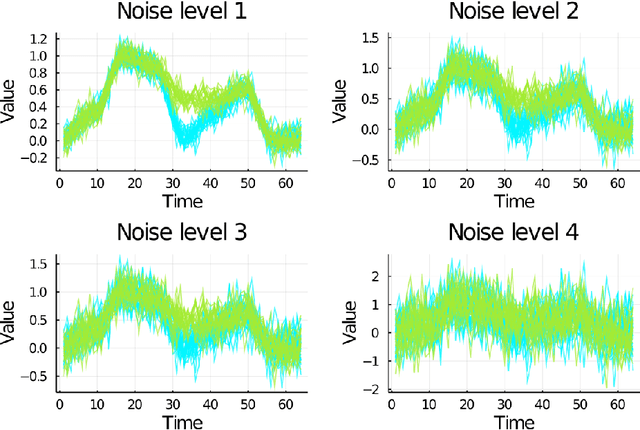
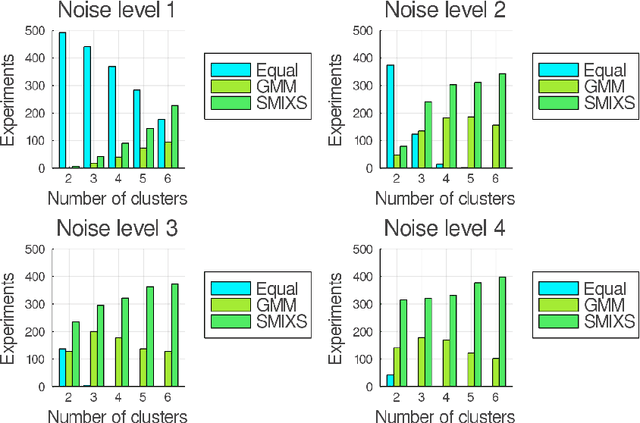
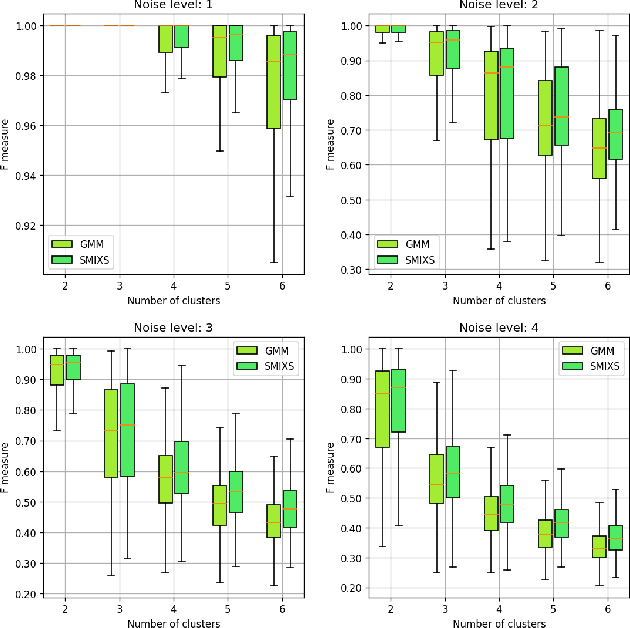
We investigate a novel non-parametric regression-based clustering algorithm for longitudinal data analysis. Combining natural cubic splines with Gaussian mixture models (GMM), the algorithm can produce smooth cluster means that describe the underlying data well. However, there are some shortcomings in the algorithm: high computational complexity in the parameter estimation procedure and a numerically unstable variance estimator. Therefore, to further increase the usability of the method, we incorporated approaches to reduce its computational complexity, we developed a new, more stable variance estimator, and we developed a new smoothing parameter estimation procedure. We show that the developed algorithm, SMIXS, performs better than GMM on a synthetic dataset in terms of clustering and regression performance. We demonstrate the impact of the computational speed-ups, which we formally prove in the new framework. Finally, we perform a case study by using SMIXS to cluster vertical atmospheric measurements to determine different weather regimes.