 Add to Chrome
 Add to Firefox
 Add to Edge
Learning to Order: Task Sequencing as In-Context Optimization
Mar 15, 2026
Task sequencing (TS) is one of the core open problems in Deep Learning, arising in a plethora of real-world domains, from robotic assembly lines to autonomous driving. Unfortunately, prior work has not convincingly demonstrated the generalization ability of meta-learned TS methods to solve new TS problems, given few initial demonstrations. In this paper, we demonstrate that deep neural networks can meta-learn over an infinite prior of synthetically generated TS problems and achieve a few-shot generalization. We meta-learn a transformer-based architecture over datasets of sequencing trajectories generated from a prior distribution that samples sequencing problems as paths in directed graphs. In a large-scale experiment, we provide ample empirical evidence that our meta-learned models discover optimal task sequences significantly quicker than non-meta-learned baselines.

POP: Prior-fitted Optimizer Policies
Feb 17, 2026Optimization refers to the task of finding extrema of an objective function. Classical gradient-based optimizers are highly sensitive to hyperparameter choices. In highly non-convex settings their performance relies on carefully tuned learning rates, momentum, and gradient accumulation. To address these limitations, we introduce POP (Prior-fitted Optimizer Policies), a meta-learned optimizer that predicts coordinate-wise step sizes conditioned on the contextual information provided in the optimization trajectory. Our model is learned on millions of synthetic optimization problems sampled from a novel prior spanning both convex and non-convex objectives. We evaluate POP on an established benchmark including 47 optimization functions of various complexity, where it consistently outperforms first-order gradient-based methods, non-convex optimization approaches (e.g., evolutionary strategies), Bayesian optimization, and a recent meta-learned competitor under matched budget constraints. Our evaluation demonstrates strong generalization capabilities without task-specific tuning.
Lightweight Correlation-Aware Table Compression
Oct 24, 2024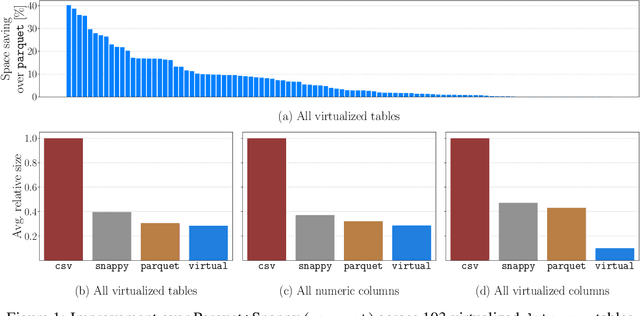
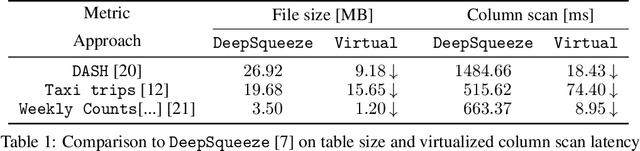
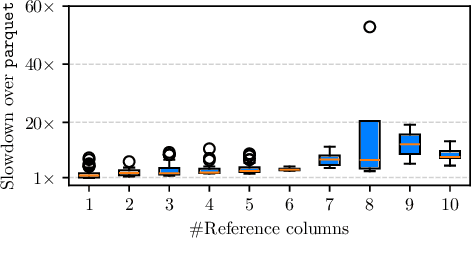
The growing adoption of data lakes for managing relational data necessitates efficient, open storage formats that provide high scan performance and competitive compression ratios. While existing formats achieve fast scans through lightweight encoding techniques, they have reached a plateau in terms of minimizing storage footprint. Recently, correlation-aware compression schemes have been shown to reduce file sizes further. Yet, current approaches either incur significant scan overheads or require manual specification of correlations, limiting their practicability. We present $\texttt{Virtual}$, a framework that integrates seamlessly with existing open formats to automatically leverage data correlations, achieving substantial compression gains while having minimal scan performance overhead. Experiments on data-gov datasets show that $\texttt{Virtual}$ reduces file sizes by up to 40% compared to Apache Parquet.