 Add to Chrome
 Add to Firefox
 Add to Edge
SaliencyDecor: Enhancing Neural Network Interpretability through Feature Decorrelation
Apr 28, 2026
Gradient-based saliency methods are widely used to interpret deep neural networks, yet they often produce noisy and unstable explanations that poorly align with semantically meaningful input features. We argue that a fundamental cause of this behavior lies in the geometry of learned representations: correlated feature dimensions diffuse attribution gradients across redundant directions, resulting in blurred and unreliable saliency maps. To address this issue, we identify feature correlation as a structural limitation of gradient-based interpretability and propose SaliencyDecor, a training framework that enforces feature decorrelation to improve attribution fidelity without modifying saliency methods or model architectures by reshaping the feature space toward orthogonality, our approach promotes more concentrated gradient flow and improves the fidelity of saliency-based explanations. SaliencyDecor jointly optimizes classification, prediction consistency under feature masking, and a decorrelation regularizer, requiring no architectural changes or inference-time overhead. Extensive experiments across multiple benchmarks and architectures demonstrate that our method produces substantially sharper and more object-focused saliency maps while simultaneously improving predictive performance, achieving accuracy gains across the datasets. These results establish our method as a principled mechanism for enhancing both interpretability and accuracy, challenging the conventional trade-off between explanation quality and model performance.

Overcoming Dimensional Collapse in Self-supervised Contrastive Learning for Medical Image Segmentation
Feb 27, 2024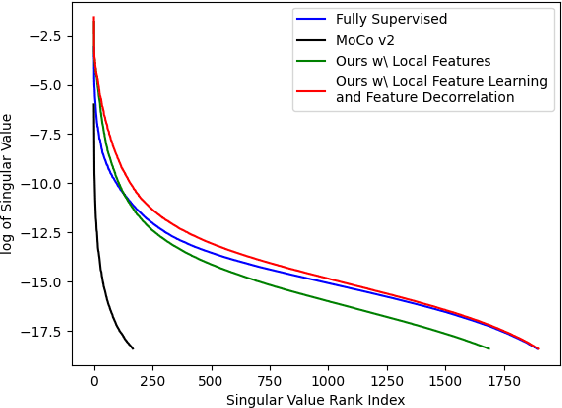
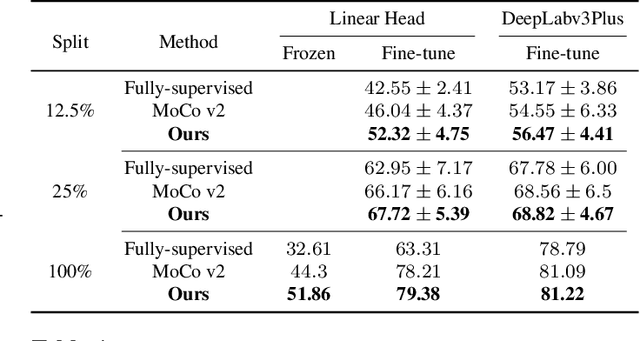
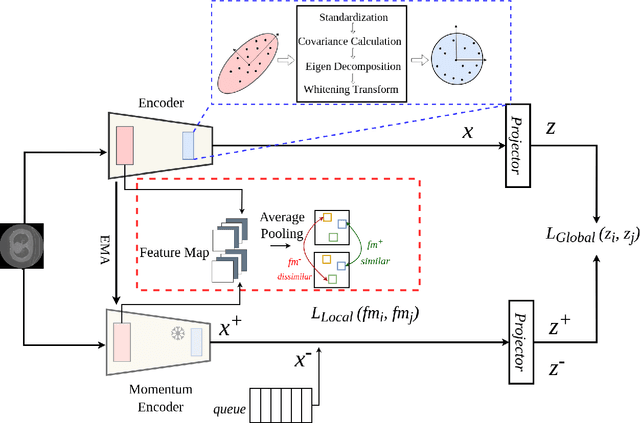
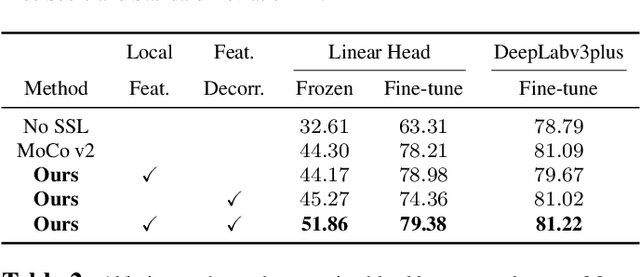
Self-supervised learning (SSL) approaches have achieved great success when the amount of labeled data is limited. Within SSL, models learn robust feature representations by solving pretext tasks. One such pretext task is contrastive learning, which involves forming pairs of similar and dissimilar input samples, guiding the model to distinguish between them. In this work, we investigate the application of contrastive learning to the domain of medical image analysis. Our findings reveal that MoCo v2, a state-of-the-art contrastive learning method, encounters dimensional collapse when applied to medical images. This is attributed to the high degree of inter-image similarity shared between the medical images. To address this, we propose two key contributions: local feature learning and feature decorrelation. Local feature learning improves the ability of the model to focus on the local regions of the image, while feature decorrelation removes the linear dependence among the features. Our experimental findings demonstrate that our contributions significantly enhance the model's performance in the downstream task of medical segmentation, both in the linear evaluation and full fine-tuning settings. This work illustrates the importance of effectively adapting SSL techniques to the characteristics of medical imaging tasks. The source code will be made publicly available at: https://github.com/CAMMA-public/med-moco