 Add to Chrome
 Add to Firefox
 Add to Edge
Fine-Tuning Large Language Models for Quantum Reasoning
Jun 20, 2026
Large language models (LLMs) exhibit abilities beyond natural language modelling and text generation. Recent advances in their reasoning capabilities have spurred interest in applying LLMs to complex scientific tasks requiring deep domain expertise and sophisticated reasoning. Quantum computing, as a highly specialised field with significant knowledge barriers and hardware constraints, could greatly benefit from such advancements. However, a key open question that first must be answered is: How can we develop fine-tuning pipelines that instil genuine quantum reasoning in LLMs, rather than task-specific pattern matching? We study this question through quantum circuit simulation as a training objective, where the model must predict the measurement probability distribution resulting from a sequence of quantum gate operations. We propose and compare two fine-tuning pipelines: (1) Supervised Fine-Tuning (SFT) on explicit gate-by-gate state-vector simulation traces, and (2) a two-stage SFT+Group Relative Policy Optimisation (GRPO) approach that sequentially applies SFT followed by GRPO with verifiable rewards. Our findings show that SFT achieves near-perfect in-distribution and gate-count extrapolation accuracy, significantly outperforming both the base model and the GPT-OSS-120B baseline. SFT+GRPO trades some in-distribution precision for better generalisation to larger qubit systems that SFT alone cannot handle. Both pipelines significantly outperform the baselines, demonstrating that targeted fine-tuning on explicit reasoning traces is an effective strategy for advancing quantum reasoning in LLMs.

Quantum entanglement provides a competitive advantage in adversarial games
Mar 11, 2026Whether uniquely quantum resources confer advantages in fully classical, competitive environments remains an open question. Competitive zero-sum reinforcement learning is particularly challenging, as success requires modelling dynamic interactions between opposing agents rather than static state-action mappings. Here, we conduct a controlled study isolating the role of quantum entanglement in a quantum-classical hybrid agent trained on Pong, a competitive Markov game. An 8-qubit parameterised quantum circuit serves as a feature extractor within a proximal policy optimisation framework, allowing direct comparison between separable circuits and architectures incorporating fixed (CZ) or trainable (IsingZZ) entangling gates. Entangled circuits consistently outperform separable counterparts with comparable parameter counts and, in low-capacity regimes, match or exceed classical multilayer perceptron baselines. Representation similarity analysis further shows that entangled circuits learn structurally distinct features, consistent with improved modelling of interacting state variables. These findings establish entanglement as a function resource for representation learning in competitive reinforcement learning.
Quantum Robust Fitting
Jun 15, 2020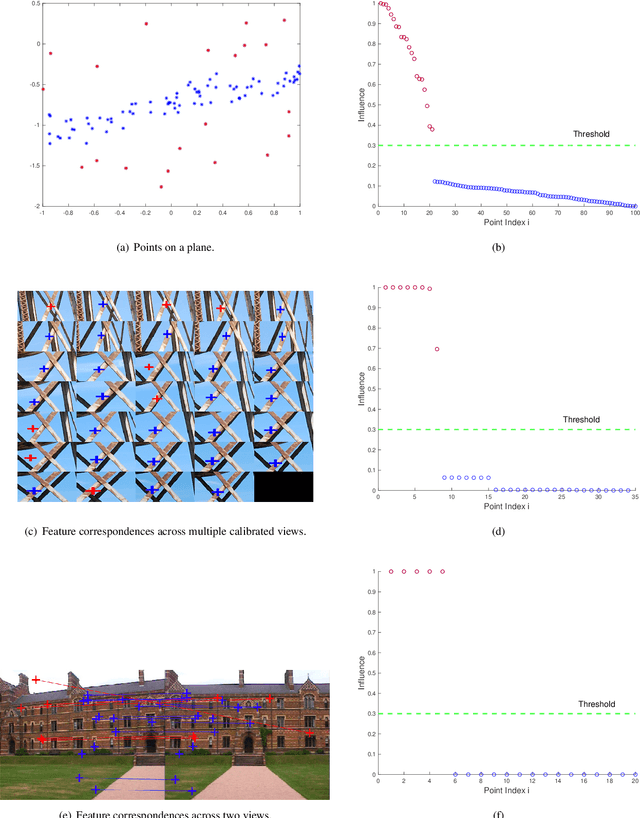
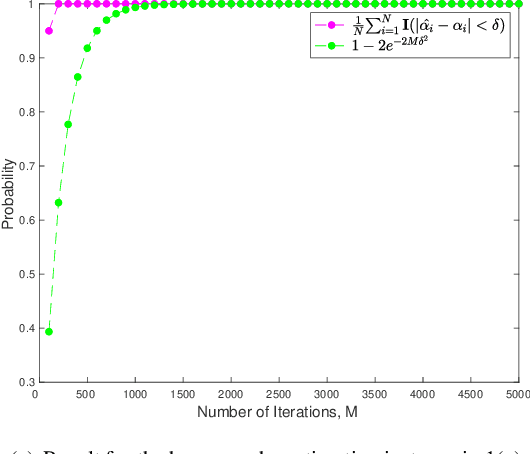
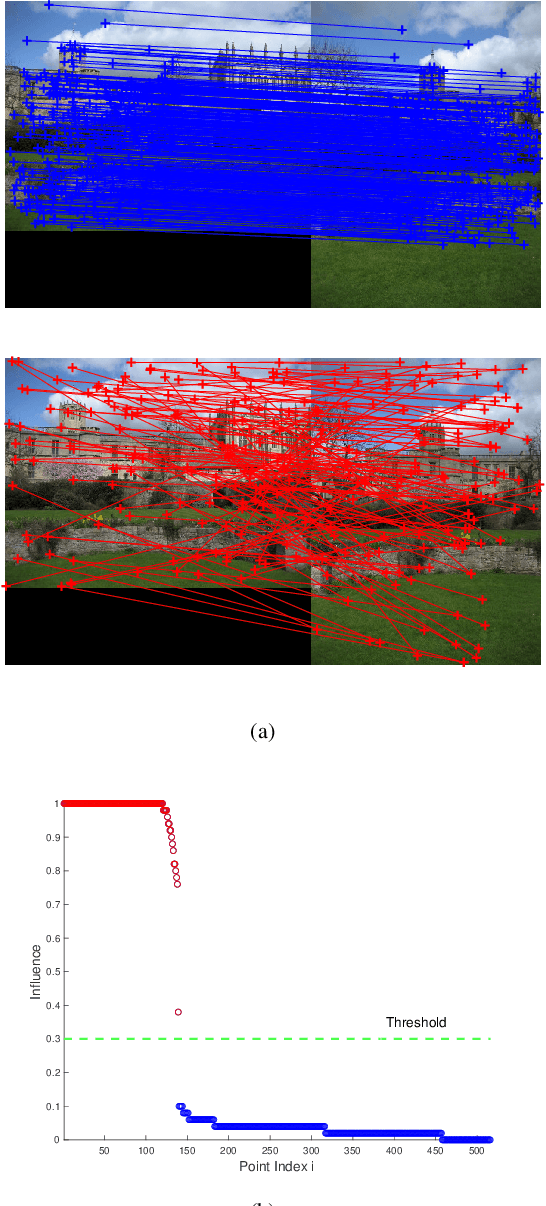
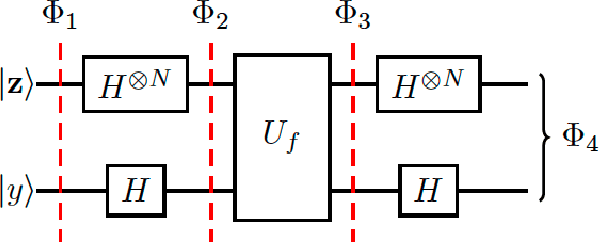
Many computer vision applications need to recover structure from imperfect measurements of the real world. The task is often solved by robustly fitting a geometric model onto noisy and outlier-contaminated data. However, recent theoretical analyses indicate that many commonly used formulations of robust fitting in computer vision are not amenable to tractable solution and approximation. In this paper, we explore the usage of quantum computers for robust fitting. To do so, we examine and establish the practical usefulness of a robust fitting formulation inspired by Fourier analysis of Boolean functions. We then investigate a quantum algorithm to solve the formulation and analyse the computational speed-up possible over the classical algorithm. Our work thus proposes one of the first quantum treatments of robust fitting for computer vision.