 Add to Chrome
 Add to Firefox
 Add to Edge
On the Asymptotic Inadmissibility of Double Machine Learning Estimators Under Structure-Agnostic Models
Jun 21, 2026
Structure-agnostic (SA) models introduced by Balakrishnan et al. (2026) aim to reflect the general lack of knowledge of structural assumptions on data-generating laws such as smoothness or sparsity in practice. Roughly speaking, SA models restrict the observed-data generating law to be in some rn-neighborhood of (black-box machine learning) estimates, treated as given and fixed, where rn encodes the convergence rates of the estimates to the truth. Under SA models, Balakrishnan et al. (2026) show that the popular Double Machine Learning (DML) estimators for three functionals, the quadratic functional in the Gaussian sequence model, the quadratic density integral functional and the expected conditional covariance, are minimax. However, minimax estimators may be inadmissible. In this paper, we show that, for the first two of the three functionals, the DML estimator is asymptotically inadmissible under the SA model. In particular, we show that these two functionals fall into a class of functionals, which we refer to as the monotone bias class. For this class, we exhibit second-order (U-statistic) estimators, which asymptotically dominate DML estimators, under the SA model. These second-order estimators are empirical higher-order influence function (HOIF) estimators introduced in Liu et al. (2017). Furthermore, the empirical HOIF estimator, like the DML estimator, is minimax for the third functional (the expected conditional covariance), although neither asymptotically dominates the other.

On assumption-free tests and confidence intervals for causal effects estimated by machine learning
Apr 08, 2019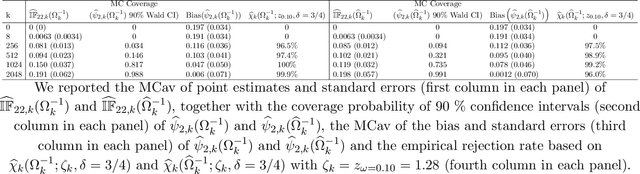
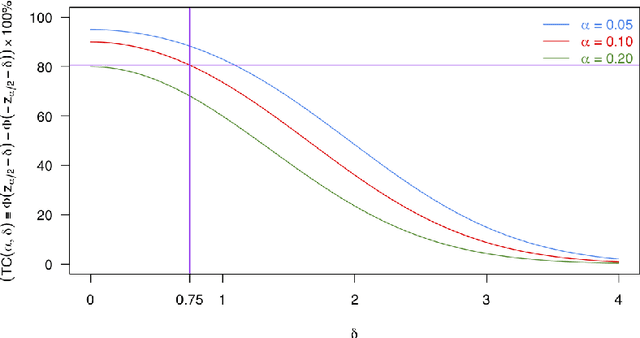
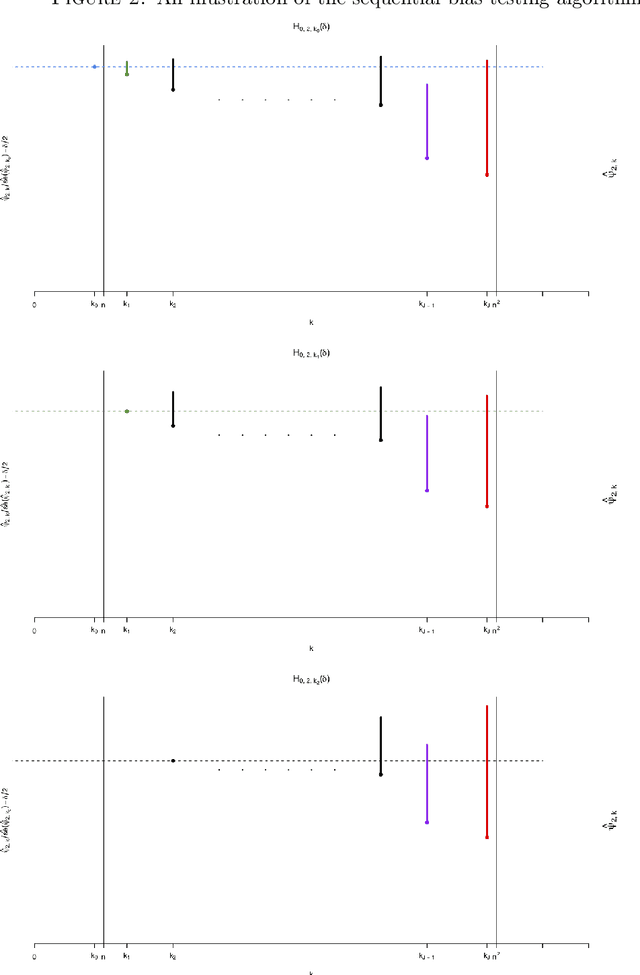
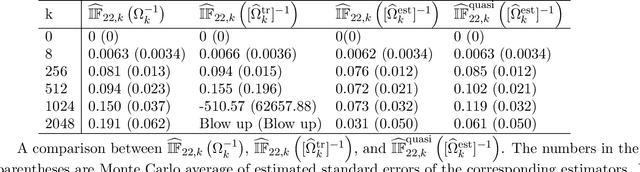
For many causal effect parameters $\psi$ of interest doubly robust machine learning estimators $\widehat\psi_1$ are the state-of-the-art, incorporating the benefits of the low prediction error of machine learning algorithms; the decreased bias of doubly robust estimators; and.the analytic tractability and bias reduction of cross fitting. When the potential confounders is high dimensional, the associated $(1 - \alpha)$ Wald intervals may still undercover even in large samples, because the bias may be of the same or even larger order than its standard error. In this paper, we introduce tests that can have the power to detect whether the bias of $\widehat\psi_1$ is of the same or even larger order than its standard error of order $n^{-1/2}$, can provide a lower confidence limit on the degree of under coverage of the interval and strikingly, are valid under essentially no assumptions. We also introduce an estimator with bias generally less than that of $\widehat\psi_1$, yet whose standard error is not much greater than $\widehat\psi_1$'s. The tests, as well as the estimator $\widehat\psi_2$, are based on a U-statistic that is the second-order influence function for the parameter that encodes the estimable part of the bias of $\widehat\psi_1$. Our impressive claims need to be tempered in several important ways. First no test, including ours, of the null hypothesis that the ratio of the bias to its standard error can be consistent [without making additional assumptions that may be incorrect]. Furthermore the above claims only apply to parameters in a particular class. For the others, our results are less sharp and require more careful interpretation.