 Add to Chrome
 Add to Firefox
 Add to Edge
ConvFormer3D-TAP: Phase/Uncertainty-Aware Front-End Fusion for Cine CMR View Classification Pipelines
Apr 13, 2026
Reliable recognition of standard cine cardiac MRI views is essential because each view determines which cardiac anatomy is visualized and which quantitative analyses can be performed. Incorrect view identification, whether by a human reader or an automated deep learning system, can propagate errors into segmentation, volumetric assessment, strain analysis, and valve evaluation. However, accurate view classification remains challenging under routine clinical variability in scanner vendor, acquisition protocol, motion artifacts, and plane prescription. We present ConvFormer3D-TAP, a cine-specific spatiotemporal architecture that integrates 3D convolutional tokenization with multiscale self-attention. The model is trained using masked spatiotemporal reconstruction and uncertainty-weighted multi-clip fusion to enhance robustness across cardiac phases and ambiguous temporal segments. The design captures complementary cues: local anatomical structure through convolutional priors and long-range cardiac-cycle dynamics through hierarchical attention. On a cohort of 150,974 clinically acquired cine sequences spanning six standard cine cardiac MRI views, ConvFormer3D-TAP achieved 96% validation accuracy with per-class F1-scores >= 0.94 and strong calibration (ECE = 0.025; Brier = 0.040). Error analysis shows that residual confusions are concentrated in anatomically adjacent long-axis and LVOT/AV view pairs, consistent with intrinsic prescription overlap. These results support ConvFormer3D-TAP as a scalable front-end for view routing, filtering and quality control in end-to-end cMRI workflows.

Faster, Cheaper, Better: Multi-Objective Hyperparameter Optimization for LLM and RAG Systems
Feb 25, 2025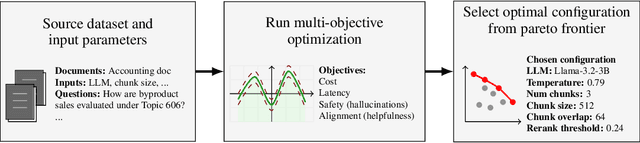
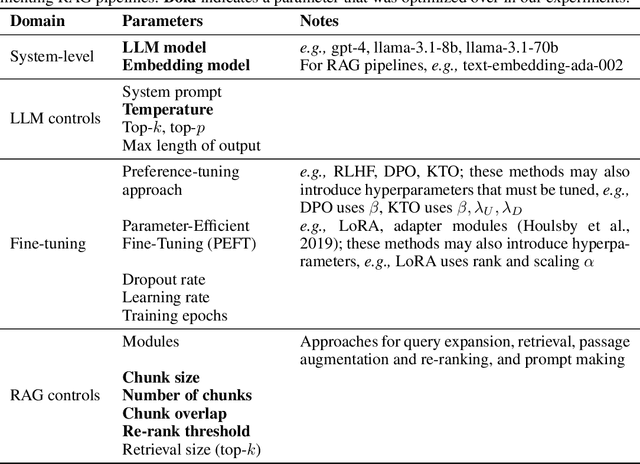
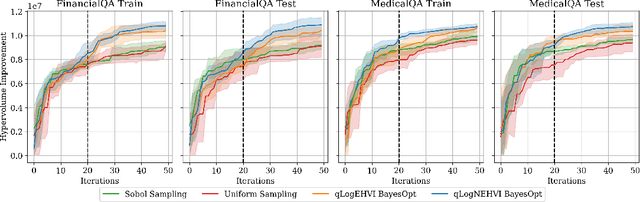
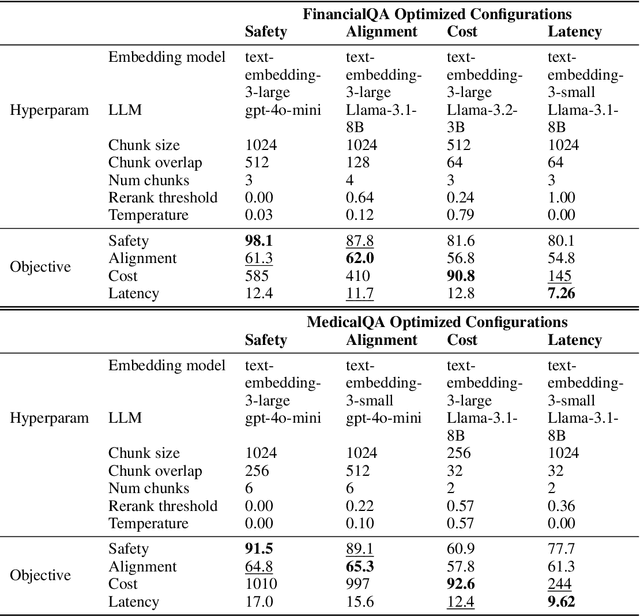
While Retrieval Augmented Generation (RAG) has emerged as a popular technique for improving Large Language Model (LLM) systems, it introduces a large number of choices, parameters and hyperparameters that must be made or tuned. This includes the LLM, embedding, and ranker models themselves, as well as hyperparameters governing individual RAG components. Yet, collectively optimizing the entire configuration in a RAG or LLM system remains under-explored - especially in multi-objective settings - due to intractably large solution spaces, noisy objective evaluations, and the high cost of evaluations. In this work, we introduce the first approach for multi-objective parameter optimization of cost, latency, safety and alignment over entire LLM and RAG systems. We find that Bayesian optimization methods significantly outperform baseline approaches, obtaining a superior Pareto front on two new RAG benchmark tasks. We conclude our work with important considerations for practitioners who are designing multi-objective RAG systems, highlighting nuances such as how optimal configurations may not generalize across tasks and objectives.