 Add to Chrome
 Add to Firefox
 Add to Edge
Can Microcanonical Langevin Dynamics Leverage Mini-Batch Gradient Noise?
Feb 06, 2026
Scaling inference methods such as Markov chain Monte Carlo to high-dimensional models remains a central challenge in Bayesian deep learning. A promising recent proposal, microcanonical Langevin Monte Carlo, has shown state-of-the-art performance across a wide range of problems. However, its reliance on full-dataset gradients makes it prohibitively expensive for large-scale problems. This paper addresses a fundamental question: Can microcanonical dynamics effectively leverage mini-batch gradient noise? We provide the first systematic study of this problem, establishing a novel continuous-time theoretical analysis of stochastic-gradient microcanonical dynamics. We reveal two critical failure modes: a theoretically derived bias due to anisotropic gradient noise and numerical instabilities in complex high-dimensional posteriors. To tackle these issues, we propose a principled gradient noise preconditioning scheme shown to significantly reduce this bias and develop a novel, energy-variance-based adaptive tuner that automates step size selection and dynamically informs numerical guardrails. The resulting algorithm is a robust and scalable microcanonical Monte Carlo sampler that achieves state-of-the-art performance on challenging high-dimensional inference tasks like Bayesian neural networks. Combined with recent ensemble techniques, our work unlocks a new class of stochastic microcanonical Langevin ensemble (SMILE) samplers for large-scale Bayesian inference.

Microcanonical Langevin Ensembles: Advancing the Sampling of Bayesian Neural Networks
Feb 10, 2025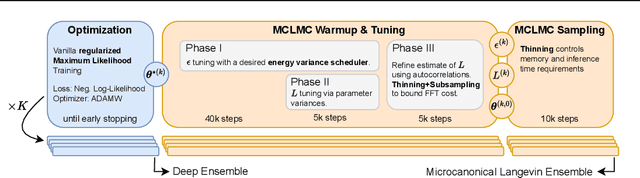
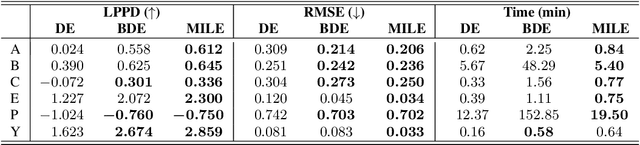
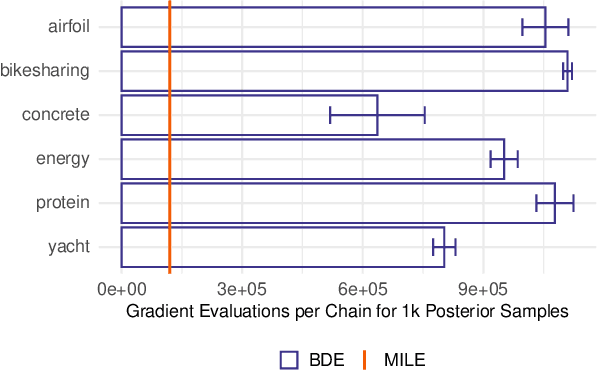
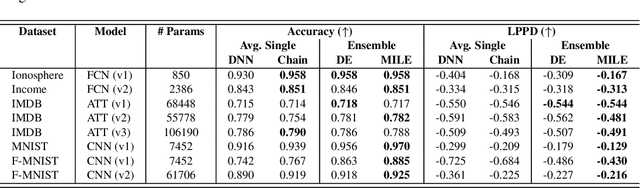
Despite recent advances, sampling-based inference for Bayesian Neural Networks (BNNs) remains a significant challenge in probabilistic deep learning. While sampling-based approaches do not require a variational distribution assumption, current state-of-the-art samplers still struggle to navigate the complex and highly multimodal posteriors of BNNs. As a consequence, sampling still requires considerably longer inference times than non-Bayesian methods even for small neural networks, despite recent advances in making software implementations more efficient. Besides the difficulty of finding high-probability regions, the time until samplers provide sufficient exploration of these areas remains unpredictable. To tackle these challenges, we introduce an ensembling approach that leverages strategies from optimization and a recently proposed sampler called Microcanonical Langevin Monte Carlo (MCLMC) for efficient, robust and predictable sampling performance. Compared to approaches based on the state-of-the-art No-U-Turn Sampler, our approach delivers substantial speedups up to an order of magnitude, while maintaining or improving predictive performance and uncertainty quantification across diverse tasks and data modalities. The suggested Microcanonical Langevin Ensembles and modifications to MCLMC additionally enhance the method's predictability in resource requirements, facilitating easier parallelization. All in all, the proposed method offers a promising direction for practical, scalable inference for BNNs.
Microcanonical Langevin Monte Carlo
Mar 31, 2023
We propose a method for sampling from an arbitrary distribution $\exp[-S(\x)]$ with an available gradient $\nabla S(\x)$, formulated as an energy-preserving stochastic differential equation (SDE). We derive the Fokker-Planck equation and show that both the deterministic drift and the stochastic diffusion separately preserve the stationary distribution. This implies that the drift-diffusion discretization schemes are bias-free, in contrast to the standard Langevin dynamics. We apply the method to the $\phi^4$ lattice field theory, showing the results agree with the standard sampling methods but with significantly higher efficiency compared to the current state-of-the-art samplers.