 Add to Chrome
 Add to Firefox
 Add to Edge
Mixed-Integer vs. Continuous Model Predictive Control for Binary Thrusters: A Comparative Study
Mar 23, 2026
Binary on/off thrusters are commonly used for spacecraft attitude and position control during proximity operations. However, their discrete nature poses challenges for conventional continuous control methods. The control of these discrete actuators is either explicitly formulated as a mixed-integer optimization problem or handled in a two-layer approach, where a continuous controller's output is converted to binary commands using analog-to digital modulation techniques such as Delta-Sigma-modulation. This paper provides the first systematic comparison between these two paradigms for binary thruster control, contrasting continuous Model Predictive Control (MPC) with Delta-Sigma modulation against direct Mixed-Integer MPC (MIMPC) approaches. Furthermore, we propose a new variant of MPC for binary actuated systems, which is informed using the state of the Delta-Sigma Modulator. The two variations for the continuous MPC along with the MIMPC are evaluated through extensive simulations using ESA's REACSA platform. Results demonstrate that while all approaches perform similarly in high-thrust regimes, MIMPC achieves superior fuel efficiency in low-thrust conditions. Continuous MPC with modulation shows instabilities at higher thrust levels, while binary informed MPC, which incorporates modulator dynamics, improves robustness and reduces the efficiency gap to the MIMPC. It can be seen from the simulated and real-system experiments that MIMPC offers complete stability and fuel efficiency benefits, particularly for resource-constrained missions, while continuous control methods remain attractive for computationally limited applications.

Benchmarking Different QP Formulations and Solvers for Dynamic Quadrupedal Walking
Feb 03, 2025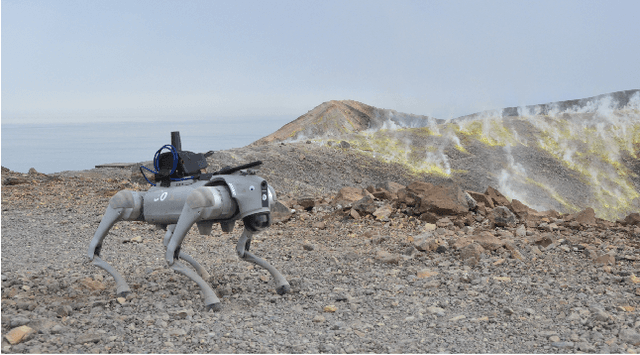
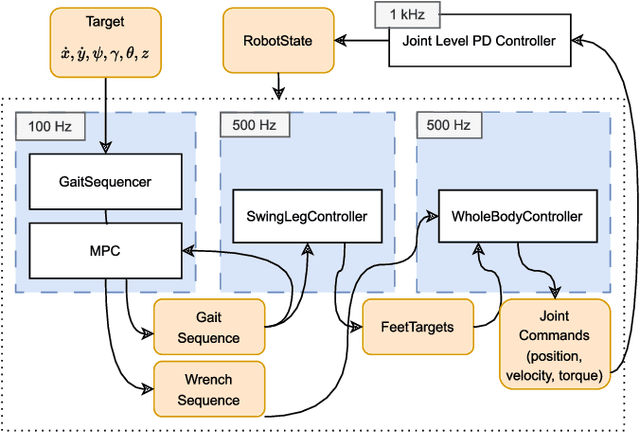
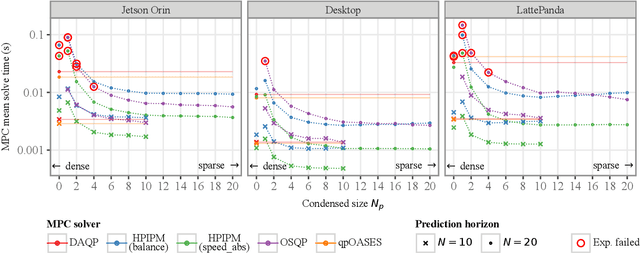
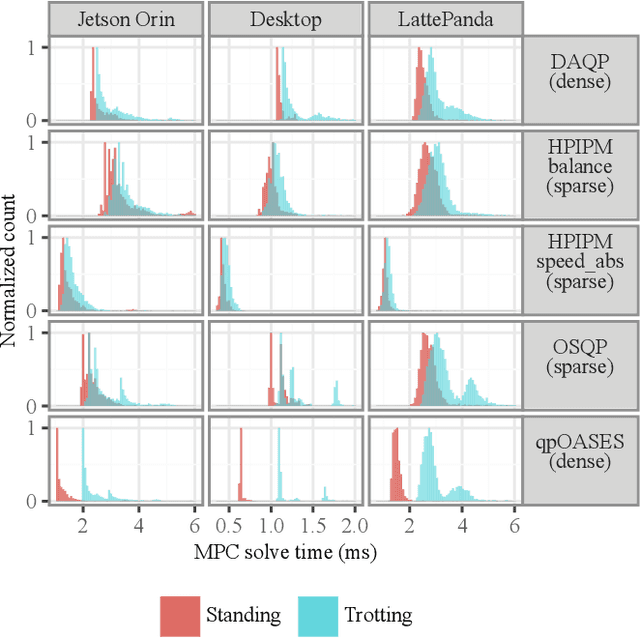
Quadratic Programs (QPs) are widely used in the control of walking robots, especially in Model Predictive Control (MPC) and Whole-Body Control (WBC). In both cases, the controller design requires the formulation of a QP and the selection of a suitable QP solver, both requiring considerable time and expertise. While computational performance benchmarks exist for QP solvers, studies comparing optimal combinations of computational hardware (HW), QP formulation, and solver performance are lacking. In this work, we compare dense and sparse QP formulations, and multiple solving methods on different HW architectures, focusing on their computational efficiency in dynamic walking of four legged robots using MPC. We introduce the Solve Frequency per Watt (SFPW) as a performance measure to enable a cross hardware comparison of the efficiency of QP solvers. We also benchmark different QP solvers for WBC that we use for trajectory stabilization in quadrupedal walking. As a result, this paper provides recommendations for the selection of QP formulations and solvers for different HW architectures in walking robots and indicates which problems should be devoted the greater technical effort in this domain in future.