 Add to Chrome
 Add to Firefox
 Add to Edge
Structured Proxy Features for Multimodal NSCLC Survival Prediction from Pretreatment CT
Aug 01, 2026
Lung cancer results in roughly 1.8 million fatalities annually worldwide, with non-small cell lung cancer (NSCLC) comprising the majority of cases. Despite advancements in treatment, survival stratification remains challenging due to intratumoral heterogeneity inadequately captured by conventional descriptors. Standard radiomic and deep learning techniques regard imaging features as independent quantities, overlooking structured interactions between tumor characteristics. We evaluate whether structured proxy features can enhance multimodal NSCLC survival prediction by augmenting pretreatment computed tomography (CT) representations, radiomics, and clinical variables with six simulation-derived features designed to capture interactions between heterogeneity and morphology. A radiomic-parameterized cellular automaton generates growth-rate and necrosis-ratio proxy features from baseline CT by using entropy and sphericity to compute low-dimensional proxy parameters. The imaging backbone is a Transformer-based Masked Autoencoder (TMAE), which was chosen after a systematic evaluation with alternative encoders within the same pipeline and provides attention-based visualizations that highlight tumor regions receiving higher model attention. On the public Lung1 cohort (n = 390), the primary four-modality fusion attained a C-index of 0.641 (iAUC 0.731, log-rank p < 0.001). The primary result compares favorably with prior multimodal results on Lung1 (C-index 0.631; iAUC 0.592 [15]) under a comparable evaluation protocol, while a separate exploratory coefficient-optimization analysis achieved a best observed C-index of 0.662 (iAUC 0.748). These results indicate that, in addition to conventional radiomic, deep, and clinical representations within the Lung1 benchmark, simulation-derived proxy features may provide complementary predictive information within this fixed Lung1 benchmark.

SVC-Probe: A Framework for Evaluating Perturbation Generalization in Spatial Foundation-Model Embeddings
Jun 26, 2026This work examines perturbation generalization in spatial foundation-model embeddings derived from fluorescence microscopy images. Although these models can discriminate drug conditions accurately, it remains unclear whether the learned representations reflect patterns consistent with expected perturbation axes that transfer across drugs. We introduce SVC-Probe, a perturbation-aware framework that combines Subcellular Embedding Atlas Stability, Mondrian Neighborhood Graphs, and a Foundation Model Perturbation Probe to assess embedding stability, neighborhood rewiring, and centroid prediction under drug treatment. Applied to the CM4AI MDA-MB-468 chemical-perturbation atlas comprising 462 antibody labels and SubCell 1536-dimensional embeddings, SVC-Probe demonstrates that 98.6% three-way condition accuracy does not correlate with reliable cross-drug prediction, with cosine similarity diminishing from 0.944 in-domain to 0.30 under leave-one-drug-out evaluation, constituting a two-drug stress test rather than a general benchmark. Null calibration indicates that raw residual-turnover coupling is largely influenced by generic embedding structure, whereas a drug-specific signal emerges under vorinostat and is consistent with chromatin-related reorganization. In contrast, the paclitaxel axis is not robustly reconstructed, likely due to sparse coverage of microtubule-associated proteins. Together, these results introduce and demonstrate a reusable diagnostic framework for stress-testing spatial virtual-cell representations and indicate that perturbation generalization may serve as a stricter and more informative benchmark than baseline condition discrimination.
* 7
LLM Agent Swarm for Hypothesis-Driven Drug Discovery
Apr 24, 2025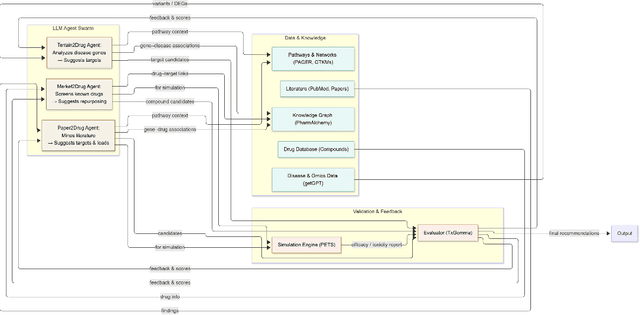
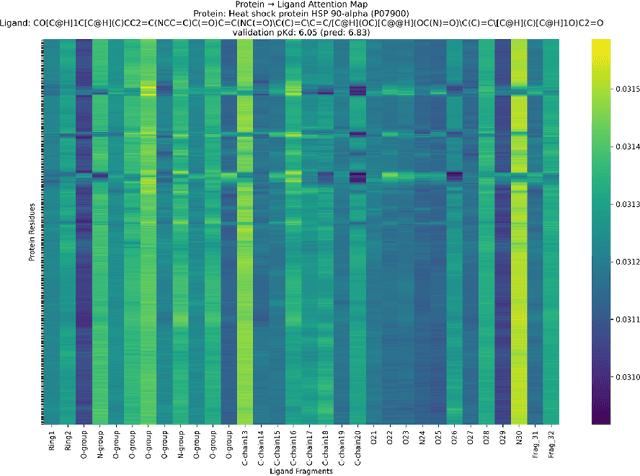
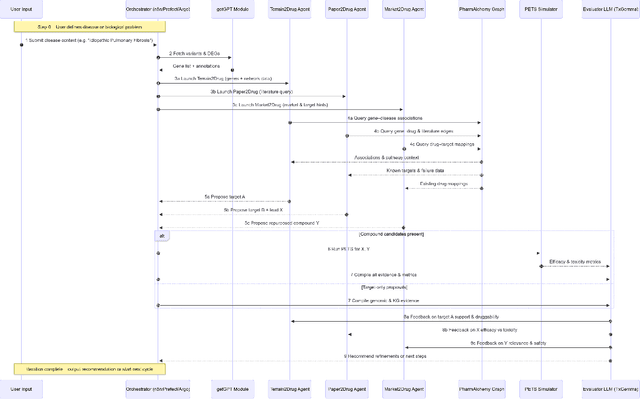
Drug discovery remains a formidable challenge: more than 90 percent of candidate molecules fail in clinical evaluation, and development costs often exceed one billion dollars per approved therapy. Disparate data streams, from genomics and transcriptomics to chemical libraries and clinical records, hinder coherent mechanistic insight and slow progress. Meanwhile, large language models excel at reasoning and tool integration but lack the modular specialization and iterative memory required for regulated, hypothesis-driven workflows. We introduce PharmaSwarm, a unified multi-agent framework that orchestrates specialized LLM "agents" to propose, validate, and refine hypotheses for novel drug targets and lead compounds. Each agent accesses dedicated functionality--automated genomic and expression analysis; a curated biomedical knowledge graph; pathway enrichment and network simulation; interpretable binding affinity prediction--while a central Evaluator LLM continuously ranks proposals by biological plausibility, novelty, in silico efficacy, and safety. A shared memory layer captures validated insights and fine-tunes underlying submodels over time, yielding a self-improving system. Deployable on low-code platforms or Kubernetes-based microservices, PharmaSwarm supports literature-driven discovery, omics-guided target identification, and market-informed repurposing. We also describe a rigorous four-tier validation pipeline spanning retrospective benchmarking, independent computational assays, experimental testing, and expert user studies to ensure transparency, reproducibility, and real-world impact. By acting as an AI copilot, PharmaSwarm can accelerate translational research and deliver high-confidence hypotheses more efficiently than traditional pipelines.