 Add to Chrome
 Add to Firefox
 Add to Edge
Closed-Loop Molecular Design with Calibrated Deference
May 27, 2026
We present Cognitive Loop via In-Situ Optimization (CLIO), an agent that couples a continuously-updated belief-state graph with a recursive plan-then-act loop. The result is a reasoning agent that can contribute something qualitatively different, which we term \emph{calibrated deference}: the capacity to recognize when its own tools or assumptions are failing, to adapt its strategy in response, and to generate mechanistic hypotheses that guide experimental revision. We tested CLIO in a closed-loop human-AI campaign to design an aqueous organic redox flow battery (AORFB) negolyte, with CLIO leading proposal and interpretation in close partnership with chemists who synthesized, characterized, and weighed in on design choices. Across 17 candidates over three rounds, CLIO converged on a top phosphonate candidate; characterization confirmed a 130~mV improvement in redox potential over the literature baseline. Characterization then revealed unexpectedly poor electrochemical reversibility -- a regression no property predictor had flagged. CLIO generated competing mechanistic hypotheses, prioritized discriminating diagnostics, traced the failure to phosphonate-potassium ion pairing, and prescribed a sulfonate replacement. The resulting compound showed substantially improved electrochemical reversibility and maintained a 90~mV improvement in redox potential, closing the design-make-test-redesign loop.

Inverse Design of Vitrimeric Polymers by Molecular Dynamics and Generative Modeling
Dec 06, 2023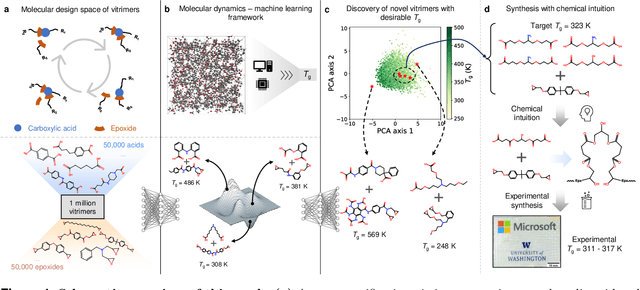
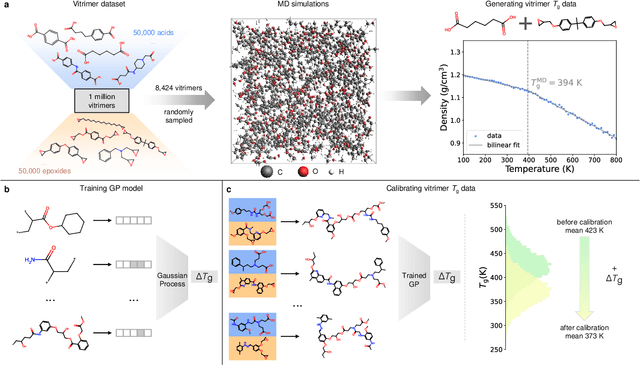

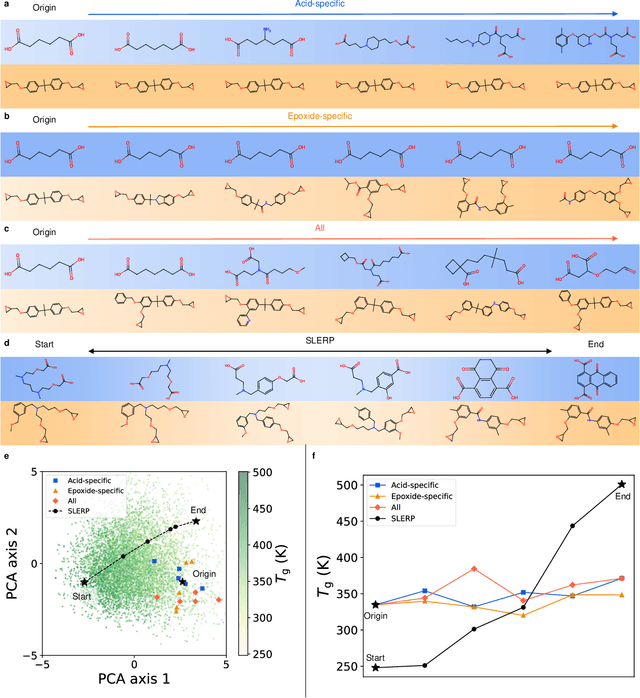
Vitrimer is a new class of sustainable polymers with the ability of self-healing through rearrangement of dynamic covalent adaptive networks. However, a limited choice of constituent molecules restricts their property space, prohibiting full realization of their potential applications. Through a combination of molecular dynamics (MD) simulations and machine learning (ML), particularly a novel graph variational autoencoder (VAE) model, we establish a method for generating novel vitrimers and guide their inverse design based on desired glass transition temperature (Tg). We build the first vitrimer dataset of one million and calculate Tg on 8,424 of them by high-throughput MD simulations calibrated by a Gaussian process model. The proposed VAE employs dual graph encoders and a latent dimension overlapping scheme which allows for individual representation of multi-component vitrimers. By constructing a continuous latent space containing necessary information of vitrimers, we demonstrate high accuracy and efficiency of our framework in discovering novel vitrimers with desirable Tg beyond the training regime. The proposed vitrimers with reasonable synthesizability cover a wide range of Tg and broaden the potential widespread usage of vitrimeric materials.