 Add to Chrome
 Add to Firefox
 Add to Edge
Closed-Loop Molecular Design with Calibrated Deference
May 27, 2026
We present Cognitive Loop via In-Situ Optimization (CLIO), an agent that couples a continuously-updated belief-state graph with a recursive plan-then-act loop. The result is a reasoning agent that can contribute something qualitatively different, which we term \emph{calibrated deference}: the capacity to recognize when its own tools or assumptions are failing, to adapt its strategy in response, and to generate mechanistic hypotheses that guide experimental revision. We tested CLIO in a closed-loop human-AI campaign to design an aqueous organic redox flow battery (AORFB) negolyte, with CLIO leading proposal and interpretation in close partnership with chemists who synthesized, characterized, and weighed in on design choices. Across 17 candidates over three rounds, CLIO converged on a top phosphonate candidate; characterization confirmed a 130~mV improvement in redox potential over the literature baseline. Characterization then revealed unexpectedly poor electrochemical reversibility -- a regression no property predictor had flagged. CLIO generated competing mechanistic hypotheses, prioritized discriminating diagnostics, traced the failure to phosphonate-potassium ion pairing, and prescribed a sulfonate replacement. The resulting compound showed substantially improved electrochemical reversibility and maintained a 90~mV improvement in redox potential, closing the design-make-test-redesign loop.

STEM image analysis based on deep learning: identification of vacancy defects and polymorphs of ${MoS_2}$
Jun 09, 2022
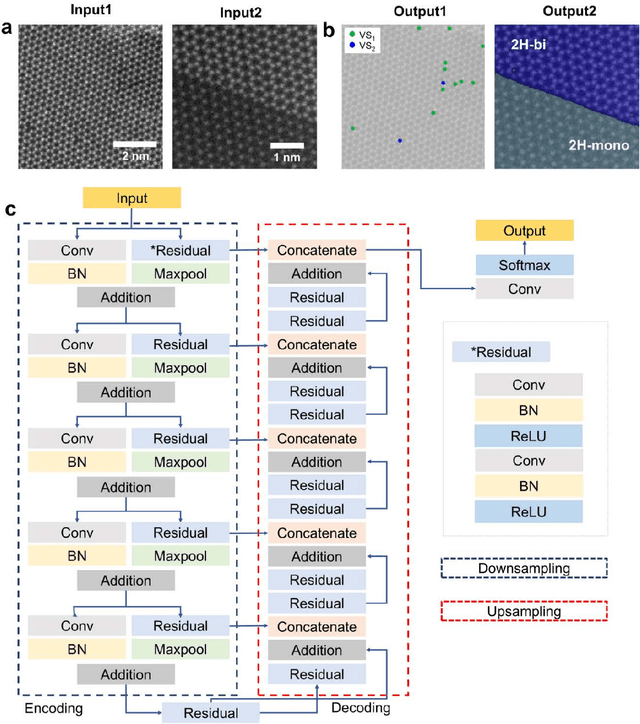
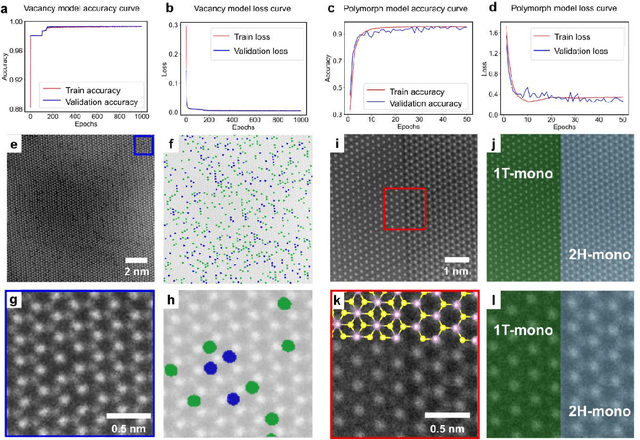
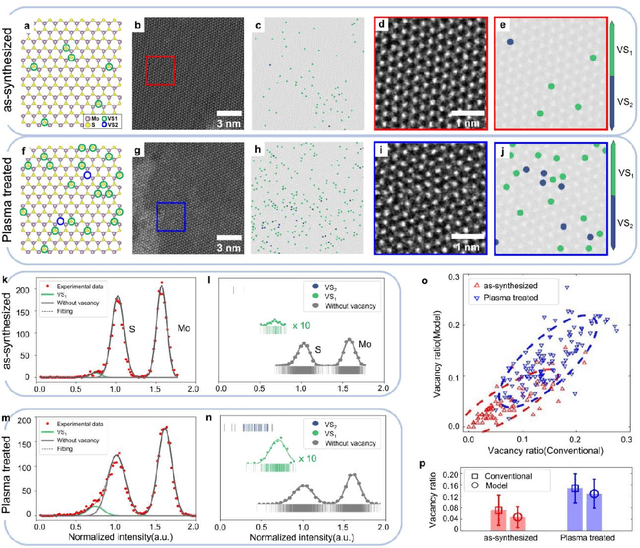
Scanning transmission electron microscopy (STEM) is an indispensable tool for atomic-resolution structural analysis for a wide range of materials. The conventional analysis of STEM images is an extensive hands-on process, which limits efficient handling of high-throughput data. Here we apply a fully convolutional network (FCN) for identification of important structural features of two-dimensional crystals. ResUNet, a type of FCN, is utilized in identifying sulfur vacancies and polymorph types of ${MoS_2}$ from atomic resolution STEM images. Efficient models are achieved based on training with simulated images in the presence of different levels of noise, aberrations, and carbon contamination. The accuracy of the FCN models toward extensive experimental STEM images is comparable to that of careful hands-on analysis. Our work provides a guideline on best practices to train a deep learning model for STEM image analysis and demonstrates FCN's application for efficient processing of a large volume of STEM data.
* 24 pages, 5 figures