 Add to Chrome
 Add to Firefox
 Add to Edge
Temporal Patch Shuffle (TPS): Leveraging Patch-Level Shuffling to Boost Generalization and Robustness in Time Series Forecasting
Apr 10, 2026
Data augmentation is a crucial technique for improving model generalization and robustness, particularly in deep learning models where training data is limited. Although many augmentation methods have been developed for time series classification, most are not directly applicable to time series forecasting due to the need to preserve temporal coherence. In this work, we propose Temporal Patch Shuffle (TPS), a simple and model-agnostic data augmentation method for forecasting that extracts overlapping temporal patches, selectively shuffles a subset of patches using variance-based ordering as a conservative heuristic, and reconstructs the sequence by averaging overlapping regions. This design increases sample diversity while preserving forecast-consistent local temporal structure. We extensively evaluate TPS across nine long-term forecasting datasets using five recent model families (TSMixer, DLinear, PatchTST, TiDE, and LightTS), and across four short-term forecasting datasets using PatchTST, observing consistent performance improvements. Comprehensive ablation studies further demonstrate the effectiveness, robustness, and design rationale of the proposed method.

Wave-Mask/Mix: Exploring Wavelet-Based Augmentations for Time Series Forecasting
Aug 20, 2024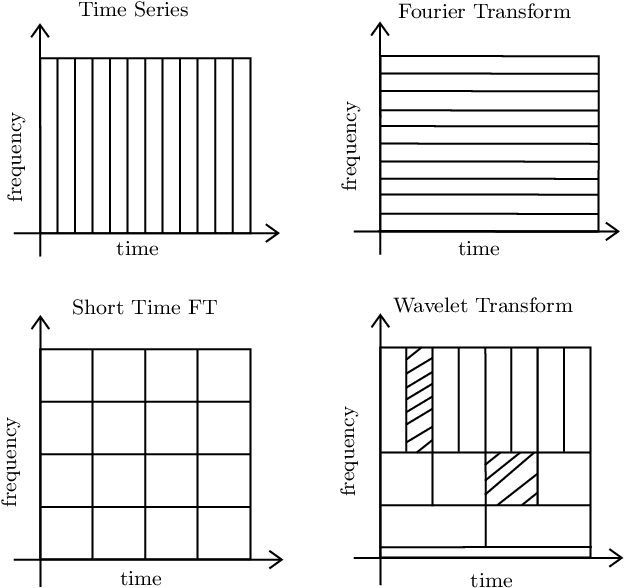
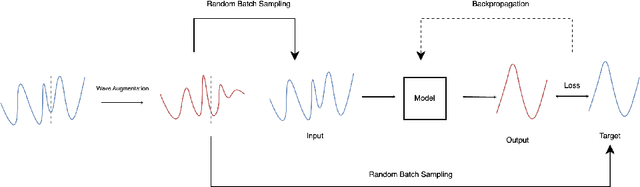
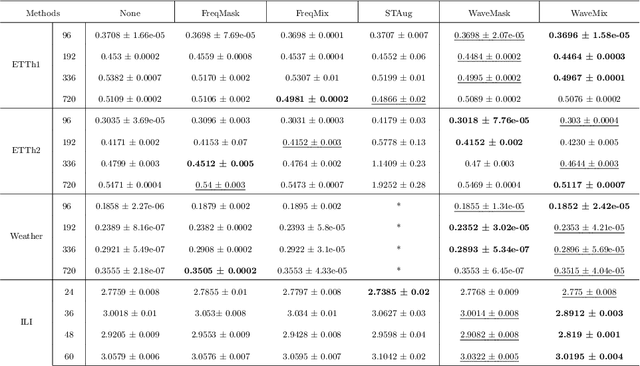
Data augmentation is important for improving machine learning model performance when faced with limited real-world data. In time series forecasting (TSF), where accurate predictions are crucial in fields like finance, healthcare, and manufacturing, traditional augmentation methods for classification tasks are insufficient to maintain temporal coherence. This research introduces two augmentation approaches using the discrete wavelet transform (DWT) to adjust frequency elements while preserving temporal dependencies in time series data. Our methods, Wavelet Masking (WaveMask) and Wavelet Mixing (WaveMix), are evaluated against established baselines across various forecasting horizons. To the best of our knowledge, this is the first study to conduct extensive experiments on multivariate time series using Discrete Wavelet Transform as an augmentation technique. Experimental results demonstrate that our techniques achieve competitive results with previous methods. We also explore cold-start forecasting using downsampled training datasets, comparing outcomes to baseline methods.