 Add to Chrome
 Add to Firefox
 Add to Edge
Controllable Dynamic 3D Shape Generation via 3D Trajectories and Text
Jun 03, 2026
We introduce T2Mo, a feed-forward framework for controllable dynamic 3D shape generation conditioned on 3D trajectories and text. Due to the inherent ambiguity of language, generating precisely intended motions using text alone remains challenging. To address this, we adopt 3D trajectories as controllable spatial guidance, specifying the exact paths along which selected points should move. By combining both, T2Mo generates object motions that spatially adhere to the given trajectories while globally reflecting the text semantics. To robustly handle trajectory inputs with arbitrary configurations, ranging from dense to sparse and unevenly distributed, we further propose a shape-grounded trajectory embedding that maps an input trajectory set into a shape-aware token set covering the entire object. We conduct extensive comparisons against text-based baselines and cascaded video-based baselines that combine trajectory-guided video generation with video-to-dynamic mesh generation. Quantitative and qualitative evaluations, along with user studies, demonstrate that our approach produces motions that more faithfully follow the given prompts with higher expressiveness while preserving motion quality.

MORPHOS: Autoregressive 4D Generation with Temporal Structured Latents
Jun 01, 2026We present MORPHOS, a novel autoregressive framework that generates dynamic 3D assets from videos across diverse representations, including meshes, 3D Gaussians, and radiance fields. Existing methods are typically limited to a single representation, struggle to model topological changes, or fail to maintain temporal consistency over long videos. To address these limitations, we introduce the Temporal Structured Latents (T-SLAT), a unified 4D representation that jointly encodes geometry and appearance along the temporal dimension. Leveraging T-SLAT, MORPHOS autoregressively generates dynamic 3D assets via causal attention, conditioning each frame on its preceding history to ensure temporal consistency while handling evolving topologies. We also propose a temporal-structural augmentation to mitigate error accumulation in autoregressive generation. MORPHOS achieves state-of-the-art performance in appearance and competitive results in geometry across multiple benchmarks, demonstrating superior generalization across various representations and robustness in long-horizon generation.
Spacer: Towards Engineered Scientific Inspiration
Aug 25, 2025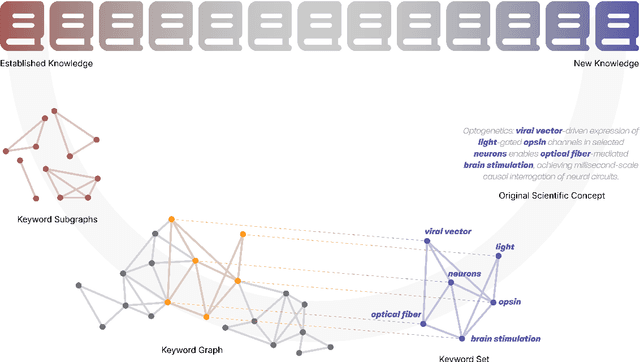
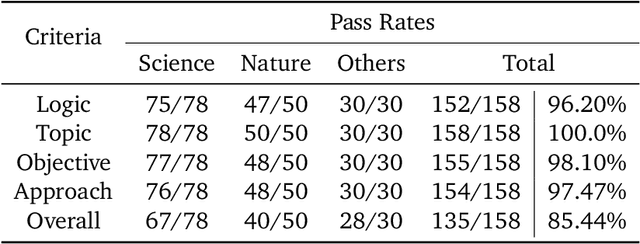
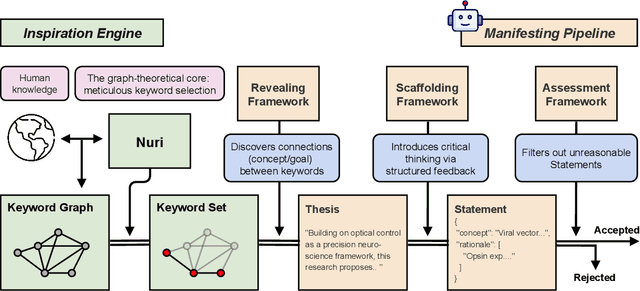

Recent advances in LLMs have made automated scientific research the next frontline in the path to artificial superintelligence. However, these systems are bound either to tasks of narrow scope or the limited creative capabilities of LLMs. We propose Spacer, a scientific discovery system that develops creative and factually grounded concepts without external intervention. Spacer attempts to achieve this via 'deliberate decontextualization,' an approach that disassembles information into atomic units - keywords - and draws creativity from unexplored connections between them. Spacer consists of (i) Nuri, an inspiration engine that builds keyword sets, and (ii) the Manifesting Pipeline that refines these sets into elaborate scientific statements. Nuri extracts novel, high-potential keyword sets from a keyword graph built with 180,000 academic publications in biological fields. The Manifesting Pipeline finds links between keywords, analyzes their logical structure, validates their plausibility, and ultimately drafts original scientific concepts. According to our experiments, the evaluation metric of Nuri accurately classifies high-impact publications with an AUROC score of 0.737. Our Manifesting Pipeline also successfully reconstructs core concepts from the latest top-journal articles solely from their keyword sets. An LLM-based scoring system estimates that this reconstruction was sound for over 85% of the cases. Finally, our embedding space analysis shows that outputs from Spacer are significantly more similar to leading publications compared with those from SOTA LLMs.