 Add to Chrome
 Add to Firefox
 Add to Edge
YeTI: You Only Need Two Noisy Images for Real-World sRGB Noise Generation
Jul 10, 2026
Real-world sRGB image denoising remains challenging due to the nonlinear characteristics of sensor noise and the difficulty of acquiring aligned clean-noisy image pairs. Supervised denoisers often overfit to limited paired datasets, while self-supervised methods still depend on sufficiently diverse noisy observations. These limitations motivate scalable noise synthesis methods that can model real-world noise without clean ground truth or camera metadata. We propose YeTI, a real-world sRGB noise generation framework that learns from only two noisy observations of the same scene. YeTI uses a Reconstruction Autoencoder to disentangle scene structure and noise characteristics, and models the latent noise distribution with a one-step Conditional Diffusion Transformer trained using consistency objectives. Given a single noisy input at inference time, YeTI generates realistic, signal-dependent noise while preserving the underlying scene content. Extensive experiments demonstrate the effectiveness of YeTI across real-world benchmarks. We evaluate noise generation on SIDD and further assess generalization on SIDD+, MAI2021, and SID, covering smartphone and diverse consumer-camera sensors. Downstream denoising results on DND further show that denoisers trained with YeTI-synthesized images achieve strong real-world performance, highlighting the practical value of clean-image-free and metadata-free noise generation.

Diffusion-Based sRGB Real Noise Generation via Prompt-Driven Noise Representation Learning
Mar 05, 2026Denoising in the sRGB image space is challenging due to noise variability. Although end-to-end methods perform well, their effectiveness in real-world scenarios is limited by the scarcity of real noisy-clean image pairs, which are expensive and difficult to collect. To address this limitation, several generative methods have been developed to synthesize realistic noisy images from limited data. These generative approaches often rely on camera metadata during both training and testing to synthesize real-world noise. However, the lack of metadata or inconsistencies between devices restricts their usability. Therefore, we propose a novel framework called Prompt-Driven Noise Generation (PNG). This model is capable of acquiring high-dimensional prompt features that capture the characteristics of real-world input noise and creating a variety of realistic noisy images consistent with the distribution of the input noise. By eliminating the dependency on explicit camera metadata, our approach significantly enhances the generalizability and applicability of noise synthesis. Comprehensive experiments reveal that our model effectively produces realistic noisy images and show the successful application of these generated images in removing real-world noise across various benchmark datasets.
IDF: Iterative Dynamic Filtering Networks for Generalizable Image Denoising
Aug 27, 2025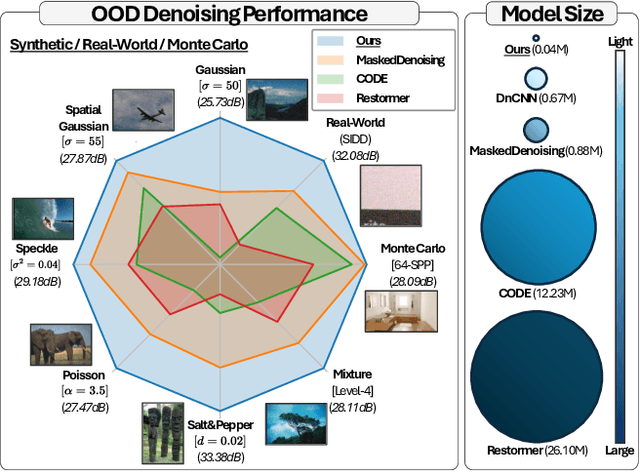
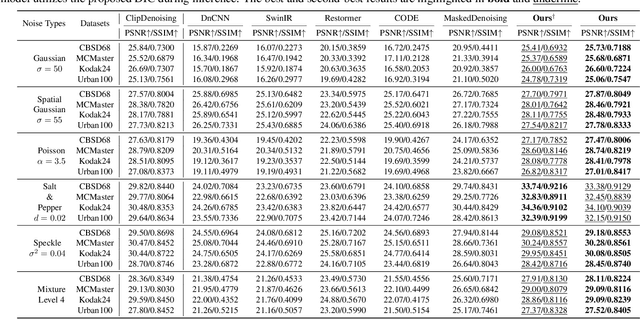

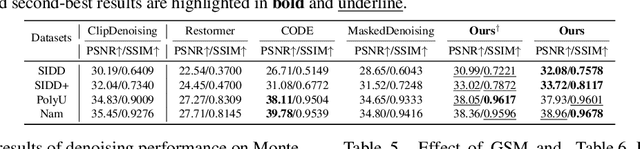
Image denoising is a fundamental challenge in computer vision, with applications in photography and medical imaging. While deep learning-based methods have shown remarkable success, their reliance on specific noise distributions limits generalization to unseen noise types and levels. Existing approaches attempt to address this with extensive training data and high computational resources but they still suffer from overfitting. To address these issues, we conduct image denoising by utilizing dynamically generated kernels via efficient operations. This approach helps prevent overfitting and improves resilience to unseen noise. Specifically, our method leverages a Feature Extraction Module for robust noise-invariant features, Global Statistics and Local Correlation Modules to capture comprehensive noise characteristics and structural correlations. The Kernel Prediction Module then employs these cues to produce pixel-wise varying kernels adapted to local structures, which are then applied iteratively for denoising. This ensures both efficiency and superior restoration quality. Despite being trained on single-level Gaussian noise, our compact model (~ 0.04 M) excels across diverse noise types and levels, demonstrating the promise of iterative dynamic filtering for practical image denoising.
Self2Self+: Single-Image Denoising with Self-Supervised Learning and Image Quality Assessment Loss
Jul 20, 2023Recently, denoising methods based on supervised learning have exhibited promising performance. However, their reliance on external datasets containing noisy-clean image pairs restricts their applicability. To address this limitation, researchers have focused on training denoising networks using solely a set of noisy inputs. To improve the feasibility of denoising procedures, in this study, we proposed a single-image self-supervised learning method in which only the noisy input image is used for network training. Gated convolution was used for feature extraction and no-reference image quality assessment was used for guiding the training process. Moreover, the proposed method sampled instances from the input image dataset using Bernoulli sampling with a certain dropout rate for training. The corresponding result was produced by averaging the generated predictions from various instances of the trained network with dropouts. The experimental results indicated that the proposed method achieved state-of-the-art denoising performance on both synthetic and real-world datasets. This highlights the effectiveness and practicality of our method as a potential solution for various noise removal tasks.