 Add to Chrome
 Add to Firefox
 Add to Edge
WT-UMI: Tactile-based Whole-Body Manipulation via Force-Supervised Contact-Aware Planning
Jun 11, 2026
Whole-body humanoid manipulation of bulky, deformable, and shared-load objects requires distributed contact sensing and explicit force regulation, yet most imitation policies treat contact force only implicitly. On the other hand, different demonstration sources provide complementary modalities with inherent trade-offs: human demonstrations capture natural contact forces but not robot-executable actions, while teleoperation directly records robot actions but with less natural force regulation. This paper presents \textbf{WT-UMI}, a wearable whole-body tactile interface worn by human operators or mounted on humanoids, providing accurate observations of tactile images, contact forces, and end-effector poses across both human demonstration and humanoid teleoperation modes. We introduce a force-conditioned target-pose correction module that converts measured human poses into contact-aware robot targets by learning corrections from teleoperation data. To leverage the natural force interaction in human data, we propose a force-supervised planner that predicts end-effector pose chunks and contact-force trajectories. The predicted contact force serves as the reference for a tactile-based admittance controller. Across five contact-rich tasks spanning deformable objects, bulky rigid objects, and human--humanoid collaboration, WT-UMI improves success rate and reduces contact-position tracking error over four policy baselines. Our project page is available at https://wt-umi.github.io/WTUMI/.

SGGNet$^2$: Speech-Scene Graph Grounding Network for Speech-guided Navigation
Jul 14, 2023The spoken language serves as an accessible and efficient interface, enabling non-experts and disabled users to interact with complex assistant robots. However, accurately grounding language utterances gives a significant challenge due to the acoustic variability in speakers' voices and environmental noise. In this work, we propose a novel speech-scene graph grounding network (SGGNet$^2$) that robustly grounds spoken utterances by leveraging the acoustic similarity between correctly recognized and misrecognized words obtained from automatic speech recognition (ASR) systems. To incorporate the acoustic similarity, we extend our previous grounding model, the scene-graph-based grounding network (SGGNet), with the ASR model from NVIDIA NeMo. We accomplish this by feeding the latent vector of speech pronunciations into the BERT-based grounding network within SGGNet. We evaluate the effectiveness of using latent vectors of speech commands in grounding through qualitative and quantitative studies. We also demonstrate the capability of SGGNet$^2$ in a speech-based navigation task using a real quadruped robot, RBQ-3, from Rainbow Robotics.
Inverse Constraint Learning and Generalization by Transferable Reward Decomposition
Jun 21, 2023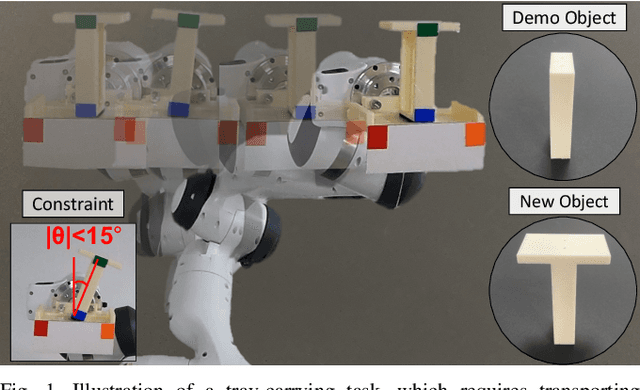
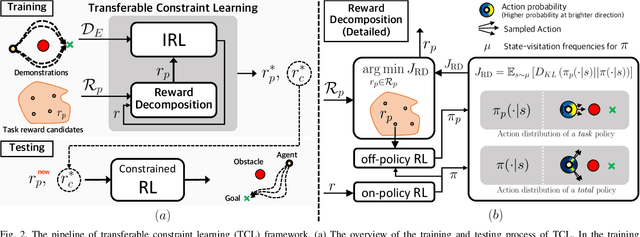
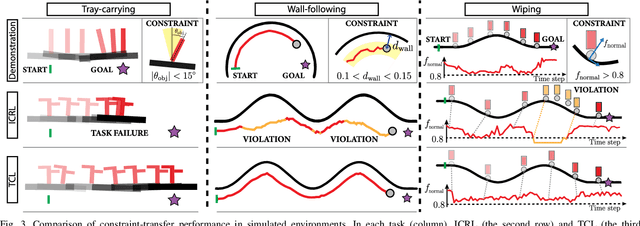
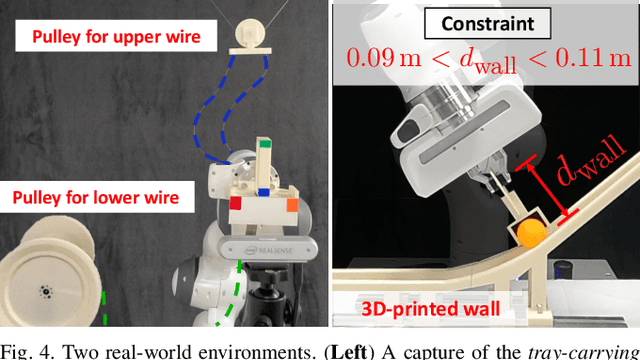
We present the problem of inverse constraint learning (ICL), which recovers constraints from demonstrations to autonomously reproduce constrained skills in new scenarios. However, ICL suffers from an ill-posed nature, leading to inaccurate inference of constraints from demonstrations. To figure it out, we introduce a transferable constraint learning (TCL) algorithm that jointly infers a task-oriented reward and a task-agnostic constraint, enabling the generalization of learned skills. Our method TCL additively decomposes the overall reward into a task reward and its residual as soft constraints, maximizing policy divergence between task- and constraint-oriented policies to obtain a transferable constraint. Evaluating our method and four baselines in three simulated environments, we show TCL outperforms state-of-the-art IRL and ICL algorithms, achieving up to a $72\%$ higher task-success rates with accurate decomposition compared to the next best approach in novel scenarios. Further, we demonstrate the robustness of TCL on a real-world robotic tray-carrying task.