 Add to Chrome
 Add to Firefox
 Add to Edge
Distributional Stability of Tangent-Linearized Gaussian Inference on Smooth Manifolds
Feb 22, 2026
Gaussian inference on smooth manifolds is central to robotics, but exact marginalization and conditioning are generally non-Gaussian and geometry-dependent. We study tangent-linearized Gaussian inference and derive explicit non-asymptotic $W_2$ stability bounds for projection marginalization and surface-measure conditioning. The bounds separate local second-order geometric distortion from nonlocal tail leakage and, for Gaussian inputs, yield closed-form diagnostics from $(μ,Σ)$ and curvature/reach surrogates. Circle and planar-pushing experiments validate the predicted calibration transition near $\sqrt{\|Σ\|_{\mathrm{op}}}/R\approx 1/6$ and indicate that normal-direction uncertainty is the dominant failure mode when locality breaks. These diagnostics provide practical triggers for switching from single-chart linearization to multi-chart or sample-based manifold inference.

You Only Pose Once: A Minimalist's Detection Transformer for Monocular RGB Category-level 9D Multi-Object Pose Estimation
Aug 20, 2025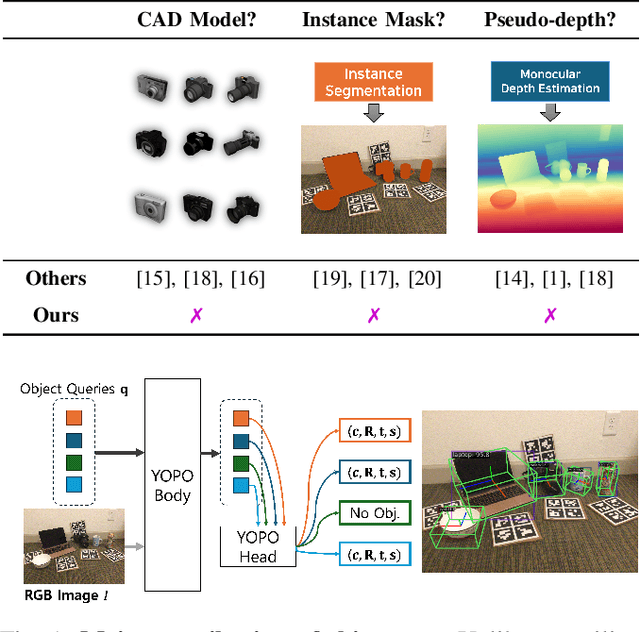
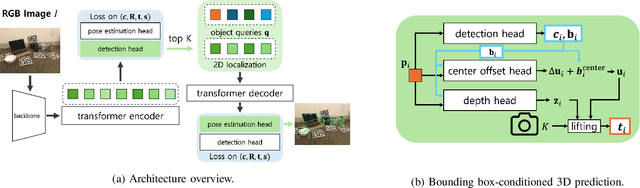
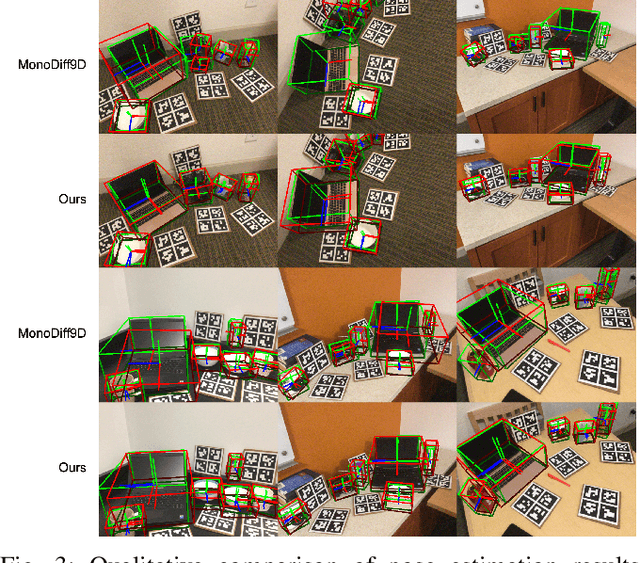
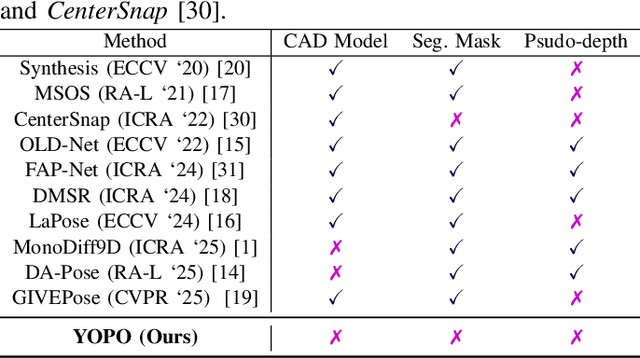
Accurately recovering the full 9-DoF pose of unseen instances within specific categories from a single RGB image remains a core challenge for robotics and automation. Most existing solutions still rely on pseudo-depth, CAD models, or multi-stage cascades that separate 2D detection from pose estimation. Motivated by the need for a simpler, RGB-only alternative that learns directly at the category level, we revisit a longstanding question: Can object detection and 9-DoF pose estimation be unified with high performance, without any additional data? We show that they can with our method, YOPO, a single-stage, query-based framework that treats category-level 9-DoF estimation as a natural extension of 2D detection. YOPO augments a transformer detector with a lightweight pose head, a bounding-box-conditioned translation module, and a 6D-aware Hungarian matching cost. The model is trained end-to-end only with RGB images and category-level pose labels. Despite its minimalist design, YOPO sets a new state of the art on three benchmarks. On the REAL275 dataset, it achieves 79.6% $\rm{IoU}_{50}$ and 54.1% under the $10^\circ$$10{\rm{cm}}$ metric, surpassing prior RGB-only methods and closing much of the gap to RGB-D systems. The code, models, and additional qualitative results can be found on our project.