 Add to Chrome
 Add to Firefox
 Add to Edge
Cooperative Multi-Satellite ISAC Networks: Centralized vs. Distributed Sensing
Mar 08, 2026
This paper investigates a downlink multi-satellite integrated sensing and communication (ISAC) network, in which multiple satellites simultaneously transmit ISAC signals to provide communication services to ground user equipments and enable cooperative sensing of airborne targets through multiple gateways. To support this dual functionality, we introduce communication and sensing beamforming designs based on uniform planar arrays with optimized power allocation. Building on these designs, we propose two cooperative sensing frameworks, namely centralized and distributed. In the centralized framework, each gateway forwards its sensing observations to a central unit (CU), where the positions of multiple targets are jointly estimated from the aggregated data using a sparse signal recovery formulation. To mitigate the signaling overhead inherent in centralized processing, a distributed framework is further proposed, in which each gateway independently estimates target positions and transmits only the local estimates to the CU. To associate estimates from different gateways, a data association problem based on the squared Euclidean distance is formulated and efficiently solved using the Hungarian algorithm. The final target positions are then obtained by minimizing the distance estimation error. Simulation results demonstrate that the proposed centralized and distributed frameworks significantly outperform existing sensing schemes while satisfying communication performance requirements. We also evaluate the sensing-communication trade-off from the viewpoints of sensing accuracy and communication power consumption under the proposed frameworks.

Beam-Squint-Aided Hierarchical Sensing for Integrated Sensing and Communications with Uniform Planar Arrays
Dec 31, 2025In this paper, we propose a novel hierarchical sensing framework for wideband integrated sensing and communications with uniform planar arrays (UPAs). Leveraging the beam-squint effect inherent in wideband orthogonal frequency-division multiplexing (OFDM) systems, the proposed framework enables efficient two-dimensional angle estimation through a structured multi-stage sensing process. Specifically, the sensing procedure first searches over the elevation angle domain, followed by a dedicated search over the azimuth angle domain given the estimated elevation angles. In each stage, true-time-delay lines and phase shifters of the UPA are jointly configured to cover multiple grid points simultaneously across OFDM subcarriers. To enable accurate and efficient target localization, we formulate the angle estimation problem as a sparse signal recovery problem and develop a modified matching pursuit algorithm tailored to the hierarchical sensing architecture. Additionally, we design power allocation strategies that minimize total transmit power while meeting performance requirements for both sensing and communication. Numerical results demonstrate that the proposed framework achieves superior performance over conventional sensing methods with reduced sensing power.
Deep Learning-Assisted Parallel Interference Cancellation for Grant-Free NOMA in Machine-Type Communication
Mar 12, 2024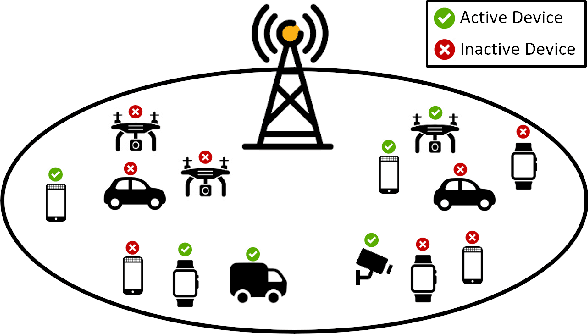
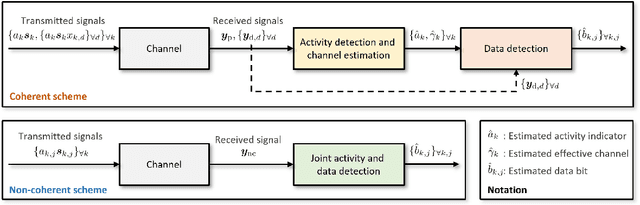
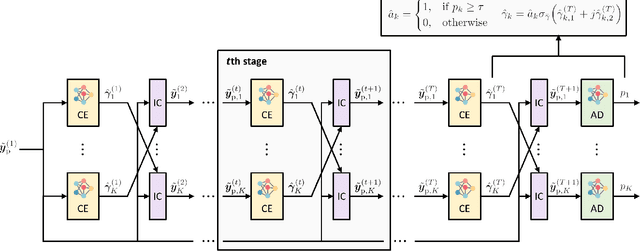
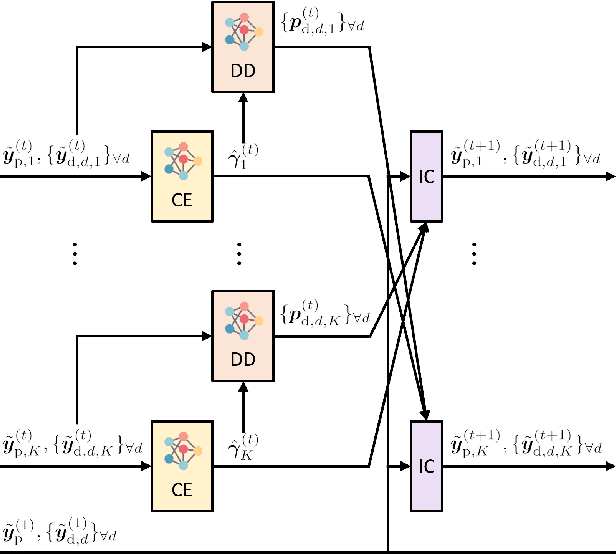
In this paper, we present a novel approach for joint activity detection (AD), channel estimation (CE), and data detection (DD) in uplink grant-free non-orthogonal multiple access (NOMA) systems. Our approach employs an iterative and parallel interference removal strategy inspired by parallel interference cancellation (PIC), enhanced with deep learning to jointly tackle the AD, CE, and DD problems. Based on this approach, we develop three PIC frameworks, each of which is designed for either coherent or non-coherence schemes. The first framework performs joint AD and CE using received pilot signals in the coherent scheme. Building upon this framework, the second framework utilizes both the received pilot and data signals for CE, further enhancing the performances of AD, CE, and DD in the coherent scheme. The third framework is designed to accommodate the non-coherent scheme involving a small number of data bits, which simultaneously performs AD and DD. Through joint loss functions and interference cancellation modules, our approach supports end-to-end training, contributing to enhanced performances of AD, CE, and DD for both coherent and non-coherent schemes. Simulation results demonstrate the superiority of our approach over traditional techniques, exhibiting enhanced performances of AD, CE, and DD while maintaining lower computational complexity.