 Add to Chrome
 Add to Firefox
 Add to Edge
Samplet limits and multiwavelets
Apr 02, 2026
Samplets are data adapted multiresolution analyses of localized discrete signed measures. They can be constructed on scattered data sites in arbitrary dimension and such that they exhibit vanishing moments with respect to any prescribed set of primitives. We consider the samplet construction in a probabilistic framework and show that, when choosing polynomials as primitives, the resulting samplet basis converges in the infinite data limit to signed measures with broken polynomial densities. These densities amount to multiwavelets with respect to a hierarchical partition of the region containing the data sites. As a byproduct, we therefore obtain a construction of general multiwavelets that allows for a flexible prescription of vanishing moments going beyond tensor product constructions. For congruent partitions we particularly recover classical multiwavelets with scale- and partition- independent filter coefficients. The theoretical findings are complemented by numerical experiments that illustrate the convergence results in case of random as well as low-discrepancy data sites.

ERIS: Enhancing Privacy and Communication Efficiency in Serverless Federated Learning
Feb 09, 2026Scaling federated learning (FL) to billion-parameter models introduces critical trade-offs between communication efficiency, model accuracy, and privacy guarantees. Existing solutions often tackle these challenges in isolation, sacrificing accuracy or relying on costly cryptographic tools. We propose ERIS, a serverless FL framework that balances privacy and accuracy while eliminating the server bottleneck and distributing the communication load. ERIS combines a model partitioning strategy, distributing aggregation across multiple client-side aggregators, with a distributed shifted gradient compression mechanism. We theoretically prove that ERIS (i) converges at the same rate as FedAvg under standard assumptions, and (ii) bounds mutual information leakage inversely with the number of aggregators, enabling strong privacy guarantees with no accuracy degradation. Experiments across image and text tasks, including large language models, confirm that ERIS achieves FedAvg-level accuracy while substantially reducing communication cost and improving robustness to membership inference and reconstruction attacks, without relying on heavy cryptography or noise injection.
Observation-specific explanations through scattered data approximation
Apr 12, 2024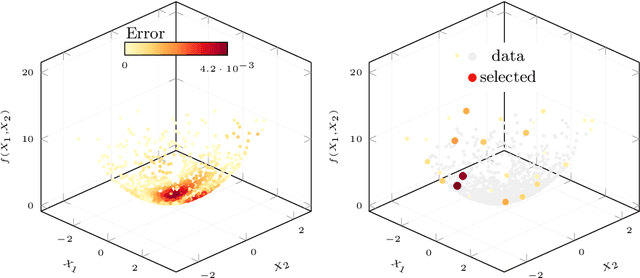
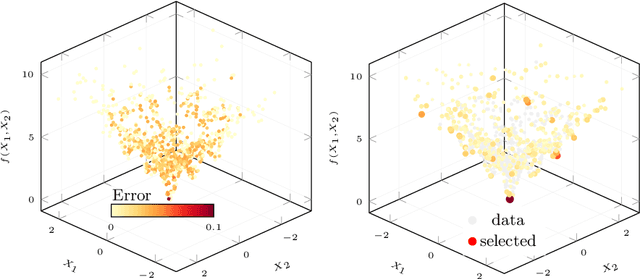
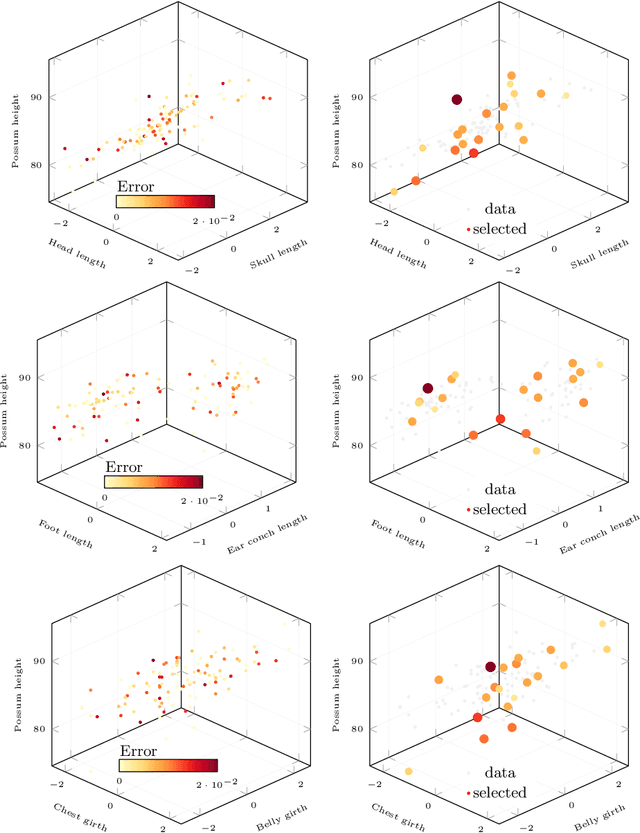
This work introduces the definition of observation-specific explanations to assign a score to each data point proportional to its importance in the definition of the prediction process. Such explanations involve the identification of the most influential observations for the black-box model of interest. The proposed method involves estimating these explanations by constructing a surrogate model through scattered data approximation utilizing the orthogonal matching pursuit algorithm. The proposed approach is validated on both simulated and real-world datasets.