 Add to Chrome
 Add to Firefox
 Add to Edge
Constraint-Aware Flow Matching: Decision Aligned End-to-End Training for Constrained Sampling
May 12, 2026
Deep generative models provide state-of-the-art performance across a wide array of applications, with recent studies showing increasing applicability for science and engineering. Despite a growing corpus of literature focused on the integration of physics-based constraints into the generation process, existing approaches fail to enforce strict constraint satisfaction while maintaining sample quality. In particular, training-free constrained sampling methods, while providing per-sample feasibility guarantees, introduce a fundamental mismatch between the training objective and the constrained sampling procedure, often leading to performance degradation. Identifying this training-sampling misalignment as a central limitation of current constrained generative modeling approaches, this paper proposes Constraint-Aware Flow Matching, a novel end-to-end framework that explicitly incorporates constraint projections into the training objective. By aligning the model's learned dynamics with the constrained sampling process, the proposed method mitigates distributional shift induced by projection-based corrections, enabling high-quality constrained generation. The proposed approach is evaluated on three challenging real-world benchmarks, illustrating the generality and efficacy of the method.

Constrained Diffusion for Accelerated Structure Relaxation of Inorganic Solids with Point Defects
Feb 22, 2026Point defects affect material properties by altering electronic states and modifying local bonding environments. However, high-throughput first-principles simulations of point defects are costly due to large simulation cells and complex energy landscapes. To this end, we propose a generative framework for simulating point defects, overcoming the limits of costly first-principles simulators. By leveraging a primal-dual algorithm, we introduce a constraint-aware diffusion model which outperforms existing constrained diffusion approaches in this domain. Across six defect configuration settings for Bi2Te3, the proposed approach provides state-of-the-art performance generating physically grounded structures.
Multi-Agent Path Finding in Continuous Spaces with Projected Diffusion Models
Dec 23, 2024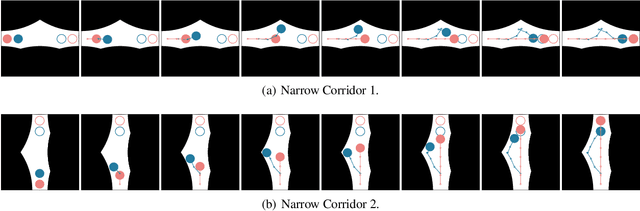
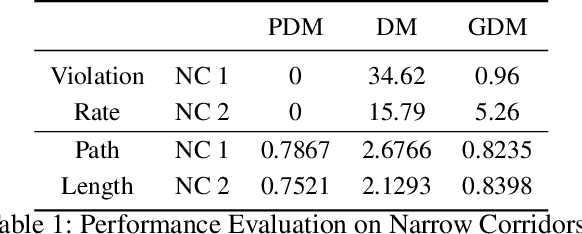
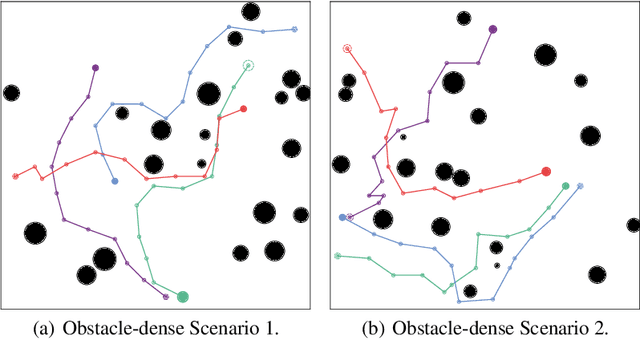
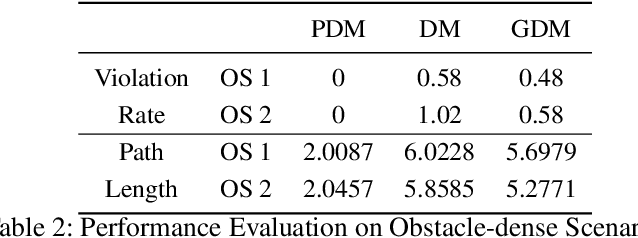
Multi-Agent Path Finding (MAPF) is a fundamental problem in robotics, requiring the computation of collision-free paths for multiple agents moving from their respective start to goal positions. Coordinating multiple agents in a shared environment poses significant challenges, especially in continuous spaces where traditional optimization algorithms struggle with scalability. Moreover, these algorithms often depend on discretized representations of the environment, which can be impractical in image-based or high-dimensional settings. Recently, diffusion models have shown promise in single-agent path planning, capturing complex trajectory distributions and generating smooth paths that navigate continuous, high-dimensional spaces. However, directly extending diffusion models to MAPF introduces new challenges since these models struggle to ensure constraint feasibility, such as inter-agent collision avoidance. To overcome this limitation, this work proposes a novel approach that integrates constrained optimization with diffusion models for MAPF in continuous spaces. This unique combination directly produces feasible multi-agent trajectories that respect collision avoidance and kinematic constraints. The effectiveness of our approach is demonstrated across various challenging simulated scenarios of varying dimensionality.