 Add to Chrome
 Add to Firefox
 Add to Edge
What Gets Unmasked First? Trajectory Analysis of Diffusion Models for Graph-to-Text Generation
May 29, 2026
We present the first systematic study of masked diffusion language models (MDLMs) for graph-to-text generation. We analyze MDLM generation trajectories -- the order in which tokens are unmasked during iterative decoding -- and find that, unlike autoregressive LLMs which generate text linearly, MDLMs naturally prioritize entities first, followed by relational and function words, with structural tokens resolved last. We further identify a previously undocumented failure mode of supervised fine-tuning: SFT disrupts this strategy by prematurely anchoring structural sentence-ending tokens early in the decoding trajectory, effectively fixing the output length which can lead to omitted or hallucinated information. To address this, we propose lambda-scaled structural decoding, a training-free inference-time modification that downweights structural token confidence and recovers +9.4 BLEU-4. Finally, we introduce Graph-LLaDA, which integrates a Graph Transformer encoder into LLaDA's decoding process to explicitly incorporate relational graph structure. Cross-dataset evaluation on LAGRANGE reveals that previous baselines overfit to dataset-specific patterns, while LLM- and MDLM-based approaches generalize significantly better.

Reasoning or Rationalization? The Role of Justifications in Masked Diffusion Models for Fact Verification
Mar 01, 2026Unlike autoregressive models, which generate tokens sequentially and benefit from reasoning-before-answering strategies such as Chain-of-Thought, Masked Diffusion Language Models (MDLMs) refine all sequence positions simultaneously, raising questions about how these models handle tasks requiring justified verdicts. In this work, we investigate the dynamics of MDLM reasoning on fact verification, examining whether justifications serve as genuine reasoning or post-hoc rationalization. We observe that MDLMs typically converge on a verdict early in the diffusion process, treating it as a global anchor that is resolved before the justification is complete. Crucially, enforcing a reasoning-first constraint via delayed verdict unmasking actively degrades performance, dropping accuracy from 86.2% to 71.9% as accumulating justification tokens introduce inconsistencies that override initially correct predictions. Interventional experiments reveal that the model rationalizes incorrect forced verdicts in 56% of cases, and that verdicts are strongly causally dependent on justification quality (57.3% accuracy with corrupted justifications vs. 97.1% with ground-truth). This causal dependence explains the degradation under forced deliberation: as the model generates noisy justification tokens, it conditions on them, gradually overriding its initially correct assessment. Our findings suggest that for fact verification with MDLMs, extended deliberation can be counterproductive, risking the dilution of accurate early predictions with noise introduced during justification generation.
CaseFacts: A Benchmark for Legal Fact-Checking and Precedent Retrieval
Jan 23, 2026Automated Fact-Checking has largely focused on verifying general knowledge against static corpora, overlooking high-stakes domains like law where truth is evolving and technically complex. We introduce CaseFacts, a benchmark for verifying colloquial legal claims against U.S. Supreme Court precedents. Unlike existing resources that map formal texts to formal texts, CaseFacts challenges systems to bridge the semantic gap between layperson assertions and technical jurisprudence while accounting for temporal validity. The dataset consists of 6,294 claims categorized as Supported, Refuted, or Overruled. We construct this benchmark using a multi-stage pipeline that leverages Large Language Models (LLMs) to synthesize claims from expert case summaries, employing a novel semantic similarity heuristic to efficiently identify and verify complex legal overrulings. Experiments with state-of-the-art LLMs reveal that the task remains challenging; notably, augmenting models with unrestricted web search degrades performance compared to closed-book baselines due to the retrieval of noisy, non-authoritative precedents. We release CaseFacts to spur research into legal fact verification systems.
Frame-Guided Synthetic Claim Generation for Automatic Fact-Checking Using High-Volume Tabular Data
Jan 23, 2026Automated fact-checking benchmarks have largely ignored the challenge of verifying claims against real-world, high-volume structured data, instead focusing on small, curated tables. We introduce a new large-scale, multilingual dataset to address this critical gap. It contains 78,503 synthetic claims grounded in 434 complex OECD tables, which average over 500K rows each. We propose a novel, frame-guided methodology where algorithms programmatically select significant data points based on six semantic frames to generate realistic claims in English, Chinese, Spanish, and Hindi. Crucially, we demonstrate through knowledge-probing experiments that LLMs have not memorized these facts, forcing systems to perform genuine retrieval and reasoning rather than relying on parameterized knowledge. We provide a baseline SQL-generation system and show that our benchmark is highly challenging. Our analysis identifies evidence retrieval as the primary bottleneck, with models struggling to find the correct data in massive tables. This dataset provides a critical new resource for advancing research on this unsolved, real-world problem.
Can LLMs Extract Frame-Semantic Arguments?
Feb 18, 2025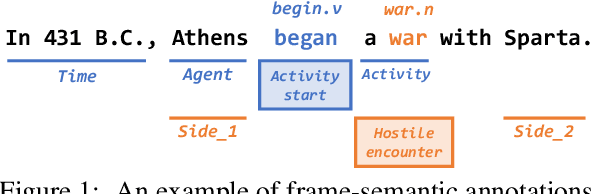
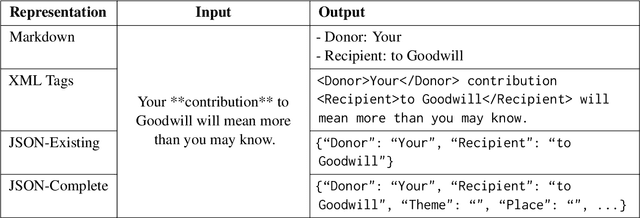
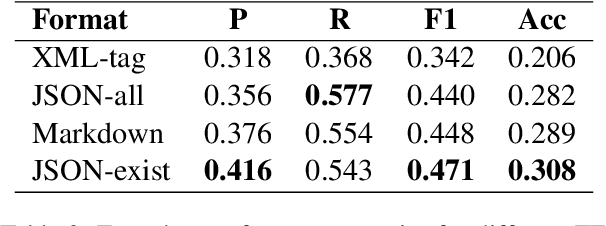
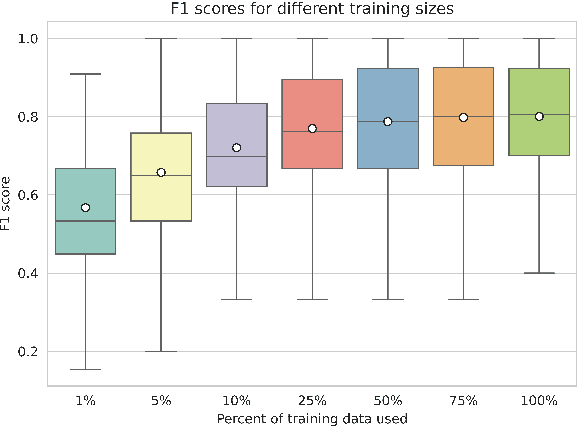
Frame-semantic parsing is a critical task in natural language understanding, yet the ability of large language models (LLMs) to extract frame-semantic arguments remains underexplored. This paper presents a comprehensive evaluation of LLMs on frame-semantic argument identification, analyzing the impact of input representation formats, model architectures, and generalization to unseen and out-of-domain samples. Our experiments, spanning models from 0.5B to 78B parameters, reveal that JSON-based representations significantly enhance performance, and while larger models generally perform better, smaller models can achieve competitive results through fine-tuning. We also introduce a novel approach to frame identification leveraging predicted frame elements, achieving state-of-the-art performance on ambiguous targets. Despite strong generalization capabilities, our analysis finds that LLMs still struggle with out-of-domain data.