 Add to Chrome
 Add to Firefox
 Add to Edge
Weight-sparse transformers have interpretable circuits
Nov 17, 2025
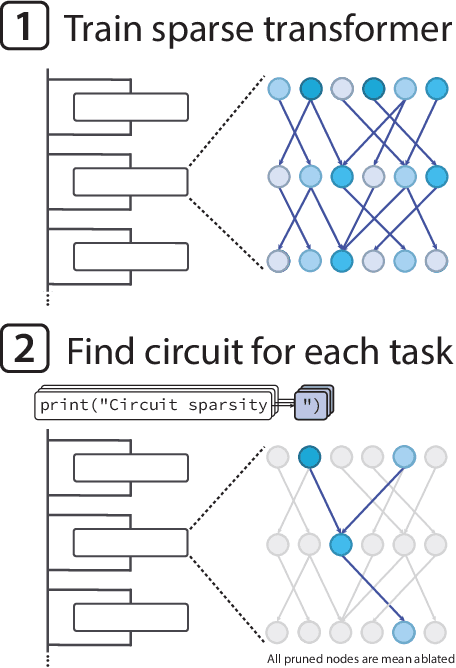
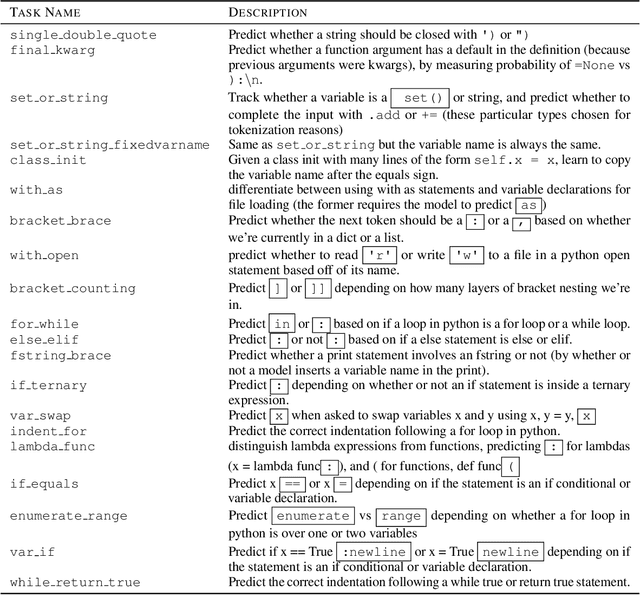
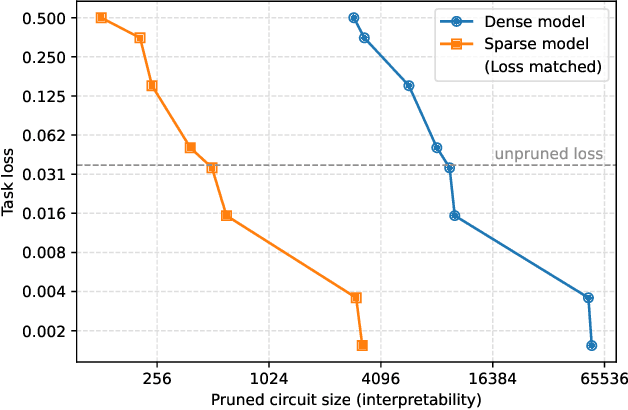
Finding human-understandable circuits in language models is a central goal of the field of mechanistic interpretability. We train models to have more understandable circuits by constraining most of their weights to be zeros, so that each neuron only has a few connections. To recover fine-grained circuits underlying each of several hand-crafted tasks, we prune the models to isolate the part responsible for the task. These circuits often contain neurons and residual channels that correspond to natural concepts, with a small number of straightforwardly interpretable connections between them. We study how these models scale and find that making weights sparser trades off capability for interpretability, and scaling model size improves the capability-interpretability frontier. However, scaling sparse models beyond tens of millions of nonzero parameters while preserving interpretability remains a challenge. In addition to training weight-sparse models de novo, we show preliminary results suggesting our method can also be adapted to explain existing dense models. Our work produces circuits that achieve an unprecedented level of human understandability and validates them with considerable rigor.

GPT-4o System Card
Oct 25, 2024GPT-4o is an autoregressive omni model that accepts as input any combination of text, audio, image, and video, and generates any combination of text, audio, and image outputs. It's trained end-to-end across text, vision, and audio, meaning all inputs and outputs are processed by the same neural network. GPT-4o can respond to audio inputs in as little as 232 milliseconds, with an average of 320 milliseconds, which is similar to human response time in conversation. It matches GPT-4 Turbo performance on text in English and code, with significant improvement on text in non-English languages, while also being much faster and 50\% cheaper in the API. GPT-4o is especially better at vision and audio understanding compared to existing models. In line with our commitment to building AI safely and consistent with our voluntary commitments to the White House, we are sharing the GPT-4o System Card, which includes our Preparedness Framework evaluations. In this System Card, we provide a detailed look at GPT-4o's capabilities, limitations, and safety evaluations across multiple categories, focusing on speech-to-speech while also evaluating text and image capabilities, and measures we've implemented to ensure the model is safe and aligned. We also include third-party assessments on dangerous capabilities, as well as discussion of potential societal impacts of GPT-4o's text and vision capabilities.