 Add to Chrome
 Add to Firefox
 Add to Edge
Authoring and Management of Transparent Research Integrity Assessments of Randomised Clinical Trial Publications Using LLM-assisted Tools and Provenance Knowledge Graphs
Aug 07, 2026
Systematic reviews of Randomised Controlled Trials (RCTs) are routinely used as evidence for clinical care guidelines. Such evidence has to meet high research integrity standards to prevent low quality or false research outputs influencing the clinical care. However, assessing research integrity of published RCTs is a complex process requiring manual effort, and potentially resulting in diverse opinions of the human assessors. This paper describes INSPECT-AI, an LLM-based interactive tool that assists human reviewers with research integrity assessments of published RCTs based on the community approved INSPECT-SR framework, and the Research Integrity Provenance and Evidence ontology (RIPE-O) for documenting the provenance of the assessment process. In addition, we present the Research Integrity Provenance and Evidence knowledge graph (RIPE-KG), an initial set of 140 expert research integrity assessments of 95 RCT publications generated by INSPECT-AI and described using RIPE-O.

Meta-Reinforcement Learning for Adaptive Motor Control in Changing Robot Dynamics and Environments
Jan 19, 2021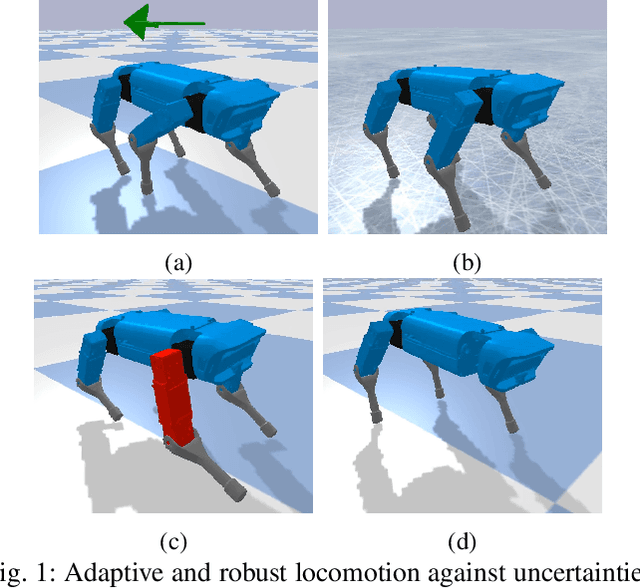
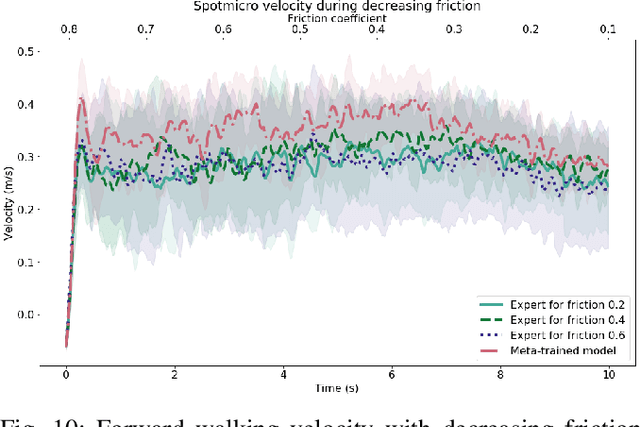
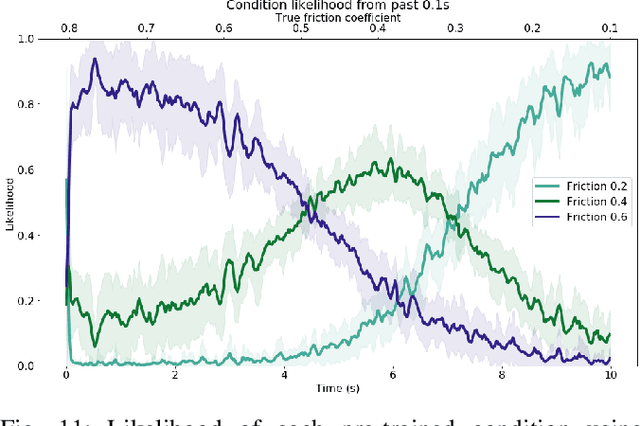
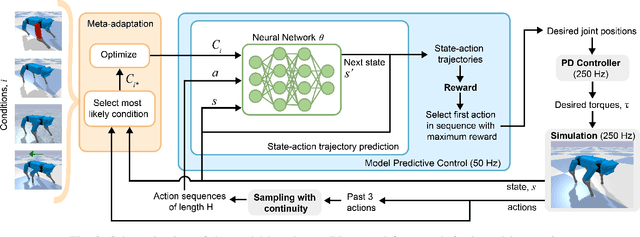
This work developed a meta-learning approach that adapts the control policy on the fly to different changing conditions for robust locomotion. The proposed method constantly updates the interaction model, samples feasible sequences of actions of estimated the state-action trajectories, and then applies the optimal actions to maximize the reward. To achieve online model adaptation, our proposed method learns different latent vectors of each training condition, which are selected online given the newly collected data. Our work designs appropriate state space and reward functions, and optimizes feasible actions in an MPC fashion which are then sampled directly in the joint space considering constraints, hence requiring no prior design of specific walking gaits. We further demonstrate the robot's capability of detecting unexpected changes during interaction and adapting control policies quickly. The extensive validation on the SpotMicro robot in a physics simulation shows adaptive and robust locomotion skills under varying ground friction, external pushes, and different robot models including hardware faults and changes.