 Add to Chrome
 Add to Firefox
 Add to Edge
Diffusion-Driven State Space Models
Jun 19, 2026
In many domains, practitioners seek models that produce accurate forecasts while faithfully capturing latent system dynamics. Existing approaches typically sacrifice one of these goals: deep state space models often assume Gaussian latent transitions, limiting fit and forecasting, while diffusion models are highly expressive but lack principled inference for the underlying dynamics. To combine the strengths of both, we introduce the Diffusion-Driven State Space Model (DDSSM), which replaces the conventional Gaussian transition distribution with a diffusion model. Our DDSSM resolves the open problem of how to jointly train an autoencoder and a diffusion model on sequential data, thereby extending the literature on latent diffusion models for time series. Moreover, we find that the DDSSM empirically outperforms a state-of-the-art deep SSM at fitting and forecasting a simulated time series with multimodal transitions.

Vectorized Computation of Euler Characteristic Functions and Transforms
Nov 05, 2025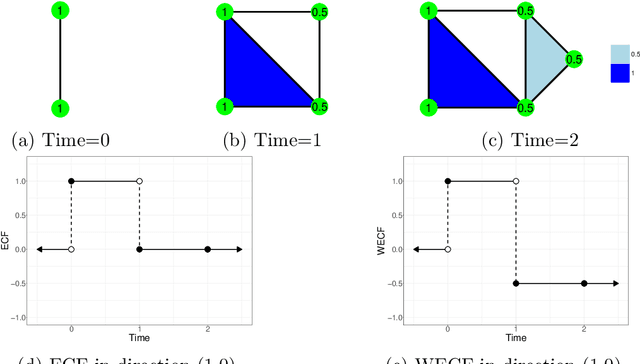
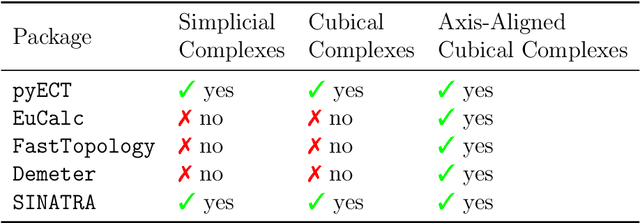
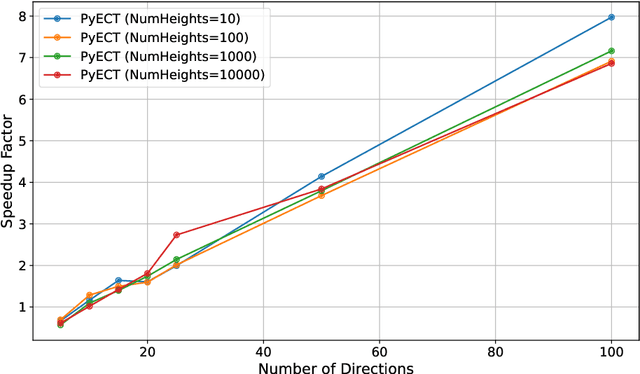
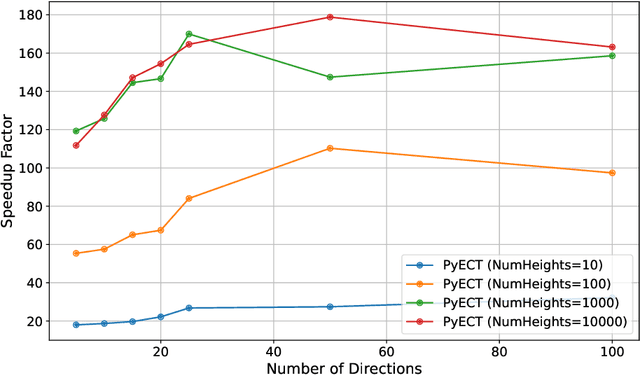
The weighted Euler characteristic transform (WECT) and Euler characteristic function (ECF) have proven to be useful tools in a variety of applications. However, current methods for computing these functions are neither optimized for speed nor do they scale to higher-dimensional settings. In this work, we present a vectorized framework for computing such topological transforms using tensor operations, which is highly optimized for GPU architectures and works in full generality across geometric simplicial complexes (or cubical complexes) of arbitrary dimension. Experimentally, the framework demonstrates significant speedups (up to $180 \times$) over existing methods when computing the WECT and ECF across a variety of image datasets. Computation of these transforms is implemented in a publicly available Python package called pyECT.