 Add to Chrome
 Add to Firefox
 Add to Edge
Vectorized Computation of Euler Characteristic Functions and Transforms
Nov 05, 2025
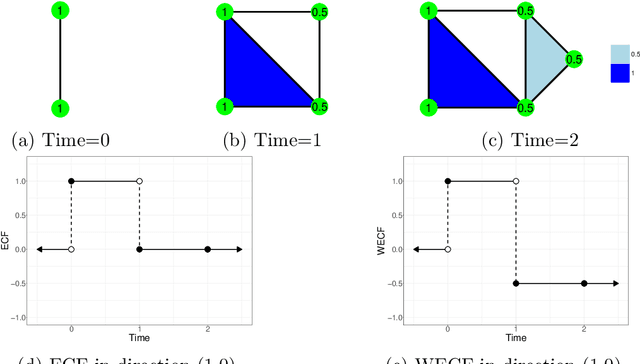
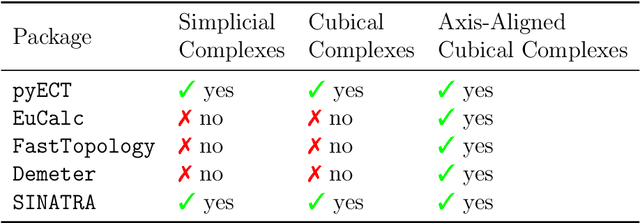
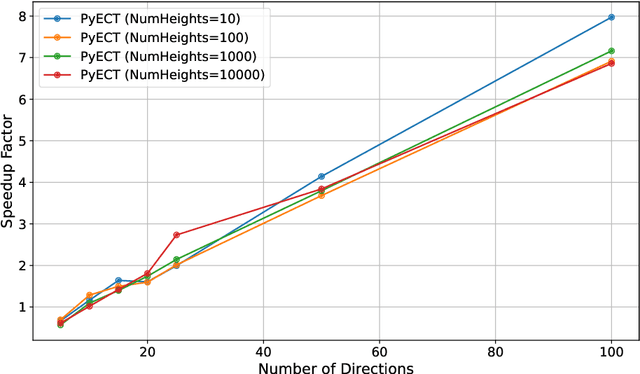
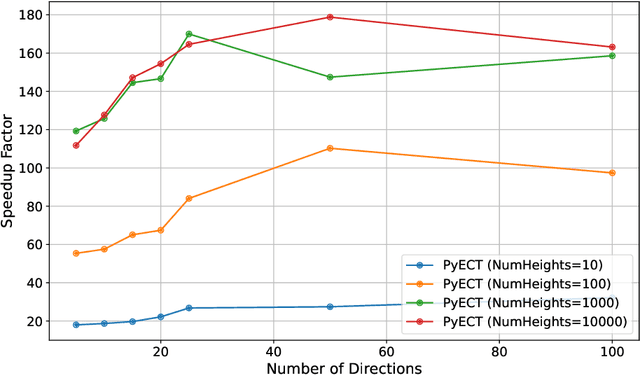
The weighted Euler characteristic transform (WECT) and Euler characteristic function (ECF) have proven to be useful tools in a variety of applications. However, current methods for computing these functions are neither optimized for speed nor do they scale to higher-dimensional settings. In this work, we present a vectorized framework for computing such topological transforms using tensor operations, which is highly optimized for GPU architectures and works in full generality across geometric simplicial complexes (or cubical complexes) of arbitrary dimension. Experimentally, the framework demonstrates significant speedups (up to $180 \times$) over existing methods when computing the WECT and ECF across a variety of image datasets. Computation of these transforms is implemented in a publicly available Python package called pyECT.

The Manifold Density Function: An Intrinsic Method for the Validation of Manifold Learning
Feb 14, 2024
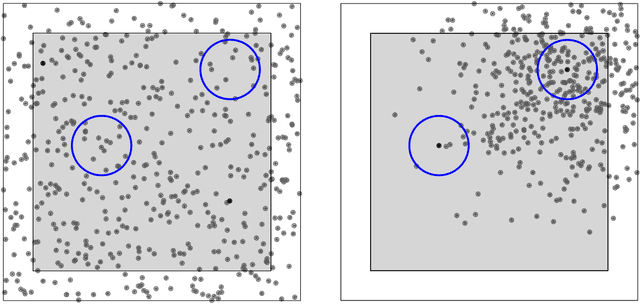

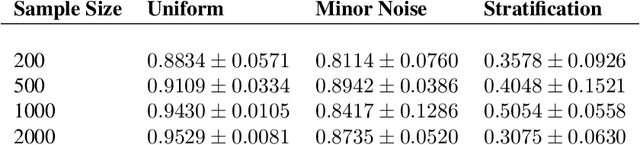
We introduce the manifold density function, which is an intrinsic method to validate manifold learning techniques. Our approach adapts and extends Ripley's $K$-function, and categorizes in an unsupervised setting the extent to which an output of a manifold learning algorithm captures the structure of a latent manifold. Our manifold density function generalizes to broad classes of Riemannian manifolds. In particular, we extend the manifold density function to general two-manifolds using the Gauss-Bonnet theorem, and demonstrate that the manifold density function for hypersurfaces is well approximated using the first Laplacian eigenvalue. We prove desirable convergence and robustness properties.