 Add to Chrome
 Add to Firefox
 Add to Edge
ModTrack: Sensor-Agnostic Multi-View Tracking via Identity-Informed PHD Filtering with Covariance Propagation
Mar 16, 2026
Multi-View Multi-Object Tracking (MV-MOT) aims to localize and maintain consistent identities of objects observed by multiple sensors. This task is challenging, as viewpoint changes and occlusion disrupt identity consistency across views and time. Recent end-to-end approaches address this by jointly learning 2D Bird's Eye View (BEV) representations and identity associations, achieving high tracking accuracy. However, these methods offer no principled uncertainty accounting and remain tightly coupled to their training configuration, limiting generalization across sensor layouts, modalities, or datasets without retraining. We propose ModTrack, a modular MV-MOT system that matches end-to-end performance while providing cross-modal, sensor-agnostic generalization and traceable uncertainty. ModTrack confines learning methods to just the \textit{Detection and Feature Extraction} stage of the MV-MOT pipeline, performing all fusion, association, and tracking with closed-form analytical methods. Our design reduces each sensor's output to calibrated position-covariance pairs $(\mathbf{z}, R)$; cross-view clustering and precision-weighted fusion then yield unified estimates $(\hat{\mathbf{z}}, \hat{R})$ for identity assignment and temporal tracking. A feedback-coupled, identity-informed Gaussian Mixture Probability Hypothesis Density (GM-PHD) filter with HMM motion modes uses these fused estimates to maintain identities under missed detections and heavy occlusion. ModTrack achieves 95.5 IDF1 and 91.4 MOTA on \textit{WildTrack}, surpassing all prior modular methods by over 21 points and rivaling the state-of-the-art end-to-end methods while providing deployment flexibility they cannot. Specifically, the same tracker core transfers unchanged to \textit{MultiviewX} and \textit{RadarScenes}, with only perception-module replacement required to extend to new domains and sensor modalities.

Learning machines for health and beyond
Mar 02, 2023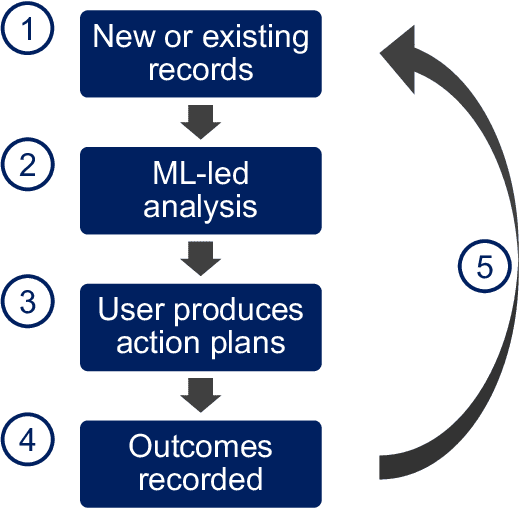
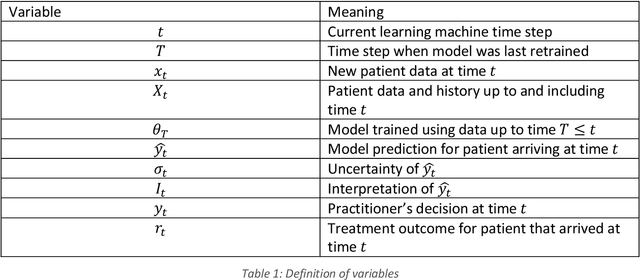

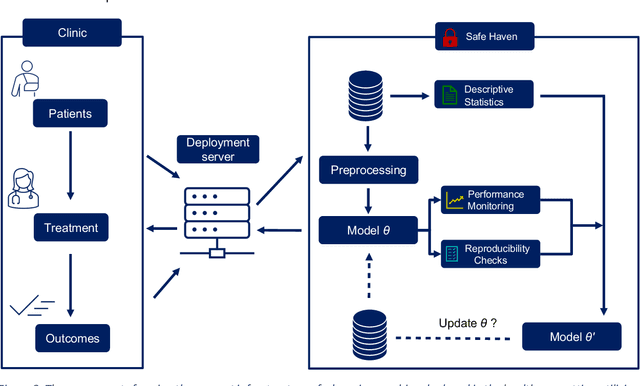
Machine learning techniques are effective for building predictive models because they are good at identifying patterns in large datasets. Development of a model for complex real life problems often stops at the point of publication, proof of concept or when made accessible through some mode of deployment. However, a model in the medical domain risks becoming obsolete as soon as patient demographic changes. The maintenance and monitoring of predictive models post-publication is crucial to guarantee their safe and effective long term use. As machine learning techniques are effectively trained to look for patterns in available datasets, the performance of a model for complex real life problems will not peak and remain fixed at the point of publication or even point of deployment. Rather, data changes over time, and they also changed when models are transported to new places to be used by new demography.