 Add to Chrome
 Add to Firefox
 Add to Edge
Pattern recognition in complex systems via vector-field representations of spatio-temporal data
Dec 18, 2025
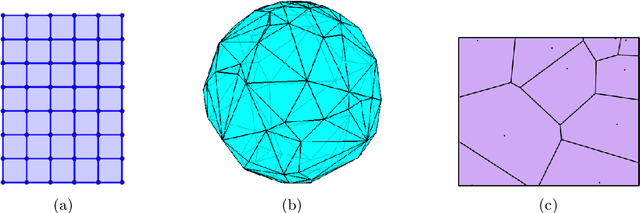
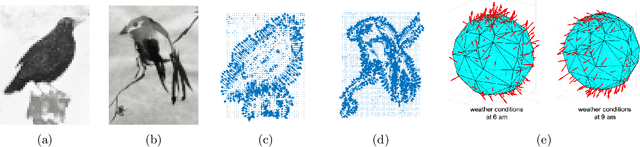
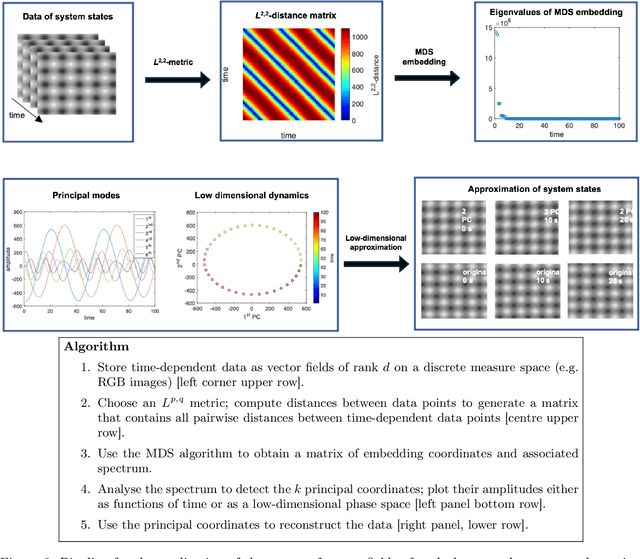
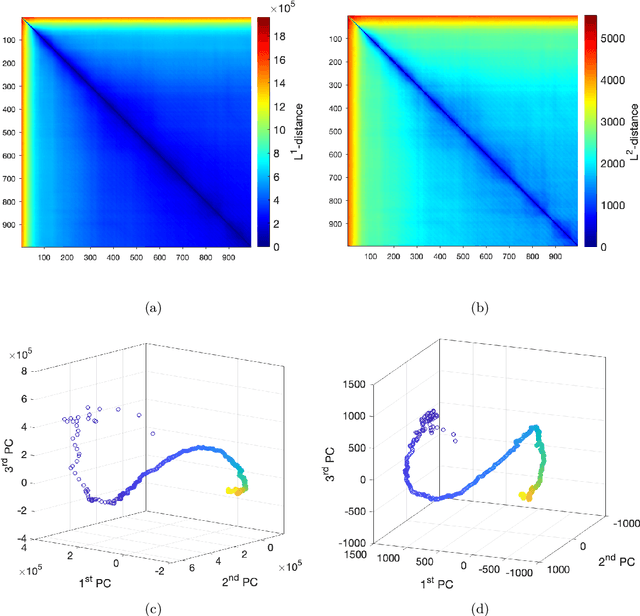
A complex system comprises multiple interacting entities whose interdependencies form a unified whole, exhibiting emergent behaviours not present in individual components. Examples include the human brain, living cells, soft matter, Earth's climate, ecosystems, and the economy. These systems exhibit high-dimensional, non-linear dynamics, making their modelling, classification, and prediction particularly challenging. Advances in information technology have enabled data-driven approaches to studying such systems. However, the sheer volume and complexity of spatio-temporal data often hinder traditional methods like dimensionality reduction, phase-space reconstruction, and attractor characterisation. This paper introduces a geometric framework for analysing spatio-temporal data from complex systems, grounded in the theory of vector fields over discrete measure spaces. We propose a two-parameter family of metrics suitable for data analysis and machine learning applications. The framework supports time-dependent images, image gradients, and real- or vector-valued functions defined on graphs and simplicial complexes. We validate our approach using data from numerical simulations of biological and physical systems on flat and curved domains. Our results show that the proposed metrics, combined with multidimensional scaling, effectively address key analytical challenges. They enable dimensionality reduction, mode decomposition, phase-space reconstruction, and attractor characterisation. Our findings offer a robust pathway for understanding complex dynamical systems, especially in contexts where traditional modelling is impractical but abundant experimental data are available.

A numerical measure of the instability of Mapper-type algorithms
Jun 04, 2019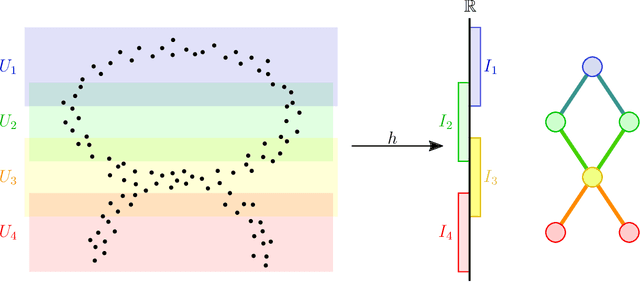
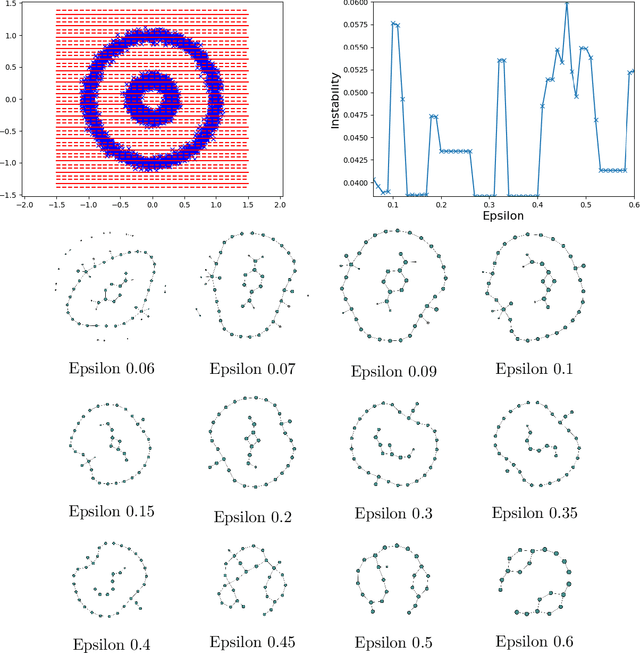
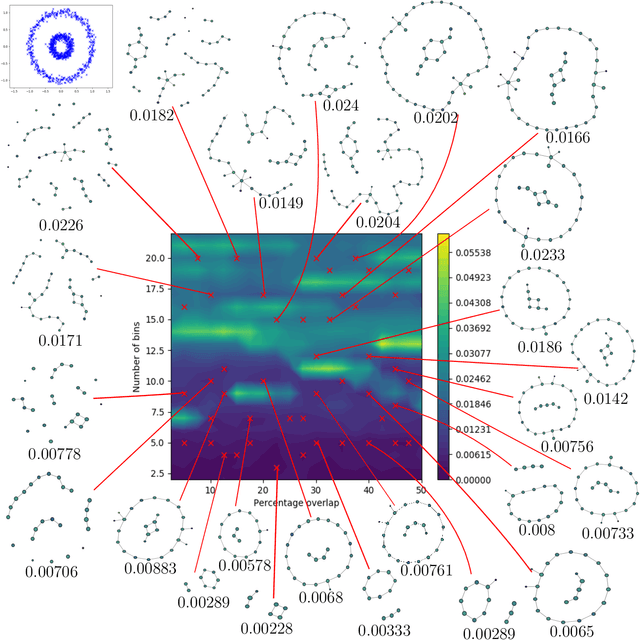
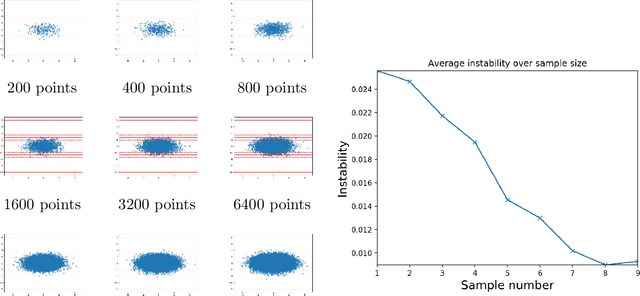
Mapper is an unsupervised machine learning algorithm generalising the notion of clustering to obtain a geometric description of a dataset. The procedure splits the data into possibly overlapping bins which are then clustered. The output of the algorithm is a graph where nodes represent clusters and edges represent the sharing of data points between two clusters. However, several parameters must be selected before applying Mapper and the resulting graph may vary dramatically with the choice of parameters. We define an intrinsic notion of Mapper instability that measures the variability of the output as a function of the choice of parameters required to construct a Mapper output. Our results and discussion are general and apply to all Mapper-type algorithms. We derive theoretical results that provide estimates for the instability and suggest practical ways to control it. We provide also experiments to illustrate our results and in particular we demonstrate that a reliable candidate Mapper output can be identified as a local minimum of instability regarded as a function of Mapper input parameters.
A self-organising eigenspace map for time series clustering
May 14, 2019


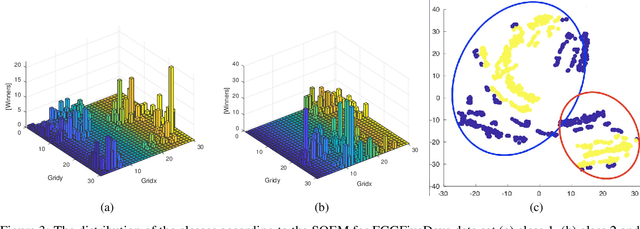
This paper presents a novel time series clustering method, the self-organising eigenspace map (SOEM), based on a generalisation of the well-known self-organising feature map (SOFM). The SOEM operates on the eigenspaces of the embedded covariance structures of time series which are related directly to modes in those time series. Approximate joint diagonalisation acts as a pseudo-metric across these spaces allowing us to generalise the SOFM to a neural network with matrix input. The technique is empirically validated against three sets of experiments; univariate and multivariate time series clustering, and application to (clustered) multi-variate time series forecasting. Results indicate that the technique performs a valid topologically ordered clustering of the time series. The clustering is superior in comparison to standard benchmarks when the data is non-aligned, gives the best clustering stage for when used in forecasting, and can be used with partial/non-overlapping time series, multivariate clustering and produces a topological representation of the time series objects.