 Add to Chrome
 Add to Firefox
 Add to Edge
A self-organising eigenspace map for time series clustering
May 14, 2019


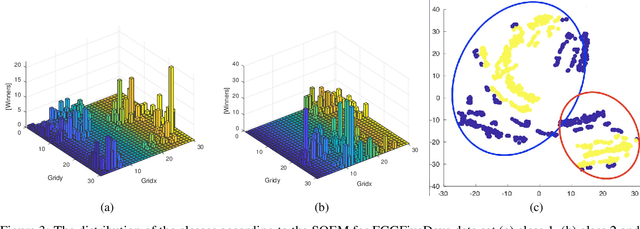
This paper presents a novel time series clustering method, the self-organising eigenspace map (SOEM), based on a generalisation of the well-known self-organising feature map (SOFM). The SOEM operates on the eigenspaces of the embedded covariance structures of time series which are related directly to modes in those time series. Approximate joint diagonalisation acts as a pseudo-metric across these spaces allowing us to generalise the SOFM to a neural network with matrix input. The technique is empirically validated against three sets of experiments; univariate and multivariate time series clustering, and application to (clustered) multi-variate time series forecasting. Results indicate that the technique performs a valid topologically ordered clustering of the time series. The clustering is superior in comparison to standard benchmarks when the data is non-aligned, gives the best clustering stage for when used in forecasting, and can be used with partial/non-overlapping time series, multivariate clustering and produces a topological representation of the time series objects.

Generic adaptation strategies for automated machine learning
Dec 27, 2018


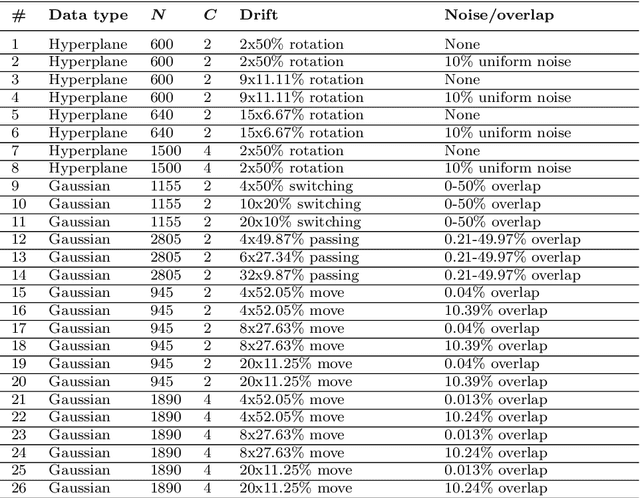
Automation of machine learning model development is increasingly becoming an established research area. While automated model selection and automated data pre-processing have been studied in depth, there is, however, a gap concerning automated model adaptation strategies when multiple strategies are available. Manually developing an adaptation strategy, including estimation of relevant parameters can be time consuming and costly. In this paper we address this issue by proposing generic adaptation strategies based on approaches from earlier works. Experimental results after using the proposed strategies with three adaptive algorithms on 36 datasets confirm their viability. These strategies often achieve better or comparable performance with custom adaptation strategies and naive methods such as repeatedly using only one adaptive mechanism.