 Add to Chrome
 Add to Firefox
 Add to Edge
Alignment-Guided Score Matching for Text-to-Image Alignment in Diffusion Models
May 28, 2026
Diffusion models generate highly realistic images but often struggle with precise text-image alignment. While recent post-training methods improve alignment using external rewards or human preference signals, their performance heavily depends on reward quality and does not directly address alignment within the diffusion process itself. Recent reward-free approaches such as SoftREPA demonstrate that optimizing soft text tokens via contrastive learning can effectively improve text-image representation alignment, outperforming standard parameter-efficient fine-tuning baselines. However, the contrastive formulation can excessively penalize negative pairs, which manifests as characteristic failure cases such as over-counting and repetition. To address this issue, we propose a lightweight, reward-free post-training method that refines soft tokens by integrating contrastive alignment guidance directly into the score-matching objective of diffusion models. By assigning alignment directions at the score level, our approach mitigates these limitations and yields more coherent and semantically faithful generations. Experiments show that our method matches SoftREPA while substantially improving its failure cases, achieving over 35% improvement in counting accuracy on the GenEval benchmark. Our method is seamlessly applicable to existing diffusion backbones (SD1.5, SDXL, and SD3), and is complementary to existing RL-based diffusion post-training methods. Project page: https://jaayeon.github.io/AGSM

Aligning Text to Image in Diffusion Models is Easier Than You Think
Mar 11, 2025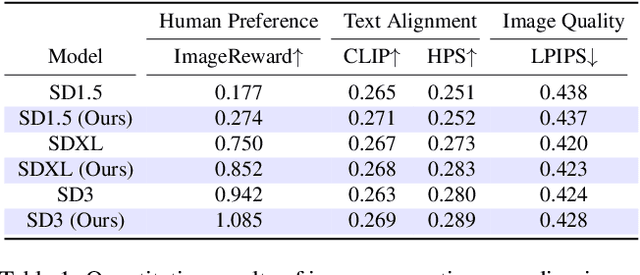
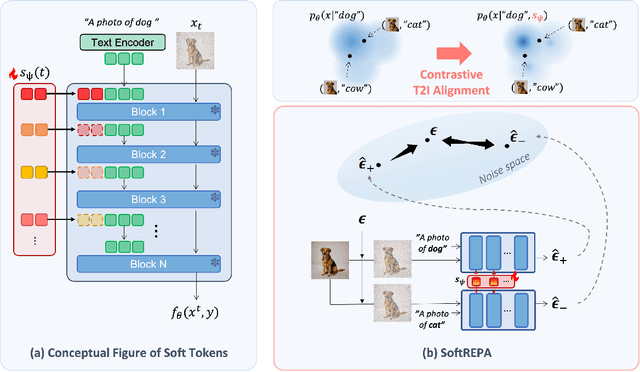
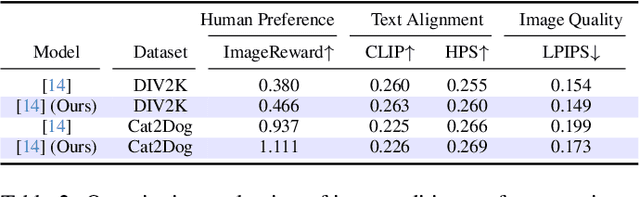
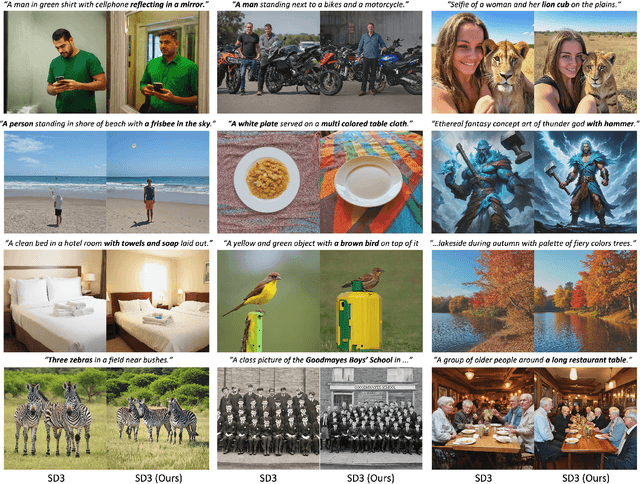
While recent advancements in generative modeling have significantly improved text-image alignment, some residual misalignment between text and image representations still remains. Although many approaches have attempted to address this issue by fine-tuning models using various reward models, etc., we revisit the challenge from the perspective of representation alignment-an approach that has gained popularity with the success of REPresentation Alignment (REPA). We first argue that conventional text-to-image (T2I) diffusion models, typically trained on paired image and text data (i.e., positive pairs) by minimizing score matching or flow matching losses, is suboptimal from the standpoint of representation alignment. Instead, a better alignment can be achieved through contrastive learning that leverages both positive and negative pairs. To achieve this efficiently even with pretrained models, we introduce a lightweight contrastive fine tuning strategy called SoftREPA that uses soft text tokens. This approach improves alignment with minimal computational overhead by adding fewer than 1M trainable parameters to the pretrained model. Our theoretical analysis demonstrates that our method explicitly increases the mutual information between text and image representations, leading to enhanced semantic consistency. Experimental results across text-to-image generation and text-guided image editing tasks validate the effectiveness of our approach in improving the semantic consistency of T2I generative models.
UNICORN: Ultrasound Nakagami Imaging via Score Matching and Adaptation
Mar 10, 2024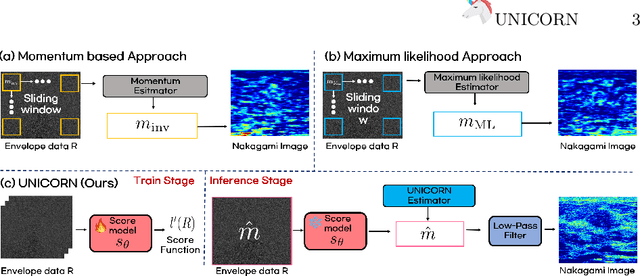
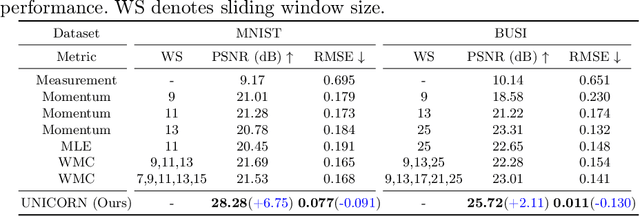
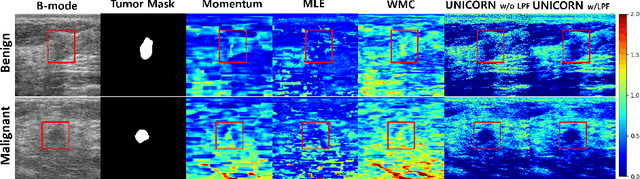
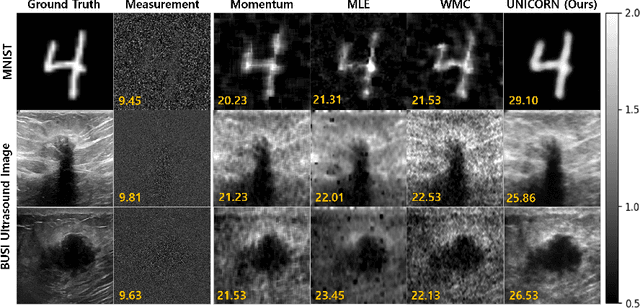
Nakagami imaging holds promise for visualizing and quantifying tissue scattering in ultrasound waves, with potential applications in tumor diagnosis and fat fraction estimation which are challenging to discern by conventional ultrasound B-mode images. Existing methods struggle with optimal window size selection and suffer from estimator instability, leading to degraded resolution images. To address this, here we propose a novel method called UNICORN (Ultrasound Nakagami Imaging via Score Matching and Adaptation), that offers an accurate, closed-form estimator for Nakagami parameter estimation in terms of the score function of ultrasonic envelope. Extensive experiments using simulation and real ultrasound RF data demonstrate UNICORN's superiority over conventional approaches in accuracy and resolution quality.