 Add to Chrome
 Add to Firefox
 Add to Edge
CMIP-Forge: An Agentic System that Retrieves, Computes, and Self-Reviews Climate Science
Jun 10, 2026
The Coupled Model Intercomparison Project Phase 6 (CMIP6) has generated thousands of peer-reviewed publications documenting model configurations, evaluation procedures, emergent constraints, and projection uncertainties. As the community transitions toward CMIP7, efficiently extracting and operationalizing this unstructured knowledge alongside live data analysis represents a critical bottleneck. Here we present CMIP-Forge, a hybrid retrieval-augmented generation (RAG) and autonomous analysis system that bridges the gap between scientific literature and Earth System Grid Federation (ESGF) data archives. The system pairs a curated corpus of 6,581 CMIP6-related open-access publications (101,828 indexed chunks) with an agentic pipeline in which a tool-augmented worker plans and executes Python workflows over live climate data, while a panel of independent reviewer models audits its methodology end to end. CMIP-Forge introduces a multi-layered Defense-in-Depth architecture that enforces physical and methodological invariants through executable mechanisms: Abstract Syntax Tree (AST) static analysis, audited scientific primitives, and an autonomous adversarial peer-review protocol. We demonstrate the system's capabilities through end-to-end autonomous research pipelines spanning atmospheric teleconnections, ocean dynamics, regional extremes, and global warming projections. An agentic analysis system grounded in peer-reviewed literature, constrained by automated code guardrails, and audited by an independent adversarial review loop can complete complex climate-research workflows autonomously. The same experiments expose concrete failure modes of the review loop (sycophantic regression, REVISE verdicts that are never resolved, and the submission of stub code for review), each diagnosable from the immutable telemetry and provenance record released with the article.

A Hierarchical Multi-Agent System for Autonomous Discovery in Geoscientific Data Archives
Feb 24, 2026The rapid accumulation of Earth science data has created a significant scalability challenge; while repositories like PANGAEA host vast collections of datasets, citation metrics indicate that a substantial portion remains underutilized, limiting data reusability. Here we present PANGAEA-GPT, a hierarchical multi-agent framework designed for autonomous data discovery and analysis. Unlike standard Large Language Model (LLM) wrappers, our architecture implements a centralized Supervisor-Worker topology with strict data-type-aware routing, sandboxed deterministic code execution, and self-correction via execution feedback, enabling agents to diagnose and resolve runtime errors. Through use-case scenarios spanning physical oceanography and ecology, we demonstrate the system's capacity to execute complex, multi-step workflows with minimal human intervention. This framework provides a methodology for querying and analyzing heterogeneous repository data through coordinated agent workflows.
Climate Knowledge in Large Language Models
Oct 09, 2025Large language models (LLMs) are increasingly deployed for climate-related applications, where understanding internal climatological knowledge is crucial for reliability and misinformation risk assessment. Despite growing adoption, the capacity of LLMs to recall climate normals from parametric knowledge remains largely uncharacterized. We investigate the capacity of contemporary LLMs to recall climate normals without external retrieval, focusing on a prototypical query: mean July 2-m air temperature 1991-2020 at specified locations. We construct a global grid of queries at 1{\deg} resolution land points, providing coordinates and location descriptors, and validate responses against ERA5 reanalysis. Results show that LLMs encode non-trivial climate structure, capturing latitudinal and topographic patterns, with root-mean-square errors of 3-6 {\deg}C and biases of $\pm$1 {\deg}C. However, spatially coherent errors remain, particularly in mountains and high latitudes. Performance degrades sharply above 1500 m, where RMSE reaches 5-13 {\deg}C compared to 2-4 {\deg}C at lower elevations. We find that including geographic context (country, city, region) reduces errors by 27% on average, with larger models being most sensitive to location descriptors. While models capture the global mean magnitude of observed warming between 1950-1974 and 2000-2024, they fail to reproduce spatial patterns of temperature change, which directly relate to assessing climate change. This limitation highlights that while LLMs may capture present-day climate distributions, they struggle to represent the regional and local expression of long-term shifts in temperature essential for understanding climate dynamics. Our evaluation framework provides a reproducible benchmark for quantifying parametric climate knowledge in LLMs and complements existing climate communication assessments.
Accelerating Earth Science Discovery via Multi-Agent LLM Systems
Mar 07, 2025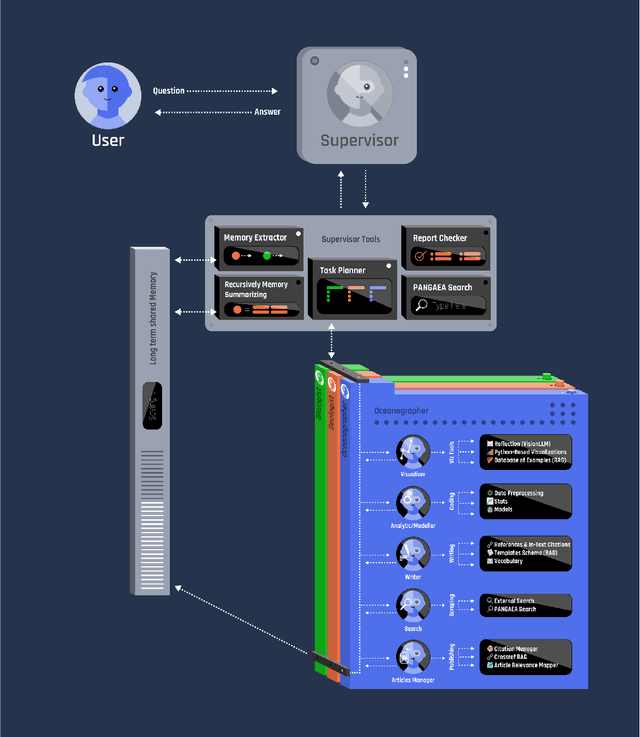
This Perspective explores the transformative potential of Multi-Agent Systems (MAS) powered by Large Language Models (LLMs) in the geosciences. Users of geoscientific data repositories face challenges due to the complexity and diversity of data formats, inconsistent metadata practices, and a considerable number of unprocessed datasets. MAS possesses transformative potential for improving scientists' interaction with geoscientific data by enabling intelligent data processing, natural language interfaces, and collaborative problem-solving capabilities. We illustrate this approach with "PANGAEA GPT", a specialized MAS pipeline integrated with the diverse PANGAEA database for Earth and Environmental Science, demonstrating how MAS-driven workflows can effectively manage complex datasets and accelerate scientific discovery. We discuss how MAS can address current data challenges in geosciences, highlight advancements in other scientific fields, and propose future directions for integrating MAS into geoscientific data processing pipelines. In this Perspective, we show how MAS can fundamentally improve data accessibility, promote cross-disciplinary collaboration, and accelerate geoscientific discoveries.