 Add to Chrome
 Add to Firefox
 Add to Edge
A Hierarchical Multi-Agent System for Autonomous Discovery in Geoscientific Data Archives
Feb 24, 2026
The rapid accumulation of Earth science data has created a significant scalability challenge; while repositories like PANGAEA host vast collections of datasets, citation metrics indicate that a substantial portion remains underutilized, limiting data reusability. Here we present PANGAEA-GPT, a hierarchical multi-agent framework designed for autonomous data discovery and analysis. Unlike standard Large Language Model (LLM) wrappers, our architecture implements a centralized Supervisor-Worker topology with strict data-type-aware routing, sandboxed deterministic code execution, and self-correction via execution feedback, enabling agents to diagnose and resolve runtime errors. Through use-case scenarios spanning physical oceanography and ecology, we demonstrate the system's capacity to execute complex, multi-step workflows with minimal human intervention. This framework provides a methodology for querying and analyzing heterogeneous repository data through coordinated agent workflows.

Accelerating Earth Science Discovery via Multi-Agent LLM Systems
Mar 07, 2025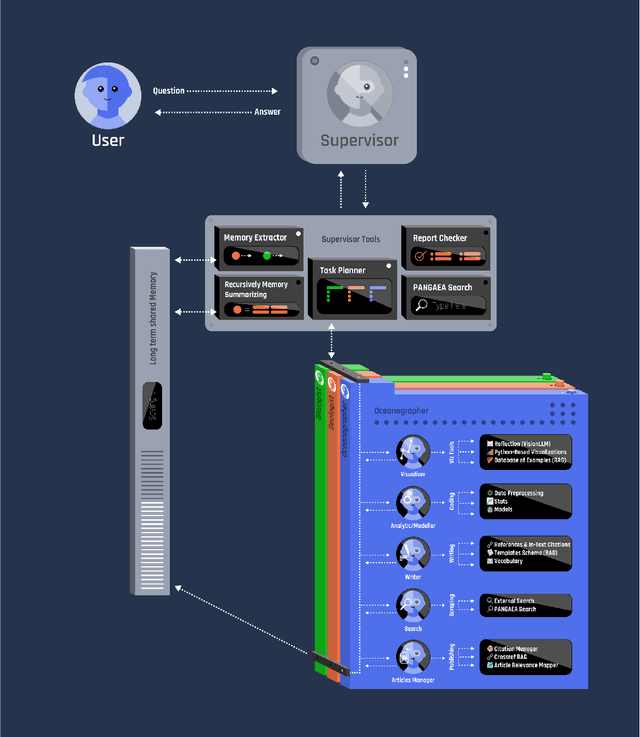
This Perspective explores the transformative potential of Multi-Agent Systems (MAS) powered by Large Language Models (LLMs) in the geosciences. Users of geoscientific data repositories face challenges due to the complexity and diversity of data formats, inconsistent metadata practices, and a considerable number of unprocessed datasets. MAS possesses transformative potential for improving scientists' interaction with geoscientific data by enabling intelligent data processing, natural language interfaces, and collaborative problem-solving capabilities. We illustrate this approach with "PANGAEA GPT", a specialized MAS pipeline integrated with the diverse PANGAEA database for Earth and Environmental Science, demonstrating how MAS-driven workflows can effectively manage complex datasets and accelerate scientific discovery. We discuss how MAS can address current data challenges in geosciences, highlight advancements in other scientific fields, and propose future directions for integrating MAS into geoscientific data processing pipelines. In this Perspective, we show how MAS can fundamentally improve data accessibility, promote cross-disciplinary collaboration, and accelerate geoscientific discoveries.