 Add to Chrome
 Add to Firefox
 Add to Edge
Hybrid Classical-Quantum Variational Autoencoder for Neural Topic Modeling
Jun 11, 2026
Neural topic models enable scalable semantic discovery, but their integration with quantum hardware remains largely unexplored. We present a proof-of-concept hybrid classical-quantum variational autoencoder (VAE) for topic modeling, embedding parameterized quantum circuits within the VAE inference network while retaining a classical topic-word decoder. To address the resource constraints of quantum hardware, we propose a modified Gaussian Softmax posterior that decouples latent space dimensionality from the number of topics to be extracted, enabling the model to operate with a low-resource 10-qubit quantum device. On the AgNews dataset, the hybrid VAE outperforms state-of-the-art neural topic models (NTMs), reaching a $C_v$ coherence score of 0.71 and an NPMI score of 0.20 while preserving high topic diversity. For comparison, we also construct a fully classical variant, which also outperforms state-of-the-art models on AgNews and exhibits clear class separation in the latent space. These results demonstrate that hybrid VAEs are computationally viable even on NISQ-era devices and represent a promising direction for quantum-enhanced topic modeling.

Quantum-inspired Embeddings Projection and Similarity Metrics for Representation Learning
Jan 08, 2025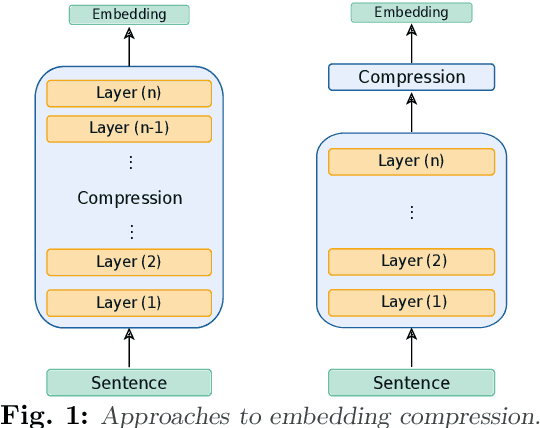
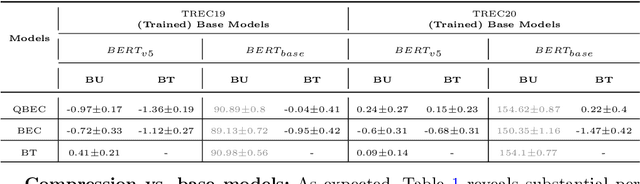
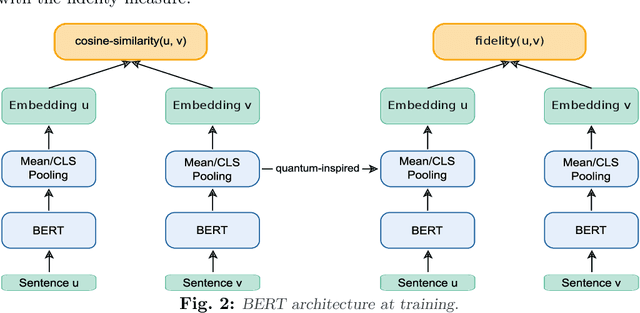
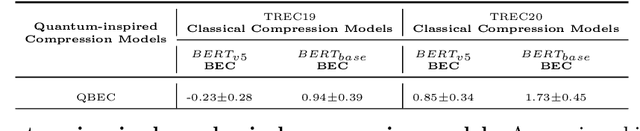
Over the last decade, representation learning, which embeds complex information extracted from large amounts of data into dense vector spaces, has emerged as a key technique in machine learning. Among other applications, it has been a key building block for large language models and advanced computer vision systems based on contrastive learning. A core component of representation learning systems is the projection head, which maps the original embeddings into different, often compressed spaces, while preserving the similarity relationship between vectors. In this paper, we propose a quantum-inspired projection head that includes a corresponding quantum-inspired similarity metric. Specifically, we map classical embeddings onto quantum states in Hilbert space and introduce a quantum circuit-based projection head to reduce embedding dimensionality. To evaluate the effectiveness of this approach, we extended the BERT language model by integrating our projection head for embedding compression. We compared the performance of embeddings, which were compressed using our quantum-inspired projection head, with those compressed using a classical projection head on information retrieval tasks using the TREC 2019 and TREC 2020 Deep Learning benchmarks. The results demonstrate that our quantum-inspired method achieves competitive performance relative to the classical method while utilizing 32 times fewer parameters. Furthermore, when trained from scratch, it notably excels, particularly on smaller datasets. This work not only highlights the effectiveness of the quantum-inspired approach but also emphasizes the utility of efficient, ad hoc low-entanglement circuit simulations within neural networks as a powerful quantum-inspired technique.