 Add to Chrome
 Add to Firefox
 Add to Edge
Statistical Properties of Training & Generalization
Jun 18, 2026
Deep learning has managed to evade numerous intuitions from classical statistics to achieve unprecedented performance on a number of real-world tasks. In this article, we investigate the key features and surprises of deep learning from a physics-informed perspective, taking care to point out and justify where possible the many choices inherent in constructing a deep learning model. In particular, we review the phenomenon of neural scaling laws and discuss their interplay with the constraints and inductive biases which may be present when applying machine learning to problems in physics.

Phase Transitions in Attention: A Bayesian Theory of Copy Head Emergence
Jun 10, 2026Attention is the key mechanism underlying in-context learning in transformers, and attention patterns have been observed empirically to emerge abruptly during training. We present a Bayesian theory of feature learning in attention; we then focus on how the copy subcircuit in the first layer of an induction head is learned by analyzing a single-layer softmax attention network trained on a copy task. We derive a closed-form posterior over the attention matrix and reduce it to a low-dimensional order parameter space. This reduction reveals a phase transition in the amount of training data, which we verify using both Bayesian sampling and standard training with Adam. We contrast our results with linear attention and find that softmax attention exhibits a \emph{first-order phase transition} while in linear attention an initial \emph{second-order phase transition} is followed by a smooth, continuous evolution toward the structured attention pattern (\emph{crossover}). Our work provides a first-principles theoretical account of the abrupt emergence of the copy subcircuit, reminiscent of the one observed in training large language models.
Symmetric Kernels with Non-Symmetric Data: A Data-Agnostic Learnability Bound
Jun 04, 2024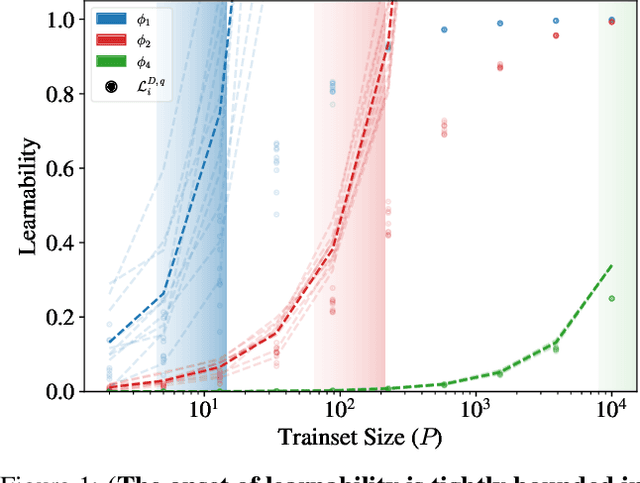
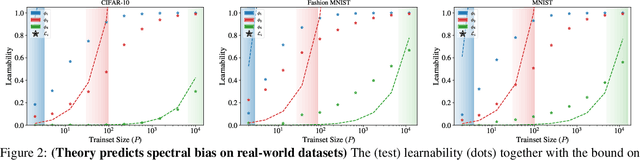
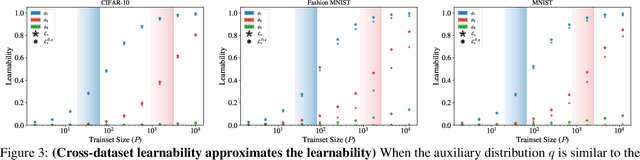
Kernel ridge regression (KRR) and Gaussian processes (GPs) are fundamental tools in statistics and machine learning with recent applications to highly over-parameterized deep neural networks. The ability of these tools to learn a target function is directly related to the eigenvalues of their kernel sampled on the input data. Targets having support on higher eigenvalues are more learnable. While kernels are often highly symmetric objects, the data is often not. Thus kernel symmetry seems to have little to no bearing on the above eigenvalues or learnability, making spectral analysis on real-world data challenging. Here, we show that contrary to this common lure, one may use eigenvalues and eigenfunctions associated with highly idealized data-measures to bound learnability on realistic data. As a demonstration, we give a theoretical lower bound on the sample complexity of copying heads for kernels associated with generic transformers acting on natural language.
Towards Understanding Inductive Bias in Transformers: A View From Infinity
Feb 07, 2024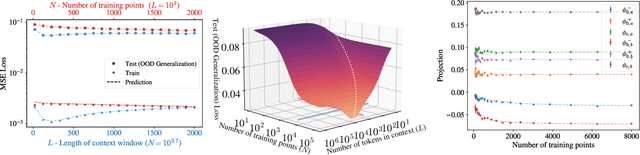
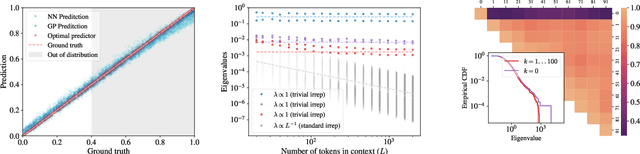
We study inductive bias in Transformers in the infinitely over-parameterized Gaussian process limit and argue transformers tend to be biased towards more permutation symmetric functions in sequence space. We show that the representation theory of the symmetric group can be used to give quantitative analytical predictions when the dataset is symmetric to permutations between tokens. We present a simplified transformer block and solve the model at the limit, including accurate predictions for the learning curves and network outputs. We show that in common setups, one can derive tight bounds in the form of a scaling law for the learnability as a function of the context length. Finally, we argue WikiText dataset, does indeed possess a degree of permutation symmetry.