 Add to Chrome
 Add to Firefox
 Add to Edge
Precomputing Multi-Agent Path Replanning using Temporal Flexibility: A Case Study on the Dutch Railway Network
Jan 08, 2026
Executing a multi-agent plan can be challenging when an agent is delayed, because this typically creates conflicts with other agents. So, we need to quickly find a new safe plan. Replanning only the delayed agent often does not result in an efficient plan, and sometimes cannot even yield a feasible plan. On the other hand, replanning other agents may lead to a cascade of changes and delays. We show how to efficiently replan by tracking and using the temporal flexibility of other agents while avoiding cascading delays. This flexibility is the maximum delay an agent can take without changing the order of or further delaying more agents. Our algorithm, FlexSIPP, precomputes all possible plans for the delayed agent, also returning the changes for the other agents, for any single-agent delay within the given scenario. We demonstrate our method in a real-world case study of replanning trains in the densely-used Dutch railway network. Our experiments show that FlexSIPP provides effective solutions, relevant to real-world adjustments, and within a reasonable timeframe.

Revisiting Landmarks: Learning from Previous Plans to Generalize over Problem Instances
Aug 29, 2025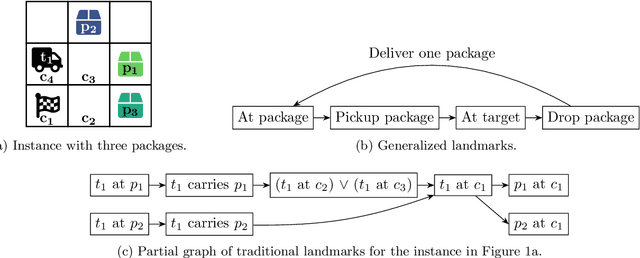

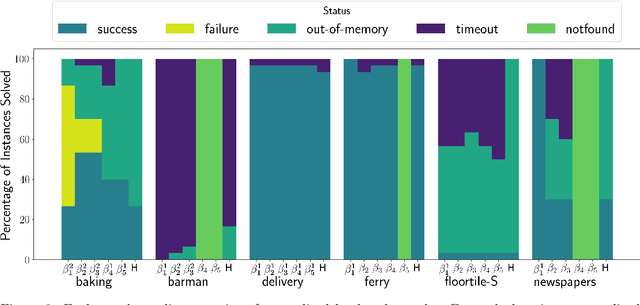
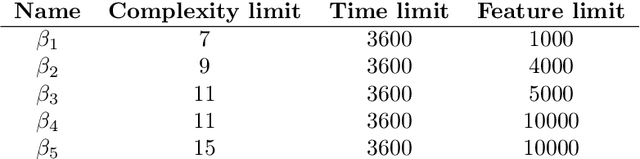
We propose a new framework for discovering landmarks that automatically generalize across a domain. These generalized landmarks are learned from a set of solved instances and describe intermediate goals for planning problems where traditional landmark extraction algorithms fall short. Our generalized landmarks extend beyond the predicates of a domain by using state functions that are independent of the objects of a specific problem and apply to all similar objects, thus capturing repetition. Based on these functions, we construct a directed generalized landmark graph that defines the landmark progression, including loop possibilities for repetitive subplans. We show how to use this graph in a heuristic to solve new problem instances of the same domain. Our results show that the generalized landmark graphs learned from a few small instances are also effective for larger instances in the same domain. If a loop that indicates repetition is identified, we see a significant improvement in heuristic performance over the baseline. Generalized landmarks capture domain information that is interpretable and useful to an automated planner. This information can be discovered from a small set of plans for the same domain.