 Add to Chrome
 Add to Firefox
 Add to Edge
Behavioral Data-Driven Optimal Trajectory Generation for Rotary Cranes
May 14, 2026
With the growth of the construction industry and the global shortage of skilled labor, the automation of crane control has become increasingly important for safe and efficient operations. A central challenge in automatic crane control is the reduction of load oscillations during motion, which is primarily addressed through appropriate slewing trajectories. In this context, classical model-based control methods rely on accurate dynamical models and expert tuning, and often struggle to meet safety and precision requirements, while many learning-based approaches require large data sets and significant computational resources. This paper proposes a behavioral data-driven framework for generating open-loop slewing trajectories for rotary cranes that suppress load sway while reducing operation time and energy consumption. The approach builds on Willems' fundamental lemma and its generalizations, to bypass explicit system modeling and operate directly on measured input-output data. A practical workflow is presented in this paper to reduce the need for expert knowledge. Despite the underactuated nature of the crane dynamics, the method identifies a nonparametric representation of the system behavior and generates smooth, optimal trajectories using limited data and convex optimization. The proposed trajectory generation method is validated on a laboratory crane setup and compared against an established model-based approach, achieving up to 35% reduction in load sway, 43% reduction in tracking error, and 50% reduction in travel time.

Impact of Leg Stiffness on Energy Efficiency in One Legged Hopping
Jan 07, 2025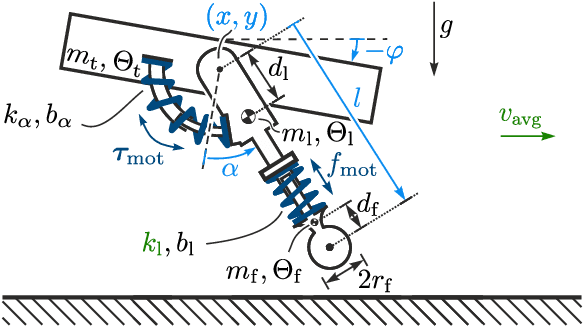
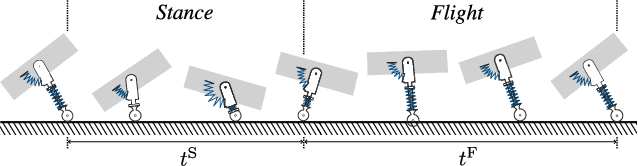
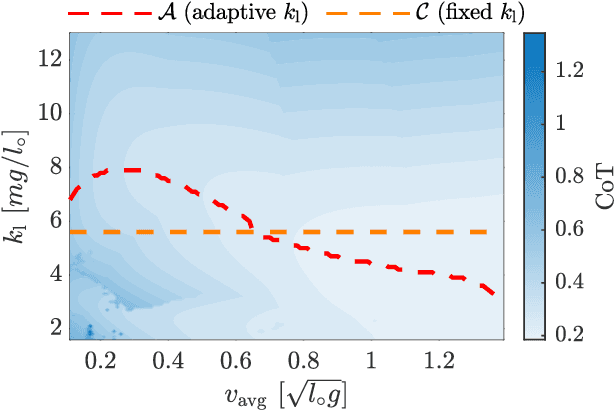
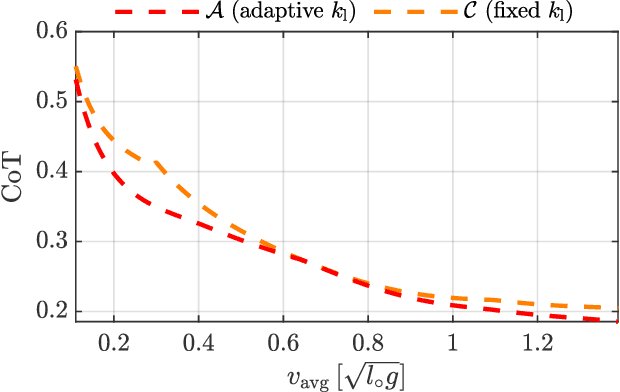
In the fields of robotics and biomechanics, the integration of elastic elements such as springs and tendons in legged systems has long been recognized for enabling energy-efficient locomotion. Yet, a significant challenge persists: designing a robotic leg that perform consistently across diverse operating conditions, especially varying average forward speeds. It remains unclear whether, for such a range of operating conditions, the stiffness of the elastic elements needs to be varied or if a similar performance can be obtained by changing the motion and actuation while keeping the stiffness fixed. This work explores the influence of the leg stiffness on the energy efficiency of a monopedal robot through an extensive parametric study of its periodic hopping motion. To this end, we formulate an optimal control problem parameterized by average forward speed and leg stiffness, solving it numerically using direct collocation. Our findings indicate that, compared to the use of a fixed stiffness, employing variable stiffness in legged systems improves energy efficiency by 20 % maximally and by 6.8 % on average across a range of speeds.