 Add to Chrome
 Add to Firefox
 Add to Edge
Modeling Doppler Shifts in Radial-Velocity Data with Deep Learning toward Earth-mass Exoplanet Detection
Jun 16, 2026
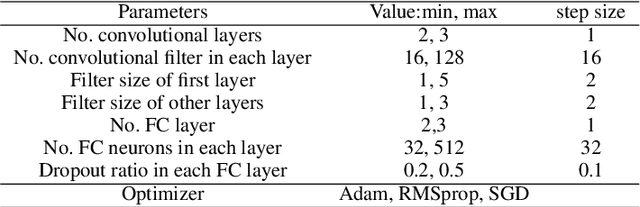
Detecting the tiny Doppler shifts induced by Earth-mass planets in stellar radial-velocity measurements remains extremely challenging due to stellar activity. Many deep-learning methods performing well on simulated data remain difficult to apply reliably on real stellar spectra. The aim of this work is to develop a deep-learning framework that generalizes to real, unseen spectra and improves the detectability of Earth-mass planets in radial-velocity data. We train artificial neural networks on HARPS-N solar spectra with injected planetary signals, using physics-motivated spectral representations based on flux and line-formation temperature, together with their velocity gradients. Two training strategies are explored: hold-out testing and cross-validation. Model robustness is enhanced through genetic-algorithm-based hyperparameter optimization, and predictive uncertainty is quantified using Monte Carlo dropout. Our most precise neural network model reliably retrieves, under the cross-validation strategy, the amplitudes, phases, and orbital periods of planetary signals with amplitudes greater than or equal to 25 cm/s and periods between 10 and 550 days. In addition, in all cases tested here, the successfully recovered signals correspond to the most significant peaks in the periodograms of the Doppler-shift predictions. Temperature-based spectral-shell representations consistently outperform flux-based shells. We also release doppleriann, a Python package implementing the proposed framework. Our results demonstrate that combining physically motivated spectral representations with deep learning provides a promising pathway toward the detection of Earth-mass planets in radial-velocity data from real observations, supported by a modeling framework that is both physically grounded and statistically rigorous, incorporating uncertainty quantification and optimized training strategies.

Improving Earth-like planet detection in radial velocity using deep learning
May 21, 2024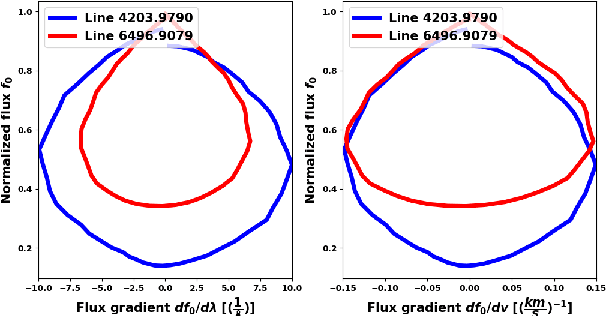
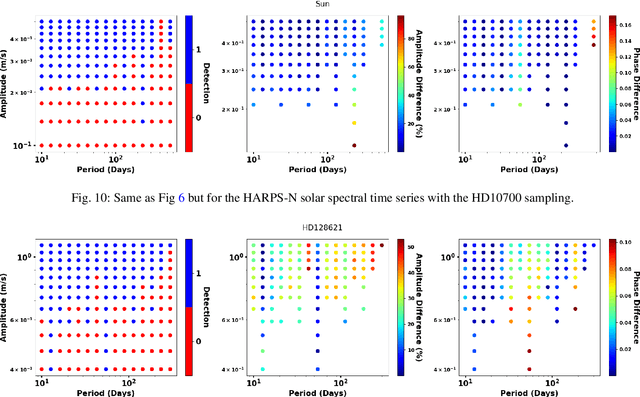
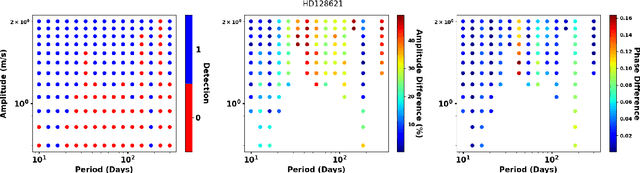
Many novel methods have been proposed to mitigate stellar activity for exoplanet detection as the presence of stellar activity in radial velocity (RV) measurements is the current major limitation. Unlike traditional methods that model stellar activity in the RV domain, more methods are moving in the direction of disentangling stellar activity at the spectral level. The goal of this paper is to present a novel convolutional neural network-based algorithm that efficiently models stellar activity signals at the spectral level, enhancing the detection of Earth-like planets. We trained a convolutional neural network to build the correlation between the change in the spectral line profile and the corresponding RV, full width at half maximum (FWHM) and bisector span (BIS) values derived from the classical cross-correlation function. This algorithm has been tested on three intensively observed stars: Alpha Centauri B (HD128621), Tau ceti (HD10700), and the Sun. By injecting simulated planetary signals at the spectral level, we demonstrate that our machine learning algorithm can achieve, for HD128621 and HD10700, a detection threshold of 0.5 m/s in semi-amplitude for planets with periods ranging from 10 to 300 days. This threshold would correspond to the detection of a $\sim$4$\mathrm{M}_{\oplus}$ in the habitable zone of those stars. On the HARPS-N solar dataset, our algorithm is even more efficient at mitigating stellar activity signals and can reach a threshold of 0.2 m/s, which would correspond to a 2.2$\mathrm{M}_{\oplus}$ planet on the orbit of the Earth. To the best of our knowledge, it is the first time that such low detection thresholds are reported for the Sun, but also for other stars, and therefore this highlights the efficiency of our convolutional neural network-based algorithm at mitigating stellar activity in RV measurements.
Deep Learning and genetic algorithms for cosmological Bayesian inference speed-up
May 06, 2024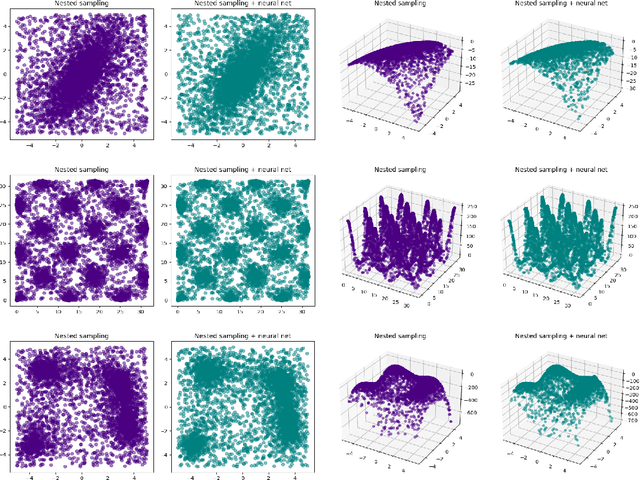
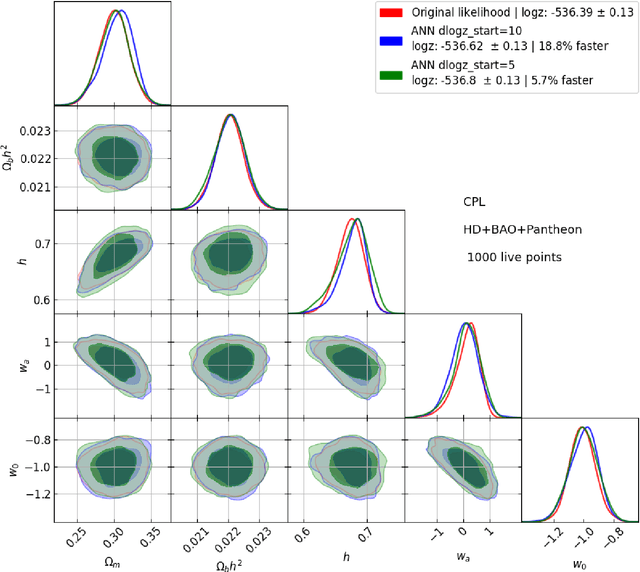
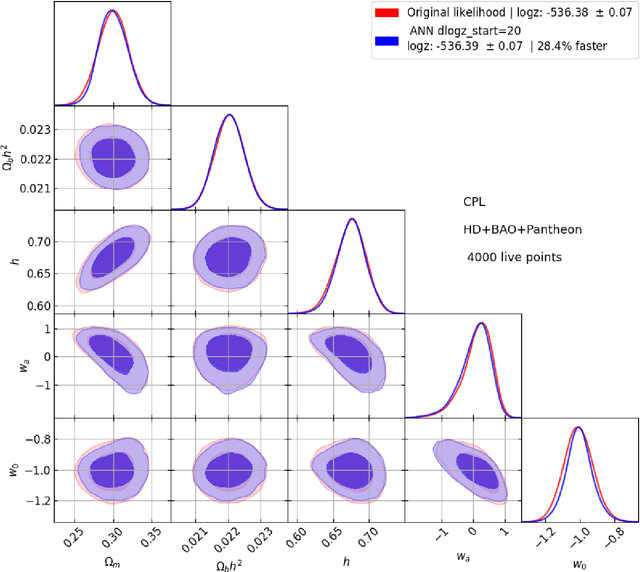
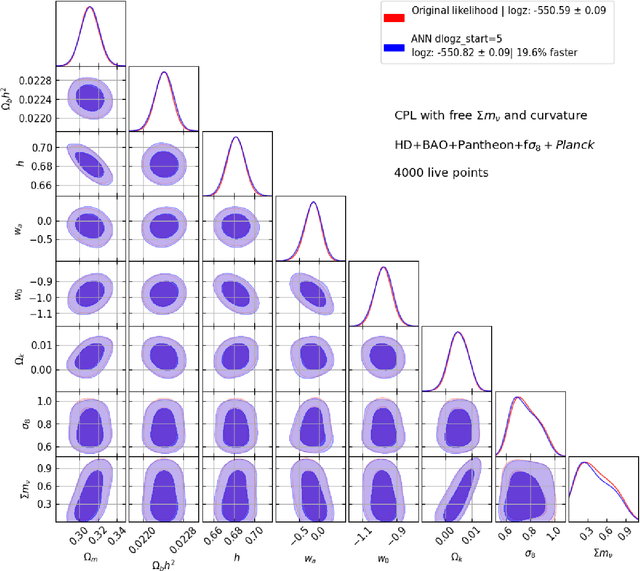
In this paper, we present a novel approach to accelerate the Bayesian inference process, focusing specifically on the nested sampling algorithms. Bayesian inference plays a crucial role in cosmological parameter estimation, providing a robust framework for extracting theoretical insights from observational data. However, its computational demands can be substantial, primarily due to the need for numerous likelihood function evaluations. Our proposed method utilizes the power of deep learning, employing feedforward neural networks to approximate the likelihood function dynamically during the Bayesian inference process. Unlike traditional approaches, our method trains neural networks on-the-fly using the current set of live points as training data, without the need for pre-training. This flexibility enables adaptation to various theoretical models and datasets. We perform simple hyperparameter optimization using genetic algorithms to suggest initial neural network architectures for learning each likelihood function. Once sufficient accuracy is achieved, the neural network replaces the original likelihood function. The implementation integrates with nested sampling algorithms and has been thoroughly evaluated using both simple cosmological dark energy models and diverse observational datasets. Additionally, we explore the potential of genetic algorithms for generating initial live points within nested sampling inference, opening up new avenues for enhancing the efficiency and effectiveness of Bayesian inference methods.