 Add to Chrome
 Add to Firefox
 Add to Edge
An Automated Multimodal Glaucoma Detection Framework Using ViT and a Stacking-Based Ensemble
Jul 02, 2026
Glaucoma is a progressive eye disease that can lead to irreversible vision loss if not detected at an early stage. Conventional diagnostic procedures are often time-consuming and rely heavily on expert interpretation, limiting their scalability for large-scale screening. In this study, glaucoma detection is investigated under two evaluation settings: sample-wise, where individual samples are analyzed independently, and patient-wise, where data from each patient are aggregated for final prediction. An automated multimodal framework is proposed that integrates fundus images with clinical data. Under the sample-wise setting, detection is performed using fundus images and clinical features individually, as well as through their multimodal combination. Under the patient-wise setting, predictions are obtained by aggregating multiple fundus image representations with corresponding clinical information for each patient. Deep visual features are extracted using a Vision Transformer (ViT) architecture and classified using classical machine-learning models, with a stacking-based ensemble of the three best-performing classifiers employed to optimize performance. Experiments conducted on the publicly available PAPILA dataset demonstrate strong diagnostic performance, achieving 97.47% accuracy and a 97.50% F1-score for sample-wise multimodal classification, and 98.97% accuracy and F1-score for subject-wise detection. The proposed framework is further deployed as an end-to-end web-based platform to support automated glaucoma screening and clinical decision support.

Alignment-Aware and Reliability-Gated Multimodal Fusion for Unmanned Aerial Vehicle Detection Across Heterogeneous Thermal-Visual Sensors
Mar 09, 2026Reliable unmanned aerial vehicle (UAV) detection is critical for autonomous airspace monitoring but remains challenging when integrating sensor streams that differ substantially in resolution, perspective, and field of view. Conventional fusion methods-such as wavelet-, Laplacian-, and decision-level approaches-often fail to preserve spatial correspondence across modalities and suffer from annotation of inconsistencies, limiting their robustness in real-world settings. This study introduces two fusion strategies, Registration-aware Guided Image Fusion (RGIF) and Reliability-Gated Modality-Attention Fusion (RGMAF), designed to overcome these limitations. RGIF employs Enhanced Correlation Coefficient (ECC)-based affine registration combined with guided filtering to maintain thermal saliency while enhancing structural detail. RGMAF integrates affine and optical-flow registration with a reliability-weighted attention mechanism that adaptively balances thermal contrast and visual sharpness. Experiments were conducted on the Multi-Sensor and Multi-View Fixed-Wing (MMFW)-UAV dataset comprising 147,417 annotated air-to-air frames collected from infrared, wide-angle, and zoom sensors. Among single-modality detectors, YOLOv10x demonstrated the most stable cross-domain performance and was selected as the detection backbone for evaluating fused imagery. RGIF improved the visual baseline by 2.13% mAP@50 (achieving 97.65%), while RGMAF attained the highest recall of 98.64%. These findings show that registration-aware and reliability-adaptive fusion provides a robust framework for integrating heterogeneous modalities, substantially enhancing UAV detection performance in multimodal environments.
Time-dependent wave selection for information processing in excitable media
Apr 24, 2012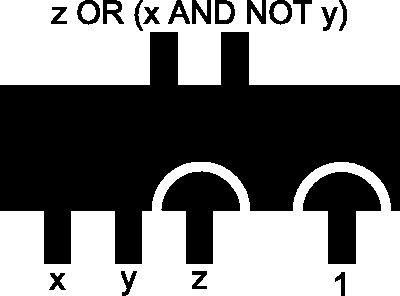
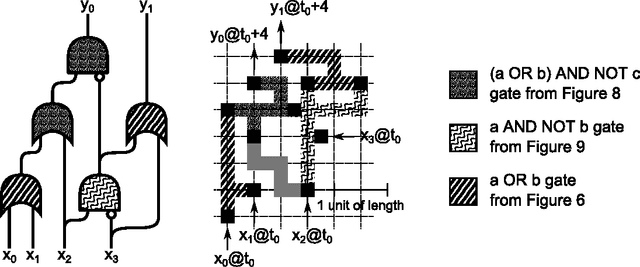
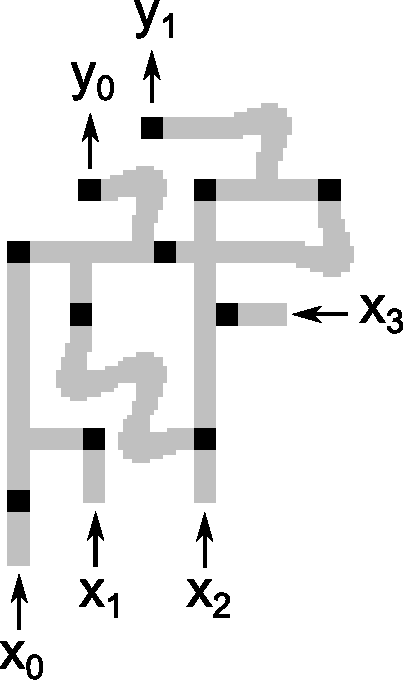
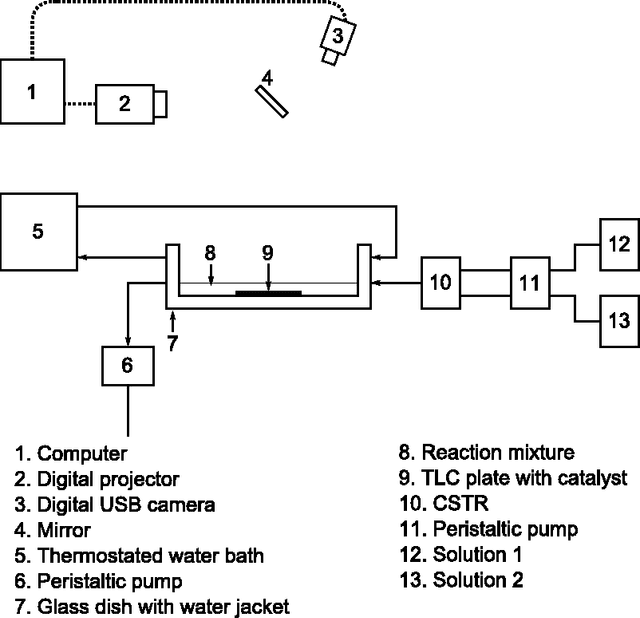
We demonstrate an improved technique for implementing logic circuits in light-sensitive chemical excitable media. The technique makes use of the constant-speed propagation of waves along defined channels in an excitable medium based on the Belousov-Zhabotinsky reaction, along with the mutual annihilation of colliding waves. What distinguishes this work from previous work in this area is that regions where channels meet at a junction can periodically alternate between permitting the propagation of waves and blocking them. These valve-like areas are used to select waves based on the length of time that it takes waves to propagate from one valve to another. In an experimental implementation, the channels which make up the circuit layout are projected by a digital projector connected to a computer. Excitable channels are projected as dark areas, unexcitable regions as light areas. Valves alternate between dark and light: every valve has the same period and phase, with a 50% duty cycle. This scheme can be used to make logic gates based on combinations of OR and AND-NOT operations, with few geometrical constraints. Because there are few geometrical constraints, compact circuits can be implemented. Experimental results from an implementation of a 4-bit input, 2-bit output integer square root circuit are given. This is the most complex logic circuit that has been implemented in BZ excitable media to date.