 Add to Chrome
 Add to Firefox
 Add to Edge
Large Language Models as Pokémon Battle Agents: Strategic Play and Content Generation
Dec 19, 2025
Strategic decision-making in Pokémon battles presents a unique testbed for evaluating large language models. Pokémon battles demand reasoning about type matchups, statistical trade-offs, and risk assessment, skills that mirror human strategic thinking. This work examines whether Large Language Models (LLMs) can serve as competent battle agents, capable of both making tactically sound decisions and generating novel, balanced game content. We developed a turn-based Pokémon battle system where LLMs select moves based on battle state rather than pre-programmed logic. The framework captures essential Pokémon mechanics: type effectiveness multipliers, stat-based damage calculations, and multi-Pokémon team management. Through systematic evaluation across multiple model architectures we measured win rates, decision latency, type-alignment accuracy, and token efficiency. These results suggest LLMs can function as dynamic game opponents without domain-specific training, offering a practical alternative to reinforcement learning for turn-based strategic games. The dual capability of tactical reasoning and content creation, positions LLMs as both players and designers, with implications for procedural generation and adaptive difficulty systems in interactive entertainment.

Lights, Camera, Consistency: A Multistage Pipeline for Character-Stable AI Video Stories
Dec 17, 2025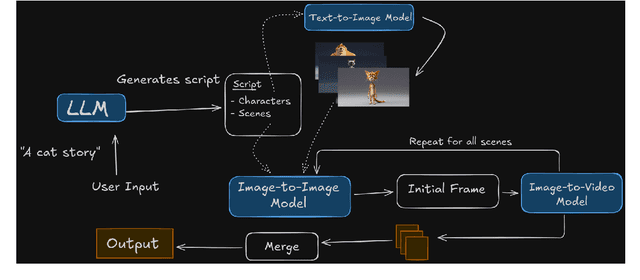
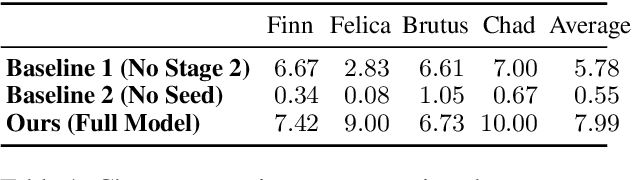
Generating long, cohesive video stories with consistent characters is a significant challenge for current text-to-video AI. We introduce a method that approaches video generation in a filmmaker-like manner. Instead of creating a video in one step, our proposed pipeline first uses a large language model to generate a detailed production script. This script guides a text-to-image model in creating consistent visuals for each character, which then serve as anchors for a video generation model to synthesize each scene individually. Our baseline comparisons validate the necessity of this multi-stage decomposition; specifically, we observe that removing the visual anchoring mechanism results in a catastrophic drop in character consistency scores (from 7.99 to 0.55), confirming that visual priors are essential for identity preservation. Furthermore, we analyze cultural disparities in current models, revealing distinct biases in subject consistency and dynamic degree between Indian vs Western-themed generations.