 Add to Chrome
 Add to Firefox
 Add to Edge
Path Planning Using Deep Deterministic Policy Gradient: A Reinforcement Learning Approach
Jun 05, 2026
Path-planning for autonomous vehicles in threat-laden environments is a fundamental challenge because the problem is nonlinear and nonconvex even in simplest scenarios. While traditional optimal control methods can be used to find ideal paths, the computational time is often too slow for real-time decision-making. To solve this challenge, we propose a method based on Deep Deterministic Policy Gradient (DDPG) and model the threat as possibly multiple circular 'no-go' zones. A mission is regarded as a failure if the vehicle enters this restricted zone at any time or does not reach a neighborhood of the destination. The DDPG agent is trained through trial and error in a simulated environment, learning a direct mapping from its current state (position and heading) to a series of feasible actions that guide the agent to safely reach its destination. The reword function has three parts: (a) an attractive field centered at the final destination, (b) some repulsive fields centered at the origins of circular obstacles, and (c) a penalty of control energy consumption (the magnitude of heading change) that indirectly in favor for straight path. The DDPG trains the agent using these incentives to find the largest possible set of starting points wherein a safe path to the destination is guaranteed. This provides critical information for mission planning, showing beforehand whether a task is achievable from a given starting point, assisting pre-mission planning activities. The approach is validated in simulation. A comparison between the DDPG method and a traditional optimal control (pseudo-spectral) method is carried out. The results show that the learning-based agent produces effective paths while being significantly faster, making it a better fit for real-time applications.

A Comparison of Reinforcement Learning and Optimal Control Methods for Path Planning
Apr 14, 2026Path-planning for autonomous vehicles in threat-laden environments is a fundamental challenge. While traditional optimal control methods can find ideal paths, the computational time is often too slow for real-time decision-making. To solve this challenge, we propose a method based on Deep Deterministic Policy Gradient (DDPG) and model the threat as a simple, circular `no-go' zone. A mission failure is claimed if the vehicle enters this `no-go' zone at any time or does not reach a neighborhood of the destination. The DDPG agent is trained to learn a direct mapping from its current state (position and velocity) to a series of feasible actions that guide the agent to safely reach its goal. A reward function and two neural networks, critic and actor, are used to describe the environment and guide the control efforts. The DDPG trains the agent to find the largest possible set of starting points (``feasible set'') wherein a safe path to the goal is guaranteed. This provides critical information for mission planning, showing beforehand whether a task is achievable from a given starting point, assisting pre-mission planning activities. The approach is validated in simulation. A comparison between the DDPG method and a traditional optimal control (pseudo-spectral) method is carried out. The results show that the learning-based agent may produce effective paths while being significantly faster, making it a better fit for real-time applications. However, there are areas (``infeasible set'') where the DDPG agent cannot find paths to the destination, and the paths in the feasible set may not be optimal. These preliminary results guide our future research: (1) improve the reward function to enlarge the DDPG feasible set, (2) examine the feasible set obtained by the pseudo-spectral method, and (3) investigate the arc-search IPM method for the path planning problem.
Multi Agent Pathfinding for Noise Restricted Hybrid Fuel Unmanned Aerial Vehicles
Mar 26, 2024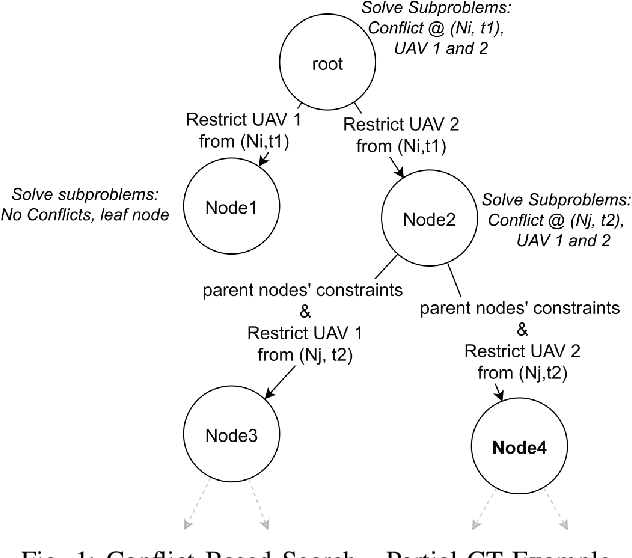
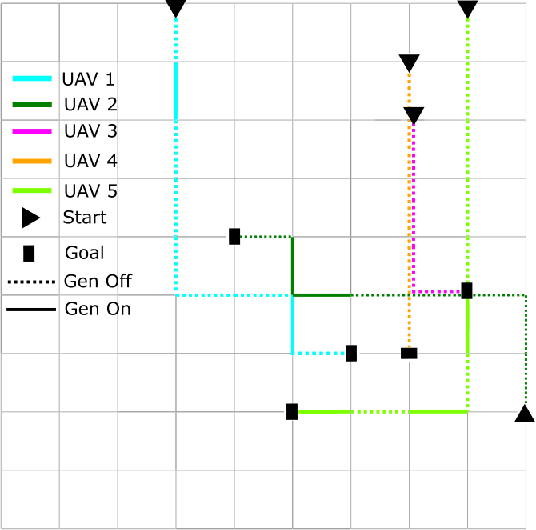
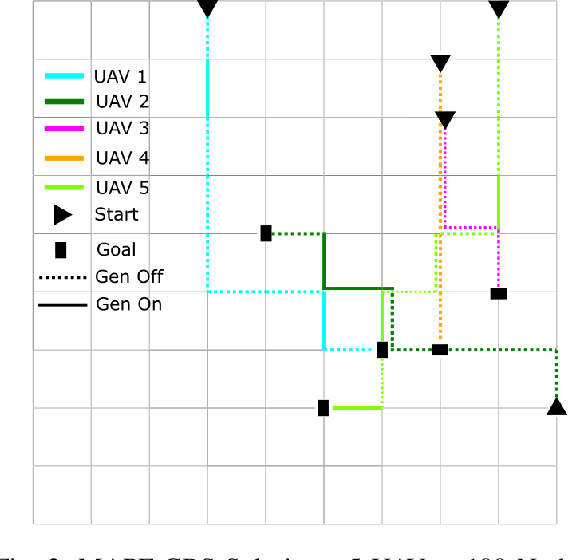
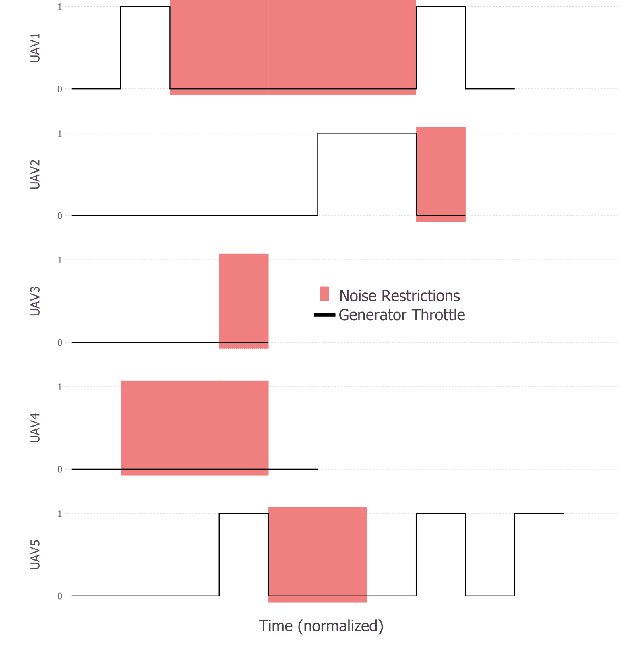
Multi Agent Path Finding (MAPF) seeks the optimal set of paths for multiple agents from respective start to goal locations such that no paths conflict. We address the MAPF problem for a fleet of hybrid-fuel unmanned aerial vehicles which are subject to location-dependent noise restrictions. We solve this problem by searching a constraint tree for which the subproblem at each node is a set of shortest path problems subject to the noise and fuel constraints and conflict zone avoidance. A labeling algorithm is presented to solve this subproblem, including the conflict zones which are treated as dynamic obstacles. We present the experimental results of the algorithms for various graph sizes and number of agents.