 Add to Chrome
 Add to Firefox
 Add to Edge
KARL: Knowledge Agents via Reinforcement Learning
Mar 05, 2026
We present a system for training enterprise search agents via reinforcement learning that achieves state-of-the-art performance across a diverse suite of hard-to-verify agentic search tasks. Our work makes four core contributions. First, we introduce KARLBench, a multi-capability evaluation suite spanning six distinct search regimes, including constraint-driven entity search, cross-document report synthesis, tabular numerical reasoning, exhaustive entity retrieval, procedural reasoning over technical documentation, and fact aggregation over internal enterprise notes. Second, we show that models trained across heterogeneous search behaviors generalize substantially better than those optimized for any single benchmark. Third, we develop an agentic synthesis pipeline that employs long-horizon reasoning and tool use to generate diverse, grounded, and high-quality training data, with iterative bootstrapping from increasingly capable models. Fourth, we propose a new post-training paradigm based on iterative large-batch off-policy RL that is sample efficient, robust to train-inference engine discrepancies, and naturally extends to multi-task training with out-of-distribution generalization. Compared to Claude 4.6 and GPT 5.2, KARL is Pareto-optimal on KARLBench across cost-quality and latency-quality trade-offs, including tasks that were out-of-distribution during training. With sufficient test-time compute, it surpasses the strongest closed models. These results show that tailored synthetic data in combination with multi-task reinforcement learning enables cost-efficient and high-performing knowledge agents for grounded reasoning.

Coarsening Optimization for Differentiable Programming
Oct 05, 2021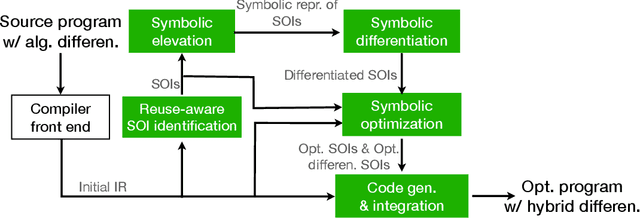
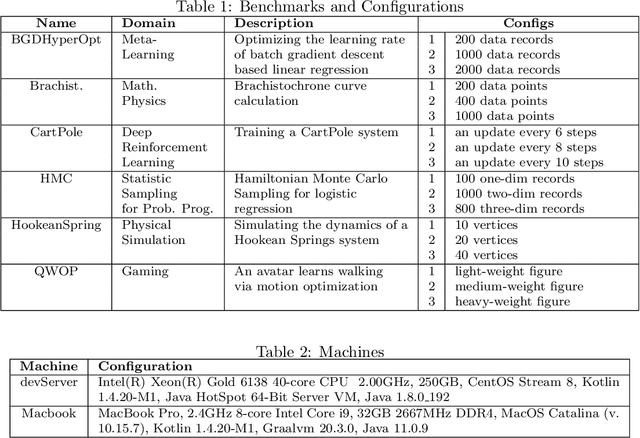
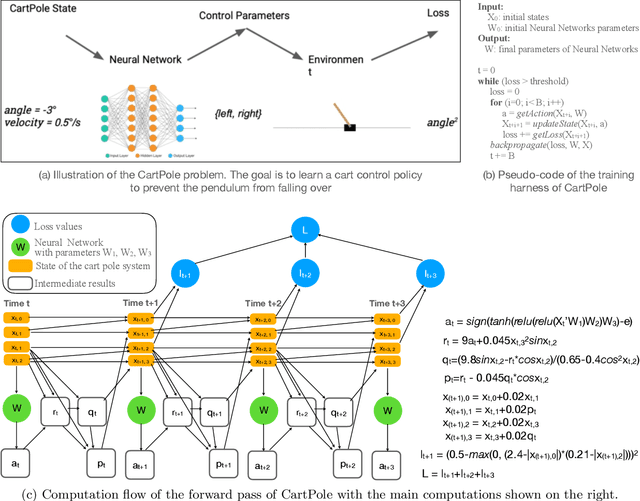
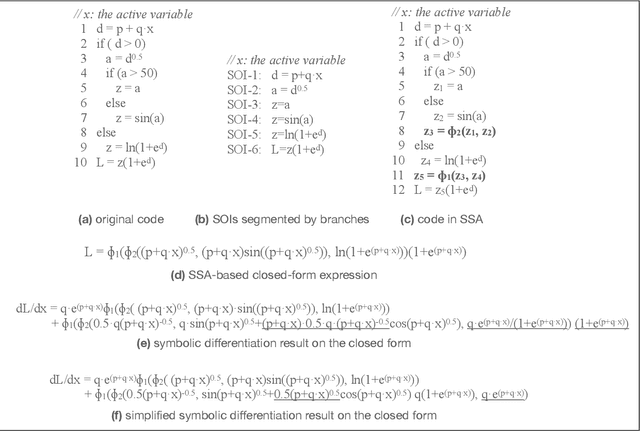
This paper presents a novel optimization for differentiable programming named coarsening optimization. It offers a systematic way to synergize symbolic differentiation and algorithmic differentiation (AD). Through it, the granularity of the computations differentiated by each step in AD can become much larger than a single operation, and hence lead to much reduced runtime computations and data allocations in AD. To circumvent the difficulties that control flow creates to symbolic differentiation in coarsening, this work introduces phi-calculus, a novel method to allow symbolic reasoning and differentiation of computations that involve branches and loops. It further avoids "expression swell" in symbolic differentiation and balance reuse and coarsening through the design of reuse-centric segment of interest identification. Experiments on a collection of real-world applications show that coarsening optimization is effective in speeding up AD, producing several times to two orders of magnitude speedups.
Gradient Descent: The Ultimate Optimizer
Sep 29, 2019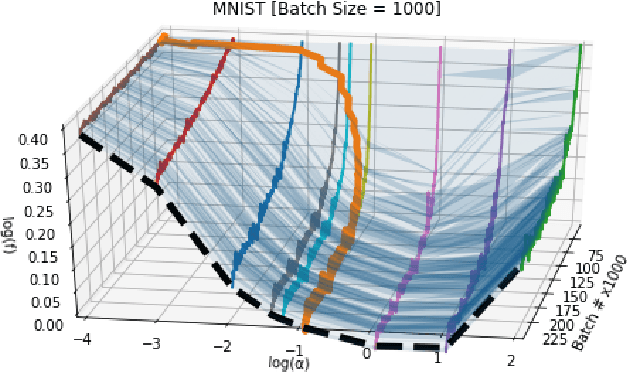
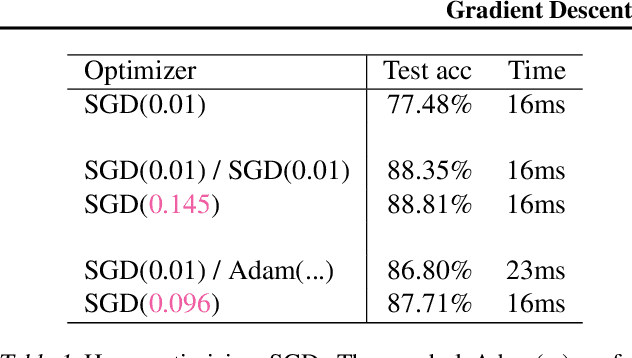
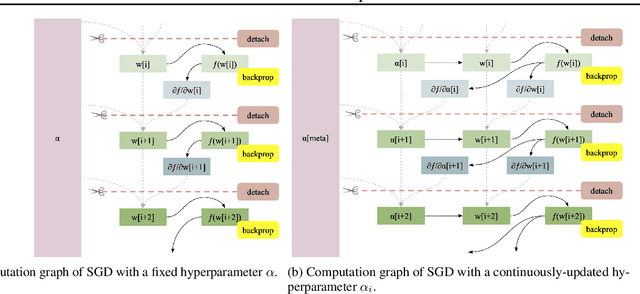
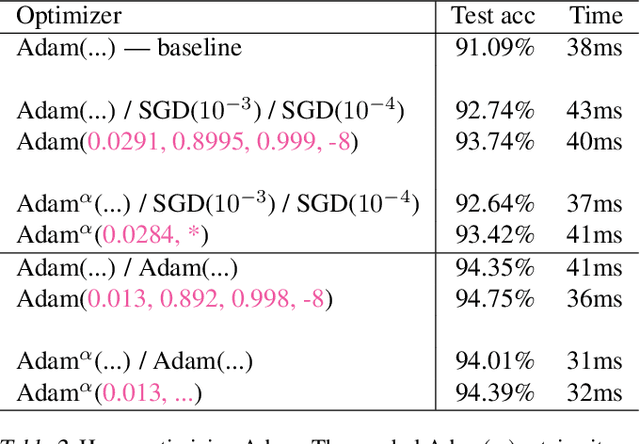
Working with any gradient-based machine learning algorithm involves the tedious task of tuning the optimizer's hyperparameters, such as the learning rate. There exist many techniques for automated hyperparameter optimization, but they typically introduce even more hyperparameters to control the hyperparameter optimization process. We propose to instead learn the hyperparameters themselves by gradient descent, and furthermore to learn the hyper-hyperparameters by gradient descent as well, and so on ad infinitum. As these towers of gradient-based optimizers grow, they become significantly less sensitive to the choice of top-level hyperparameters, hence decreasing the burden on the user to search for optimal values.