 Add to Chrome
 Add to Firefox
 Add to Edge
Post-Calibration Reliability Reranking of Relevance Decisions via Label-wise Monotone Projection
Aug 11, 2026
Web search, product search, and question-answering retrieval systems often assign a relevance label and confidence score to each query-candidate pair. The relevance label describes how well a page, product, or passage matches the query, while the confidence often guides downstream use or fallback decisions. Post-hoc calibration is therefore needed because misaligned confidence can make systems over-trust wrong predictions or unnecessarily defer correct ones. However, calibration mainly aligns confidence with average correctness, and does not remove predicted-label-dependent reliability differences that remain within the same calibrated confidence level. We address this gap with Label-wise Monotone Reliability Projection (MRP), which learns label-wise monotone functions that map calibrated confidence to correctness reliability while preserving the original predicted labels and class probabilities. The resulting reliability score reranks fixed predictions according to residual risk. Across six information access relevance datasets and multiple post-hoc calibrators, MRP improves reliability reranking and average fallback utility while preserving full-coverage accuracy and ECE. Structural ablations show that the main gains come from label-wise residual reliability rather than from global confidence remapping. We further analyze when MRP reliability scores can be embedded back into top-label probability geometry, showing that this projection is useful as a compatibility analysis but is distinct from the main reliability-reranking objective. The implementation will be made publicly available.

Anatomy of Machines for Markowitz: Decision-Focused Learning for Mean-Variance Portfolio Optimization
Sep 15, 2024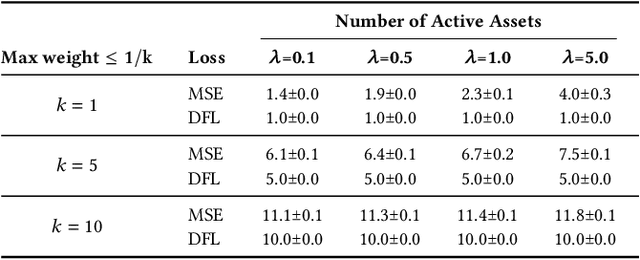

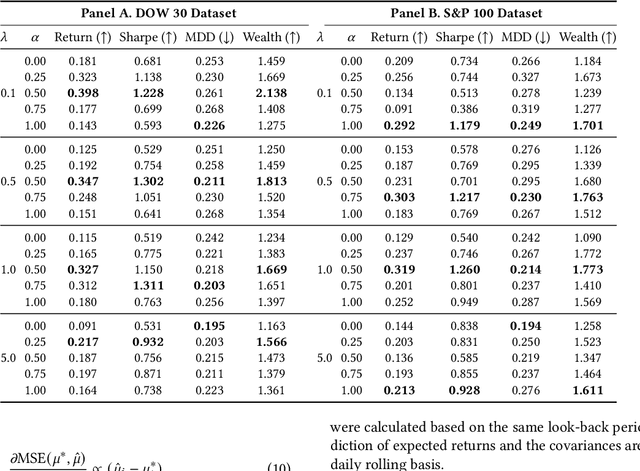
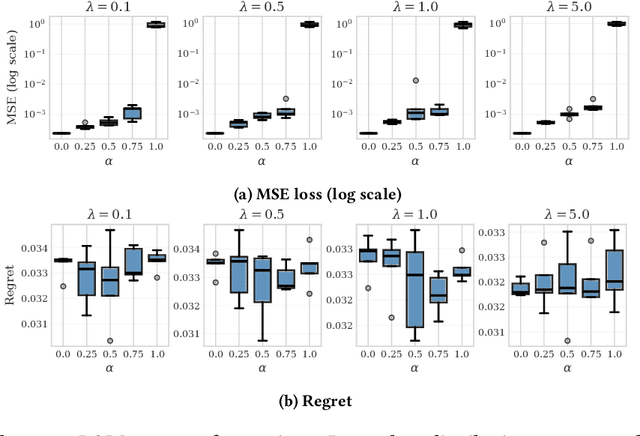
Markowitz laid the foundation of portfolio theory through the mean-variance optimization (MVO) framework. However, the effectiveness of MVO is contingent on the precise estimation of expected returns, variances, and covariances of asset returns, which are typically uncertain. Machine learning models are becoming useful in estimating uncertain parameters, and such models are trained to minimize prediction errors, such as mean squared errors (MSE), which treat prediction errors uniformly across assets. Recent studies have pointed out that this approach would lead to suboptimal decisions and proposed Decision-Focused Learning (DFL) as a solution, integrating prediction and optimization to improve decision-making outcomes. While studies have shown DFL's potential to enhance portfolio performance, the detailed mechanisms of how DFL modifies prediction models for MVO remain unexplored. This study aims to investigate how DFL adjusts stock return prediction models to optimize decisions in MVO, addressing the question: "MSE treats the errors of all assets equally, but how does DFL reduce errors of different assets differently?" Answering this will provide crucial insights into optimal stock return prediction for constructing efficient portfolios.