 Add to Chrome
 Add to Firefox
 Add to Edge
PR-IQA: Partial-Reference Image Quality Assessment for Diffusion-Based Novel View Synthesis
Apr 07, 2026
Diffusion models are promising for sparse-view novel view synthesis (NVS), as they can generate pseudo-ground-truth views to aid 3D reconstruction pipelines like 3D Gaussian Splatting (3DGS). However, these synthesized images often contain photometric and geometric inconsistencies, and their direct use for supervision can impair reconstruction. To address this, we propose Partial-Reference Image Quality Assessment (PR-IQA), a framework that evaluates diffusion-generated views using reference images from different poses, eliminating the need for ground truth. PR-IQA first computes a geometrically consistent partial quality map in overlapping regions. It then performs quality completion to inpaint this partial map into a dense, full-image map. This completion is achieved via a cross-attention mechanism that incorporates reference-view context, ensuring cross-view consistency and enabling thorough quality assessment. When integrated into a diffusion-augmented 3DGS pipeline, PR-IQA restricts supervision to high-confidence regions identified by its quality maps. Experiments demonstrate that PR-IQA outperforms existing IQA methods, achieving full-reference-level accuracy without ground-truth supervision. Thus, our quality-aware 3DGS approach more effectively filters inconsistencies, producing superior 3D reconstructions and NVS results. The project page is available at https://kakaomacao.github.io/pr-iqa-project-page/.

Culture-TRIP: Culturally-Aware Text-to-Image Generation with Iterative Prompt Refinment
Feb 24, 2025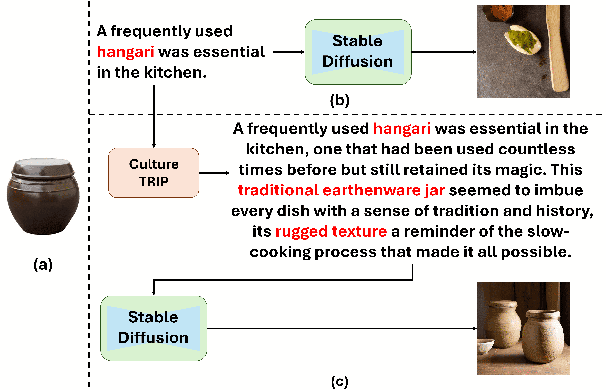
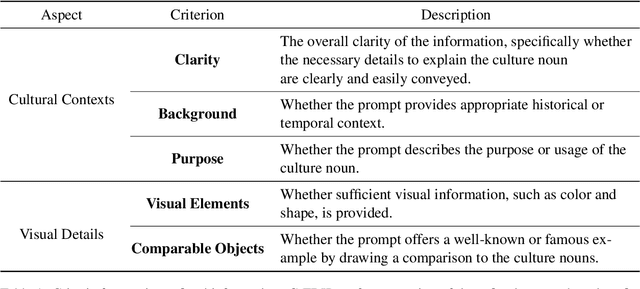
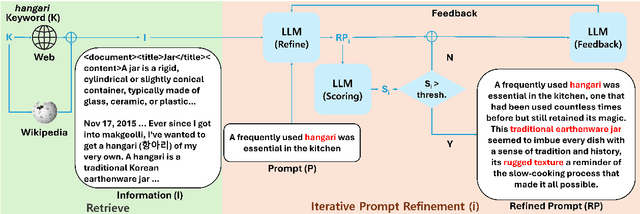
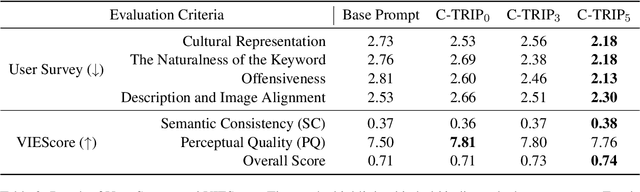
Text-to-Image models, including Stable Diffusion, have significantly improved in generating images that are highly semantically aligned with the given prompts. However, existing models may fail to produce appropriate images for the cultural concepts or objects that are not well known or underrepresented in western cultures, such as `hangari' (Korean utensil). In this paper, we propose a novel approach, Culturally-Aware Text-to-Image Generation with Iterative Prompt Refinement (Culture-TRIP), which refines the prompt in order to improve the alignment of the image with such culture nouns in text-to-image models. Our approach (1) retrieves cultural contexts and visual details related to the culture nouns in the prompt and (2) iteratively refines and evaluates the prompt based on a set of cultural criteria and large language models. The refinement process utilizes the information retrieved from Wikipedia and the Web. Our user survey, conducted with 66 participants from eight different countries demonstrates that our proposed approach enhances the alignment between the images and the prompts. In particular, C-TRIP demonstrates improved alignment between the generated images and underrepresented culture nouns. Resource can be found at https://shane3606.github.io/Culture-TRIP.